
This article was written exclusively for The Film Magazine by Paul A J Lewis of paul-a-j-lewis.com.
Milano calibro 9 / Caliber 9 (1972)
Director: Fernando Di Leo
Screenwriter: Fernando Di Leo
Starring: Gastone Moschin, Barbara Bouchet, Mario Adorf, Frank Wolff, Luigi Pistilli, Ivo Garrani, Philippe Leroy, Lionel Stander
Fernando Di Leo’s work repeatedly returns to one central idea: fate. His characters rarely control their destinies; they respond to circumstances and play the hands they are dealt. How well they play them depends on skill, luck and, often, a cruel twist of irony.
Di Leo emerged from Italian theatre and literature into cinema, where his early career included screenwriting work on landmark Spaghetti Westerns and a first solo film in 1967. By the late 1960s and early 1970s he had established a distinct voice in Italian noir, one that blended European sensibilities with themes familiar to American directors of the period—moral ambiguity, shifting gender dynamics and the erosion of traditional authority. Yet Di Leo’s films also push back against some Hollywood narratives. Instead of glorifying lone, rogue lawmen, he often focuses on the criminal world itself and the complex moral economy inside it.
Milano calibro 9, released in 1972, is the first entry in Di Leo’s so-called “milieu trilogy,” followed by La mala ordina and Il boss. Inspired by stories from Giorgio Scerbanenco, Caliber 9 is set in Milan and follows Ugo Piazza (Gastone Moschin), an ex-con navigating pressure from both the police and his old criminal associates.
Piazza is suspected of stealing a large sum from the shadowy crime boss known only as The Americano (Lionel Stander). Despite his intention—whether genuine or feigned—to leave crime behind, he is drawn back into a web of suspicion, manipulation and violence. His former girlfriend Nelly Bordon (Barbara Bouchet) appears to urge him toward a quieter life, yet her loyalties become murky as the story unfolds.
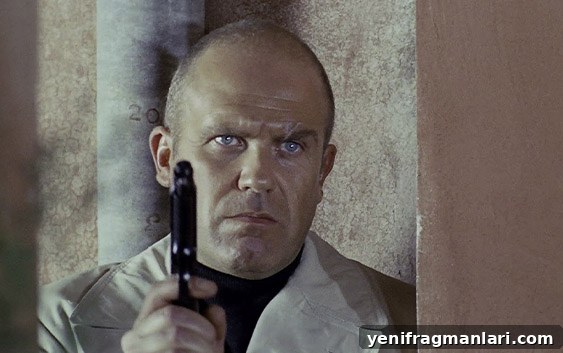
Moschin (left) and Adorf (right) in Milano calibro 9 (1972)
Piazza calls on his friend Chino (Philippe Leroy) for help, but alliances shift and violence escalates. During a tense exchange, money is stolen and a bagman is killed; suspicion falls on Piazza, and the plot moves toward a bloody climax. Don Vincenzo (Ivo Garrani), a figure who represents an older order of criminal authority, is killed, while Chino survives only to later take violent revenge. The Americano, long a powerful but mostly unseen force, meets his end in the chaos that follows. The film ends with a bitter reconciliation of sorts: Piazza is revealed to have taken the money, then betrayed by Nelly and her younger lover, Luca, leading to a tragic chain of deaths and a final, ironic moment of respect between former enemies.
Di Leo structures Caliber 9 around two interlocking ideas: passivity and inevitability. Piazza’s outward calm—his habit of “taking it easy”—is tested repeatedly. He endures interrogation from a cynical police commissioner (Frank Wolff), threats and rough treatment by Rocco Musco (Mario Adorf) and the manipulations of other criminals. Yet his apparent passivity masks a capacity for calculated action: the film ultimately reveals that Piazza has been waiting for the right moment to make his play. That duality—stoic exterior, scheming interior—drives the narrative and feeds the film’s moral ambivalence.
The police presence in the film offers a counterpoint, voiced most clearly in dialogue between Frank Wolff’s abrasive commissioner and Luigi Pistilli’s Mercuri. Wolff champions retribution over rehabilitation and embodies the hardline “supercop” archetype popular in 1970s cinema, while Mercuri argues for a broader, more socially aware approach that examines the structural causes of crime—poverty, migration and exclusion. These exchanges deepen the film’s portrait of Milan as a city shaped by social dislocation and competing powers.
The Americano functions almost like a godhead in the story: respected, feared and largely hidden from view. Yet Di Leo reminds viewers that even these powerful figures are subject to change and decline. Don Vincenzo’s comment that today’s gangs are not the true Mafia underlines the film’s attention to shifting criminal ecosystems and the human costs of those shifts.
Caliber 9’s final irony is that the very traits others deplore in Piazza—manipulation, self-interest, opportunism—are what allow him to survive as long as he does. The film offers no easy moral closure. Instead it asks the viewer to accept a bleak realism: fate and force shape lives, and sometimes the only option is to accept what comes.
21/24
Written by Paul A J Lewis
You can support Paul A J Lewis in the following places:
Website – paul-a-j-lewis.com
Twitter – @Krycek_Facility