
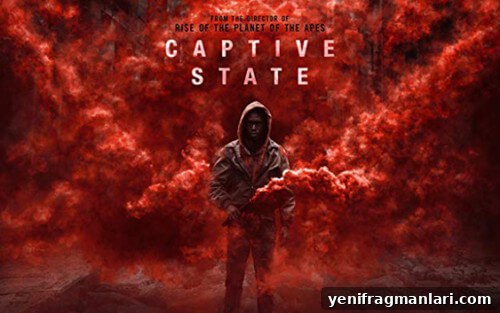
Captive State (2019)
Director: Rupert Wyatt
Screenwriters: Erica Beeney, Rupert Wyatt
Starring: John Goodman, Ashton Sanders, Jonathan Majors, Machine Gun Kelly
This review examines Captive State, a 2019 science fiction drama directed by Rupert Wyatt that attempts to blend political allegory with a resistance thriller set against an alien occupation. The film’s premise—an extraterrestrial power controlling Earth and exploiting humans—sets up a high-concept landscape for exploring authority, collaboration, surveillance, and social inequality. While it contains striking moments and strong cast members, the film struggles to fully realize its potential because of structural issues and an inconsistent tone.
The story follows three principal perspectives, each representing different positions in the occupied society. The first act invests time in establishing these separate lives, but the pacing falters as the narrative spreads itself thin across multiple arcs. This fragmentation prevents any one storyline from developing the depth required to sustain emotional investment. The film reaches a peak in a gripping, well-executed sequence where a group stages a daring attack on the alien administration; that section showcases the movie’s ability to build tension, choreograph action, and convey stakes. Unfortunately, the momentum dissipates again during the aftermath and a predictable reversal that undermines the earlier suspense.
One of the clearer strengths of Captive State is its atmosphere. The production creates a believable, controlled urban dystopia where daily life is governed by heavy surveillance and bureaucratic enforcement. Cinematography and set design combine to evoke a sense of pervasive control, and the film benefits from moments of quiet dread and carefully composed frames that underline themes of occupation and resistance. This visual sensibility often elevates scenes even when the plotting feels uncertain.
Performances are uneven but notable in places. The cast brings a seriousness and presence that frequently saves otherwise thin exposition. John Goodman and other experienced actors provide grounded portrayals that suggest the moral compromises and human costs of living under an oppressive regime. Younger cast members convey the urgency and frustration of a generation shaped by occupation. The dynamic between the actors strengthens sequences that emphasize interpersonal tension and ethical dilemmas.
Where the film falters is in its choice to literalize its allegory by making the oppressors aliens rather than human institutions. The alien rulers function more as a distant symbol than as fleshed-out antagonists, and their design and motivations remain vague—elements that weaken the political critique at the heart of the script. The film wants to interrogate collaboration, privilege, and authoritarianism, and at times it offers sharp observations about class, sycophancy, and deportation. Yet turning those ideas into a sci-fi spectacle dilutes them: the commentary could have been more effective if it were sharper and less encumbered by creature-feature aesthetics.
Another recurring issue is the film’s lack of focus. By attempting to juggle multiple storylines and thematic ambitions—spy-thriller mechanics, resistance drama, and social allegory—Captive State loses narrative cohesion. A more disciplined approach, concentrating on one main perspective or fully integrating the three arcs into a single escalating tension, would have likely resulted in a stronger, more memorable film.
Despite these criticisms, the movie achieves moments of genuine interest. The attack sequence and several character-driven scenes demonstrate that the concept can pay off when the filmmakers commit to clarity and intensity. The film’s runtime, roughly 110 minutes, sometimes feels longer than necessary because of episodic pacing, but there are still compelling beats that make the viewing worthwhile for genre fans who appreciate thoughtful, slower-burning science fiction.
In sum, Captive State is an ambitious film with an intriguing premise and a capable cast that doesn’t quite cohere. It offers worthwhile visuals and thematic intent—addressing occupation, authoritarianism, and social inequality—but the storytelling choices undercut its larger aims. Viewers looking for a polished, tightly focused sci-fi thriller may be disappointed; those interested in atmospheric, idea-driven cinema with political undertones will find moments to admire. Wait for this to hit Netflix.
8/24