
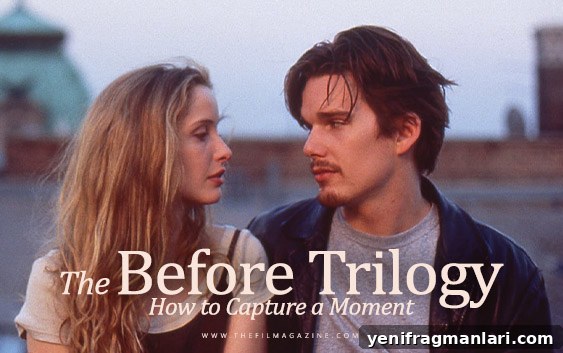
If cinema’s purpose is to seize moments, Richard Linklater’s Before Trilogy stands as one of the clearest examples. A love story is a mosaic of moments: glances, touches, heartbreaks, reconciliations. Each film in the trilogy focuses on a distinct phase of a relationship — the spark of falling in love, a chance reconnection years later, and the quiet, painful maintenance and questioning of a long-term partnership — while also showing what it feels like to live through those instants. The Criterion Collection calls the trilogy an exploration of “cinematic time” for a reason: each roughly ninety-minute film stretches and compresses time at once, turning an instant into an epic and compressing a lifetime into a single evening. These movies show what it is to be present in a moment and, in turn, what it means to be human.
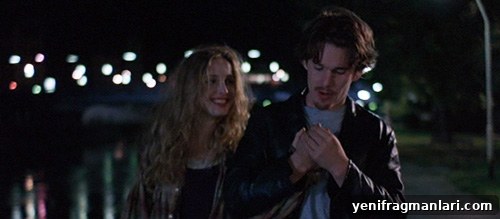
Before Sunrise could easily be mistaken for a simple, pedestrian film: much of its action is two people walking around a city. But the relationship between Celine and Jesse is the beating heart that keeps the film alive, illustrating that the company we keep is often more important than the plot that surrounds it. Linklater’s script was shaped significantly by Julie Delpy and Ethan Hawke, and their contributions breathe a natural, improvisational flow into the dialogue. The chemistry between Delpy and Hawke is sharp and alive; their precise blocking, fast wordplay, and those subtle, stunned expressions draw you into the intimacy of a single night.
Consider the scene with the street poet: as Celine and Jesse have their first argument, a local poet offers to write them a poem if they give him a single word. The poem is overtly romantic and explicit about their feelings, yet the staging and dialogue show how much each character still holds back. They walk near enough to take each other’s hand, yet never do. While waiting, they lean on opposite sides of a stone corner, physically divided even as they hover close together. Their laughter and performative coolness mask the nervous excitement and fear of vulnerability typical of the early stages of love. Jesse postures with competitive bravado while Celine frames tension as flirtation; beneath the banter, small looks and soft expressions reveal the deeper connection only the camera and the audience fully notice.
The moment’s power comes from what’s unsaid: the fumbling desire to present the best self, the embarrassment and thrill of flirting, and those subtle signals of attraction. When the poem clarifies their feelings and they finally trade private, tender glances, the emotional truth of the scene lands with quiet force.
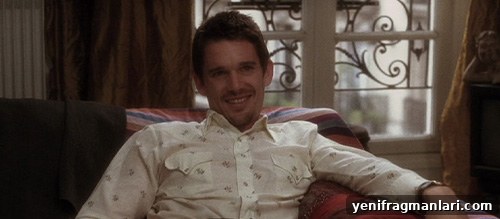
Before Sunset compresses its tension into the last hours before Jesse must catch a flight. The film’s central anxiety — that time is running out — is physically embodied in the blocking of the climactic apartment scene: Jesse lounges on Celine’s couch while she paces. The door, visible from Jesse’s point of view, is always behind Celine. To leave would require him to face her directly and step away. The audience shares the tug-of-war: we don’t want him to go, yet we dread the dwindling moments.
By this point the characters have relaxed into one another. Their exchange is less clever in the intellectual sense and more honest; age, experience, and disappointment have stripped away many pretenses. In that secluded space, they finally speak with the kind of intimacy that makes time feel elastic — conversations that, while long, still end far too soon. Resentment has faded, replaced by warmth and a fragile peace. When Jesse fidgets with his wedding ring and admits he will miss his flight, his smile at Celine’s small impersonations carries the weight of the entire film, and the credits feel like the only graceful end to a fragile, perfect moment.
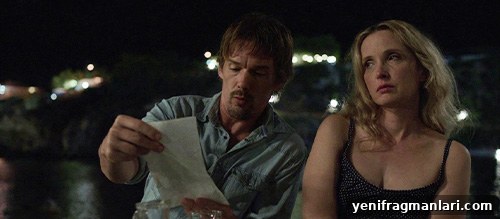
Before Midnight departs from the trilogy’s earlier romanticism. The palette grows cooler and the dialogue harder-edged; the playful philosophical banter gives way to sharp, sometimes painful exchanges. Celine and Jesse are adults shaped by years and by choices: exile, family, missed opportunities. The film examines the labor of love as much as the feeling of it, exploring the fear that a life’s decisions might have been mistakes and the daily work required to love someone through those doubts.
The film’s emotional crescendo takes place in a hotel room meant as a last attempt to recreate intimacy. An argument erupts, exposing the rawness beneath their years together. Celine’s vulnerability becomes a weapon as she challenges Jesse on his absences and the compromises she has had to make; Jesse, in turn, carries his own unresolved guilt and defensiveness. The conversation is brutal and barbed, every line weighted by nine years of history. It can feel hopeless and relentless, yet Linklater and his collaborators again find a way to salvage tenderness from the wreckage. Jesse tells a simple, tender story — an olive branch — and Celine, despite everything, chooses to engage. In that small surrender the film allows for a fragile reconciliation, one that acknowledges both damage and the capacity for repair.
Across all three films, the directing and performances make these moments feel authentic. Fleeting looks in a listening booth, a near-touch in a car, the heavy silence after a slammed door — these are cinematic choices that translate years of feeling into a single beat. The trilogy’s strength lies in how it captures the texture of relationships: their messiness, the hurts we cause and endure, and the stubborn resilience that keeps us trying. These are not moral tales packaged with tidy lessons; they are studies of people who try, fail, reconcile, and move forward.
In a film landscape often dominated by franchise formulas and spectacle, Linklater’s Before Trilogy offers an urgent reminder of the art of capturing a moment. Shot on film and performed with striking honesty, these movies reflect what it means to be alive — to be vulnerable, to err, and to persist. That persistence, played out in small, intimate moments, is the trilogy’s lasting gift: it shows us that the essence of love is not a single grand gesture but the accumulation of ordinary, truthful instances.
Written by Jack Fanning