
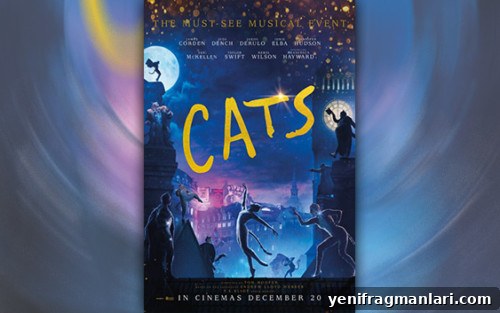
Cats (2019)
Director: Tom Hooper
Screenwriters: Lee Hall, Tom Hooper
Starring: Francesca Haywood, Taylor Swift, Idris Elba, Laurie Davidson, Rebel Wilson, Judi Dench, Jennifer Hudson, Ian McKellen, James Corden, Jason Derulo, Ray Winstone
My reaction to the opening ten minutes of Cats was immediate and physical: a sense of unease that lingered through most of the film. The story begins with a haunting view of London as a young cat, Victoria (Francesca Hayward), is abandoned by her owners. The sequence is meant to establish empathy, but it instead introduces an unsettling visual approach—the human actors rendered as feline hybrids through digital effects that often feel unfinished and oddly proportioned.
The film adapts Andrew Lloyd Webber’s stage musical, itself inspired by T.S. Eliot’s 1939 book of poetry. The original West End production, which premiered in 1981, became a surprising cultural phenomenon: a stage show celebrated for its daring choreography, distinctive design, and unconventional, plot-light structure. Hooper’s adaptation preserves that skeletal narrative. A tribe of Jellicle Cats gathers and performs at the Jellicle Ball, where the venerable Old Deuteronomy (Dame Judi Dench) will choose one cat to ascend to the Heaviside Layer and be reborn.
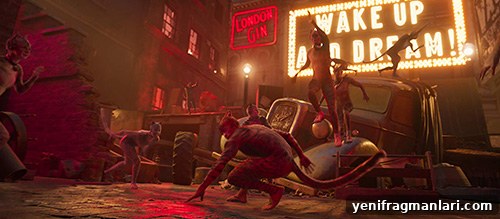
One of the film’s small visual pleasures is how it expands the stage’s single, oversized junkyard setting into multiple, richly styled locations: a milk bar, neon-lit streets, a London townhouse and finally an Egyptian theatre for the ball. These sets are often striking in color and detail, yet the cats themselves frequently appear out of scale with their surroundings. The bold palettes and textured production design occasionally compensate for the dissonant character visuals, but not always enough to fully suspend disbelief.
Certain performances stand out. Sir Ian McKellen brings a tender vulnerability to Gus the Theatre Cat, and Judi Dench’s Old Deuteronomy carries a quiet authority. Taylor Swift’s brief turn as Bombalurina is surprisingly lively—she delivers “Macavity” with confident stage presence—and Jason Derulo’s Rum Tum Tugger provides energetic showmanship. These moments of charisma and warmth are genuine highlights amid an otherwise uneven adaptation.
Where the film struggles most is in its visual realization and tonal consistency. The attempt to translate the stage’s expressive, costumed bodies into a photorealistic live-action realm results in an uncanny valley: human hands and feet remain visible beneath fur textures, and some characters wear shoes while others do not. The so-called digital fur technology often reads as distracting rather than immersive, leaving key musical and dance sequences feeling unmoored. At times, characters appear to float or be insufficiently grounded within outdoor choreography, and the placement of human features can break the intended illusion.
Pacing and character development are additional shortcomings. The film leans heavily on spectacle and musical numbers without providing deeper backstories or emotional arcs for its ensemble. Francesca Hayward’s Victoria is frequently limited to a narrow range of expressions, which reduces audience connection to her journey. Attempts at humor or narrative clarity rarely land, leaving much of the runtime to spectacle rather than storytelling.
Some creative choices verge on baffling. Moments of grotesque comedy—such as characters consuming insects during a performance—underline a tonal dissonance that the film never successfully resolves. At the same time, the production occasionally returns to moments of genuine theatricality and craft, reminders of why the original stage show captured imaginations despite its oddities.
If there is a constructive takeaway from this adaptation, it is a reminder that film and theatre are distinct art forms with different strengths. The live stage embraces stylization, distance from realism, and the immediacy of choreography and costume; film, conversely, often demands a different kind of visual coherence and emotional realism. Attempting to fuse the two without fully committing to either approach can produce dissonance, as this film demonstrates. Studios and audiences may find equal value in both versions, but they should be enjoyed on their own terms.
3/24
Written by Pagan Carruthers
Make sure to support Pagan in the following places:
Twitter – @PaganCarruthers
Letterboxd – /pagancarruthers