
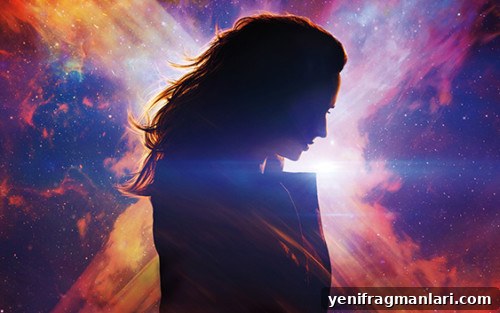
Dark Phoenix (2019)
Director: Simon Kinberg
Screenwriter: Simon Kinberg
Starring: Sophie Turner, James McAvoy, Michael Fassbender, Jennifer Lawrence, Nicholas Hoult, Tye Sheridan, Alexandra Shipp, Evan Peters, Kodi Smit-McPhee, Jessica Chastain
The twelfth film in the long-running X-Men series, Dark Phoenix arrives as both a farewell and a final attempt to revisit a franchise that helped define the superhero genre. After nearly two decades and more than a dozen films, this entry serves as a closing chapter for a group of characters that have meant a lot to fans—though it does so with mixed results. The movie aims to deliver a character-driven drama anchored by Jean Grey’s transformation, but production uncertainty and tonal shifts limit its reach.
Simon Kinberg, who has written and produced many X-Men films, made his directorial debut here. His familiarity with the universe is evident: he captures several of the franchise’s recurring themes—identity, belonging, and the cost of power—and crafts moments of emotional clarity that will resonate with long-time viewers. Kinberg stages some inventive action sequences, notably a tense set piece on a moving train, and he understands when the story needs quieter, character-focused beats rather than spectacle for spectacle’s sake.
At the heart of the film is Sophie Turner as Jean Grey, whose psychological unraveling becomes the central arc. Turning the film into a deeply personal story about trauma and mental health was a bold choice and one that gives the movie emotional stakes it otherwise might lack. That focus, however, creates an “all-or-nothing” experience: if viewers connect with Jean’s journey and Turner’s performance, the movie can feel meaningful; if not, the rest of the film struggles to compensate.
The ensemble cast provides familiar strengths. James McAvoy and Michael Fassbender receive satisfying resolutions to their long-running rivalry, and supporting characters such as Mystique, Beast, Cyclops and Nightcrawler are given moments of closure. Unfortunately, some of those resolutions feel tacked on—added to the story rather than grown organically from it—which diminishes their emotional payoff. Jennifer Lawrence’s Mystique, once a magnetic presence, is underused here and often reduced to a narrative function rather than a fully realized character.
Another notable thread involves an extraterrestrial threat led by Jessica Chastain’s character. The alien subplot never fully integrates with Jean’s intimate tale; at times it feels like an external obligation meant to give the film a larger canvas. Chastain’s cold, inscrutable antagonist is effective as a concept, but without stronger development the subplot becomes a distraction rather than a complement. Hans Zimmer’s score, however, elevates the menace in these moments—his music lends gravity and tension and remains one of the film’s most persuasive elements.
Visually, the film occasionally leans toward an older superhero aesthetic rather than the cutting-edge intensity modern audiences expect, but there are striking images and sequences that work. The special effects support the emotional arc rather than overpower it, which suits a story that prioritizes Jean’s inner turmoil over constant action. Still, the film’s visual identity does not always match the emotional ambition on screen.
Structurally, Dark Phoenix bears the marks of a project that evolved during a period of studio uncertainty. Reported reshoots and a shifting production context appear to have prevented a fuller commitment to either a universe-building finale or a definitive closure. As a result, the film ends up somewhere in the middle: accomplished in parts, uneven in execution, and ultimately smaller in scope than its premise hinted.
For fans, the film offers moments of genuine catharsis. Long-running character arcs reach conclusions that, while not always perfectly earned, nod respectfully to the series’ history. The film also reinforces what the X-Men franchise did best: providing allegory and empathy for outsiders and marginalized communities, themes that helped the series remain culturally relevant across many installments.
In the end, Dark Phoenix is a fitting but unspectacular farewell. It saves itself from outright failure thanks to committed performances, a few inspired scenes, and a clear emotional throughline centered on Jean Grey. It does not, however, deliver the triumphant send-off some fans hoped for. The franchise’s legacy will be defined by its broader body of work—films that introduced powerful characters and important ideas—rather than by this single final entry. Dark Phoenix gives those fans one last chapter: not the grand finale many imagined, but an earnest and sometimes affecting goodbye.
For your consideration: Every X-Men Movie (2000-2018) Ranked
12/24