
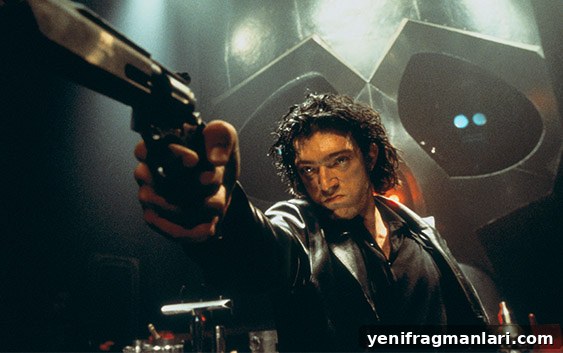

Dobermann (1997)
Director: Jan Kounen
Screenwriters: Frederique Dumas, Eric Neve
Starring: Vincent Cassel, Monica Bellucci, Tcheky Karyo, Antoine Basler
The late 1980s and 1990s saw cinema push boundaries in both explicit content and stylistic violence, driven by home video, premium television, and a loosening of industry self-censorship. Directors like Brian De Palma, Quentin Tarantino and Takashi Miike helped normalize a cinematic language that mixed entertainment, style and provocation. Jan Kounen’s Dobermann (1997) belongs to this wave: a loud, confrontational crime film adapted from the novels of Joël Houssin that prioritizes shock, attitude and kinetic energy over subtle character study.
Dobermann centers on the gang led by the titular Dobermann (Vincent Cassel) and their escalating conflict with a ruthless, obsessive police officer. Critics at the time framed the film as part of a rebellious cinematic movement in France, a reaction against established criticism and what some filmmakers saw as a conservative cultural gatekeeping. Kounen and his peers openly mocked institutions like Cahiers du Cinéma; that irreverence is literalized in one memorable, intentionally transgressive scene that aims to puncture pretension and assert a new, more anarchic cinematic voice.
Stylistically, Dobermann is unapologetically aggressive. Violent sequences are frequently over-the-top—groin shots, exploding heads and immensely exaggerated bloodshed are staged with a darkly comic sensibility. Grenades and threats to innocents heighten the stakes and reinforce the film’s intent to shock and provoke. For viewers seeking pure adrenaline and anarchic spectacle, those final sequences deliver exactly what they promise: a chaotic, euphoric crescendo that matches the film’s combative aesthetics.
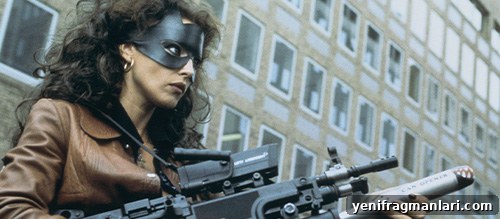
The cast is one of the film’s strengths. Vincent Cassel and Monica Bellucci create a magnetic pair; their chemistry is physical and immediate, and Bellucci’s largely non-verbal presence adds an ambiguous, almost mythic element to their relationship. Scenes of intimacy staged amid a robbery communicate the volatile mix of desire and danger driving their characters. The supporting ensemble is intentionally eccentric: a shotgun-wielding priest, a member of the gang with a pet puppy, a brutish lawman whose cruelty contrasts with other crooked cops, and a cross-dressing character who adds both comic relief and complexity. These figures contribute to the film’s carnival-like atmosphere, even as their development remains limited.
Where Dobermann falters is in depth and motivation. Many characters exist primarily to sustain action rather than to reveal interior life, and the protagonist himself remains underwritten. Aside from an opening anecdote in which Dobermann receives a pistol at a christening, the film offers little insight into his inner drives or long-term goals. That absence weakens emotional investment; the police antagonist’s relentless pursuit is compelling because it gives the story a clear engine, but the central criminal gang often lacks comparable narrative purpose beyond escalating set pieces.
Despite those shortcomings, the film’s formal bravado and daring visual choices make it memorable. Jan Kounen’s direction is confident, leaning into punkish energy and postmodern pastiche. The movie’s deliberate tastelessness—used as a form of critique and provocation—can feel purposeful, even if at times it tips into gratuitousness. For audiences attuned to transgressive cinema, the film reads as a successful manifesto against cinematic conservatism: noisy, vulgar, and proudly irreverent.
As a result, Dobermann occupies a particular place in late-1990s French cinema: not a subtle classic, but a cult work that continues to attract attention for its style, its lead performances and its willingness to offend. Fans who appreciate hyper-stylized crime films, extreme action and confrontational tone will find much to enjoy. Those seeking richer character development or a more balanced narrative may feel the film’s excesses undermine its potential.
In the twenty-five years since its release, Dobermann has retained a cult appeal. It’s worth revisiting for the bold visual flair, the chemistry of its leads and the way it captures a specific, restless moment in European genre filmmaking. With stronger character work and clearer narrative aims, the film might have been more than a provocative spectacle. As it stands, it remains an energetic, abrasive entry in the canon of transgressive crime cinema—flawed, entertaining and impossible to forget.
Score: 16/24
Presented by Blue Finch Film Releasing in cinemas and on digital download.