

EBONY AND IVORY Intentionally Disrupts the “Biopic” Formula | Interview with Jim Hosking

Ahead of the Canadian premiere of Ebony and Ivory at the Calgary Underground Film Festival on April 19, I spoke with director Jim Hosking over Zoom. Hosking returns to CUFF after opening the 2018 festival with An Evening with Beverly Luff Linn, and this time he’ll be attending with actors Sky Elobar and Gil Gex, who star in his new film.
Ebony and Ivory is a surreal, fictional imagining of what a first meeting between Paul McCartney and Stevie Wonder might feel like, rather than an attempt to recreate events. The 1982 duet “Ebony and Ivory” is the film’s starting point, but Hosking deliberately avoids straightforward nostalgia or a conventional tribute. Where the song once became a pop-cultural lightning rod—celebrated for its message of racial harmony and criticized for its simplicity—Hosking’s movie goes in a different direction: it disrupts expectation, prioritizes atmosphere and discomfort over literal accuracy.
Check out 10 Must-Watch Films at CUFF 2025
Tickets forEbony and Ivoryat CUFF 2025 Here
What is Ebony and Ivory About?
This is emphatically not a biopic, and it isn’t primarily about the song. Instead, Ebony and Ivory is a slow-burning, off-kilter character piece that leans into the absurd. Hosking describes the film as intentionally unfaithful to fact: “They don’t really look anything like them, they don’t sound anything like them, there’s nothing true in the film. The music has no bearing on the sound of the song Ebony and Ivory,” he says, laughing. The casting itself signals the film’s refusal to imitate reality—Sky Elobar and Gil Gex, longtime collaborators, are older than the real McCartney and Wonder would have been in 1982, and their performances are heightened, often cartoonish.
Set at a remote cottage near the Mull of Kintyre, a subtle nod to McCartney’s real-life ties to the region, the film follows Stevie (Gex) arriving by boat to visit Paul (Elobar). The narrative resists conventional plotting: conversations loop and fragment, scenes repeat with variations, and the film lets mood and rhythm take precedence over forward momentum. Rather than moving from point A to B, the movie creates a textured space where repetition and small disturbances build tension.
“I think I just wanted to make something small and strange,” Hosking explains. He conceived the idea during COVID, fixated on the genesis of a song he isn’t attached to. That distance from reverence freed him to play with tone, repetition and dislocation.
Sky Elobar and Gil Gex as Paul McCartney and Stevie Wonder
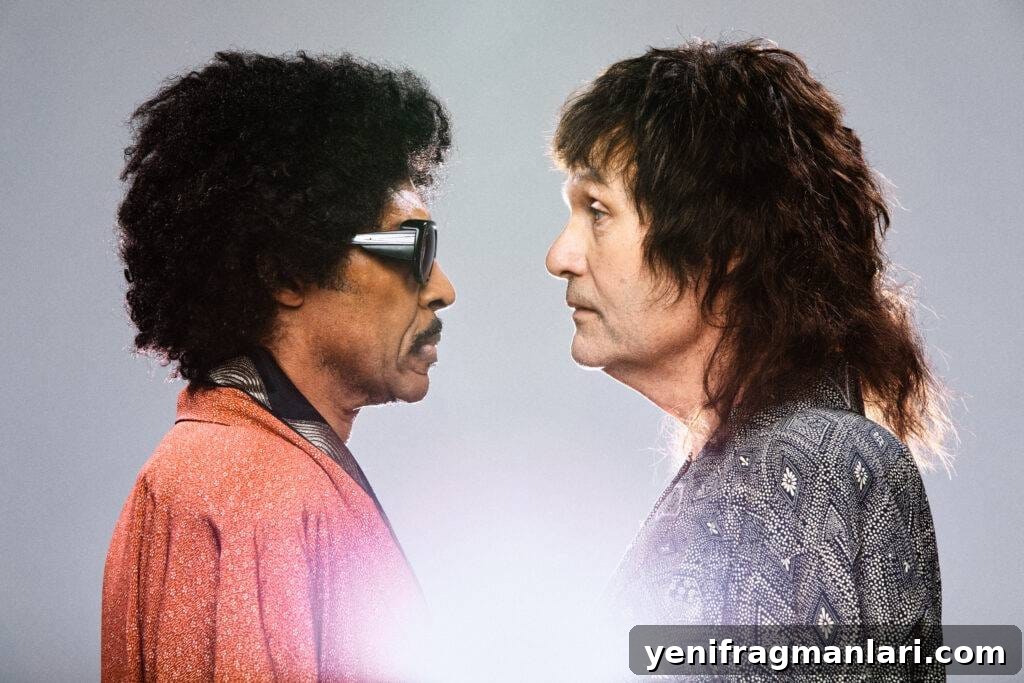
Hosking wrote the script, but he treated it as a flexible framework rather than a strict blueprint. “There were parts of the script that I’d completely forgotten that I’d written,” he says. Often he discovered pages on the shoot and realized he’d already filmed a different take with the same rhythm. While the performances were not heavily improvised, Hosking frequently fed actors alternate lines mid-scene or pulled them off-script to create deliberate unease.
That disorienting approach is purposeful. Hosking enjoys nudging performers out of their comfort zones: Sky Elobar arrived thoroughly prepared, having studied McCartney interviews, only to be asked on his first take, “Now could you do it as if you’re from Liverpool?” The tactic unmoors preparation and opens space for unexpected choices. Gil Gex arrived with restless energy and little sleep, often asking to rehearse the same beat. Hosking teased him and pushed for smaller, more fragmented delivery, which ultimately shaped the film’s unique cadence.
The Comedy of Ebony and Ivory
The film’s humor comes from tension and repetition rather than set-piece jokes. Small obsessions become comic through insistence: at one point, Gex began repeating a vulgar phrase as if it were a single word, and Hosking found himself stuck on it, “I just locked in.” That compulsive repetition — a serious moment becoming absurd by insistence — is central to the film’s energy.
“When something feels like the wrong strategy, then I’m drawn to doing it” – Jim Hosking
Hosking says he doesn’t consider himself strictly a comedy director and admits he doesn’t watch much comedy. He finds humor in places that aren’t trying to be funny, or in moments that resist humor altogether. For viewers expecting tidy punchlines and conventional closure, Ebony and Ivory may be challenging. The film doesn’t wink at the audience or offer reassuring irony; it cultivates an idiosyncratic tone, born from creative freedom and tension rather than from audience expectation.
Making Films for Himself
Editing the film revealed something to Hosking: he didn’t once think about how others would receive it. “When I finished editing this, I realized I never once thought about how anyone else would receive it,” he admits. In an industry that often asks creators to shape projects around marketability or funding, that kind of singular focus stands out. Hosking doesn’t seek mass approval; he prefers to ambush viewers and split opinion rather than tailor his work to consensus.
He does read some reactions — he recently checked Letterboxd and was surprised by how polarizing responses were. “Some people loved it. Some people really didn’t. I thought everyone would get it.” That divisiveness doesn’t change his approach. “It’s more fun to ambush people,” he says. He wants the film to surprise not only fans who already understand his sensibility but also newcomers.
The movie contains deliberately absurd touches: a surreal product placement (“Wee Billy’s Big Wee Fizzy Beer”) that functions as a character of its own, the playful possibility that characters may turn into goats, and graphic prosthetic elements used for aesthetic shock rather than mean-spirited mockery. Hosking jokes about the attention to prosthetics—he contacted peers in the industry for advice and tested props carefully because he didn’t want the gag to be simply about size.
Ebony and Ivory as a Contradictory Manifestation of Anxiety and Freedom

Underneath the provocation there is a sincere impulse. Hosking’s provocations are less about provocation itself and more about following an instinct until it’s complete. He admits that festivals and repeat screenings don’t appeal to him—he prefers to finish a film and move on—but the intense focus he brings to editing, sound design and every detail of craft demonstrates how seriously he takes his work.
That tension—between everyday anxiety and the freedom he experiences while making a film—infuses the movie. On screen it shows up as controlled chaos: moments of deep discomfort alongside flashes of intimate specificity. The film can feel anxious, strange and liberating all at once.
What’s Next for Jim Hosking?
Hosking has four projects in development. One of them he describes as “not a comedy at all.” He resists neat genre labels, saying that calling the project “horror” would be too limiting. Instead, he calls it more of a nightmare—erotic, uncanny and very different from his previous work. Whatever form his next films take, they will likely continue to defy formula and lean into that original creative impulse.
For longtime fans, that unpredictability is part of Hosking’s appeal. For newcomers, a fair warning: don’t expect a music biopic. If you go into Ebony and Ivory with an open mind, you may find your expectations gently, unexpectedly fractured—and that is precisely the point.
Read More:
- CUFF
- Interviews
- Film Reviews