

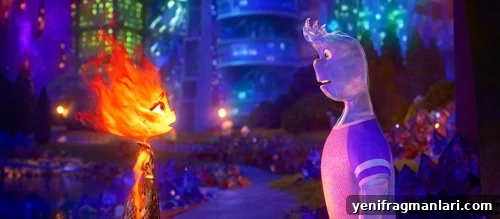
Elemental (2023)
Director: Peter Sohn
Screenwriters: John Hoberg, Kat Likkel, Brenda Hsueh
Starring: Leah Lewis, Mamoudou Athie, Ronnie del Carmen, Shila Ommi, Mason Wertheimer, Wendi McLendon-Covey, Catherine O’Hara, Ronobir Lahiri, Joe Pera, Matt Yang Kang
With dazzling, kaleidoscopic visuals and a heartfelt romantic-comedy core, Elemental explores how differences can become strengths. Pixar’s latest feature revisits the timeless story of star-crossed lovers who struggle against societal barriers, telling it through anthropomorphized elements—fire, water, earth, and air—set in a vibrant urban world known as Element City.
The film opens as fire immigrants Bernie and Cinder Lumen (voiced by Ronnie del Carmen and Shila Ommi) arrive in Element City. Shunned by many residents who are air, earth, or water, the Lumens carve out a life in a neglected neighborhood and build a close-knit fire community. They run a small family shop called The Fireplace, where their passionate and volatile daughter Ember (Leah Lewis) is expected to learn the business and control her temper before taking over.
When Ember’s anger causes a basement pipe to burst, a flood forces city inspector Wade (Mamoudou Athie) into the shop. Wade initially cites The Fireplace for building-code violations, but when he learns how much the business means to Ember and her parents, he agrees to help. The only way to dismiss the violations is to find and fix the source of the leak that caused the flood. What begins as a municipal task becomes a shared quest that brings Ember and Wade closer, and their budding romance challenges the long-standing divide between opposing elements.
Director Peter Sohn, who worked at Pixar in story and production roles for many years, drew inspiration from his upbringing as the son of Korean immigrants in New York City. That personal perspective shapes the film’s themes: the sacrifices made by immigrant parents, the pride of cultural traditions, and the pain of exclusion when newcomers are treated as outsiders. Sohn’s Element City highlights both the warmth of close community bonds and the sting of prejudice from residents fearful of what they don’t understand.
The movie uses the elemental divide as a metaphor for real-world cultural and social tensions. Some air, earth, and water residents view fire-dwellers as dangerous, a reflection of xenophobic attitudes that marginalize entire communities. Sohn counters that viewpoint by showing fire as essential, generous, and vulnerable—especially when opposed by water—underscoring the film’s message about mutual dependence and empathy.
That metaphor has strengths and limitations. In trying to signify the fire community with a range of cultural markers—accent styles, traditions, food, and family dynamics—the film sometimes flirts with broad generalizations. Well-meaning homages to multiple cultures risk blending distinct identities into a single, simplified portrayal, and a few character touches veer close to familiar stereotypes rather than fully individualized representation.
Beyond immigration, the screenplay also addresses social-class divisions and civic infrastructure. Element City’s design visually separates neighborhoods by element and status, with water-designed transit systems literally towering over lower-income Firetown. The plot’s urgency—Ember and Wade racing to fix the leak before it causes citywide damage—ties personal stakes to larger urban problems like neglectful governance and failing public systems. While these themes are timely and relevant, the film occasionally stretches to cover too many topics, which means some ideas aren’t explored as deeply as they could be.
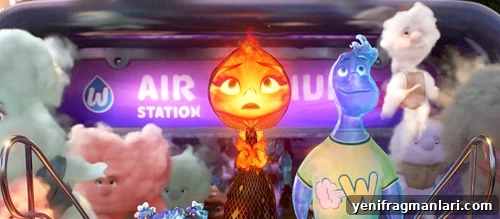
At its emotional center, Elemental succeeds with the romance between Ember and Wade. Their relationship stands in for an interracial partnership that challenges Element City’s social norms. Both characters are given believable arcs: Ember wrestles with her temper, her identity as an outsider, and the expectation that she will inherit the family business; Wade grapples with his future and unresolved feelings about his late father. Their chemistry is genuine—his optimism softens her guardedness, while her dedication and creativity inspire him to find purpose.
A secondary strand—Ember’s tension with her parents over duty versus artistic ambition—adds emotional depth. Ember yearns to pursue glassblowing and creative expression, but she also feels indebted to her parents’ sacrifices. That conflict feels authentic and anchors the romance in family obligation and cultural loyalty. Wade’s gentle humor and steady encouragement position him among the modern cinematic portrayal of caring, non-toxic romantic leads.
Technically, the film is a triumph. The animation renders air, water, and fire—materials notoriously difficult for computer artists—with outstanding artistry. The animators balanced physical realism with stylized, expressive character design, a process that took years to refine. Vocal performances by Leah Lewis and Mamoudou Athie are warm and convincing, supported by strong work from Wendi McLendon-Covey, Catherine O’Hara, and others in a capable ensemble cast.
While Elemental may not reach the emotional heights of Pixar’s most celebrated masterpieces, it remains a heartfelt and visually inventive film. Its strengths lie in character-driven storytelling, striking worldbuilding, and its timely themes about belonging, cultural identity, and urban inequality. A tighter focus on fewer themes might have elevated the film further, but as it stands, Elemental offers a moving, family-friendly experience with a clear emotional core.
Score: 18/24