This article was originally published to SSP Thinks Film by Sam Sewell-Peterson.
Ex Machina (2014)
Director: Alex Garland
Screenwriter: Alex Garland
Starring: Alicia Vikander, Domhnall Gleeson, Oscar Isaac, Sonoya Mizuno
For years audiences waited for a film that truly captured the tension, intelligence and ethical dilemmas of an AI thriller. While landmark films like 2001: A Space Odyssey touched on the perils of artificial intelligence in memorable scenes—the astronaut arguing with HAL—the broader narratives of many genre films either leaned heavily into action or failed to develop their ideas fully. Franchises such as The Terminator and The Matrix prioritized spectacle and kinetic set pieces, and several big-budget attempts at AI storytelling traded thoughtful inquiry for star-driven action. Into this gap stepped Alex Garland, already an established screenwriter with credits like 28 Days Later and Sunshine, and with Ex Machina he made a striking directorial debut that feels both intimate and intellectually rigorous.
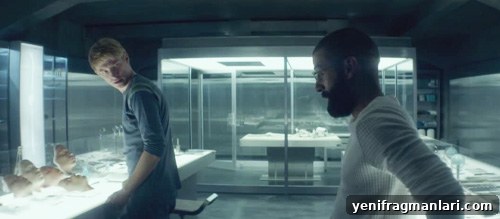
The film follows Caleb (Domhnall Gleeson), a young programmer who unexpectedly wins a company contest to spend a week at the secluded estate of the company’s enigmatic founder, Nathan (Oscar Isaac). What begins as an exclusive, surreal retreat soon becomes an intense experiment: Caleb is asked to conduct a series of Turing-style tests on Nathan’s newest creation, an artificial intelligence named Ava (Alicia Vikander). The objective is deceptively simple—determine whether Ava’s responses and behaviour are convincing enough to be taken for human—but the dynamics that unfold between the three characters turn into a psychological chess match. Each character watches and manipulates the others, and motives are slowly revealed, shifting the balance of power in unsettling ways.
At its core, Ex Machina is interested in recurring questions about AI—free will, personhood, moral responsibility—but it equally interrogates observation and control. From the moment Caleb arrives, he is under surveillance. Nathan monitors him and Ava studies him, parsing micro-expressions and emotional cues. Caleb in turn studies both of them, trying to discern the true purpose of Nathan’s experiments and the limits of Ava’s autonomy. This mutual scrutiny creates an atmosphere of persistent tension: everyone is both observer and observed, and each interaction becomes a test of intent and trust. The film’s narrative unfolds like an intricate game where pieces shift allegiance and hidden rules reveal themselves only gradually.
The success of such a claustrophobic, character-driven drama rests heavily on performance, and the principal cast rises to the challenge. Domhnall Gleeson presents Caleb as an earnest, somewhat naive technical expert whose emotional awareness is repeatedly tested. Oscar Isaac gives Nathan a volatile charisma—charming, brilliant and dangerously unpredictable in equal measure. Alicia Vikander’s portrayal of Ava is the film’s most arresting element. Rather than opting for exaggerated robotic movement or obvious mechanical ticks, Vikander crafts a being who feels almost human in posture and rhythm, only to reveal tiny, carefully controlled moments that remind viewers of her artificial nature. Those subtle divergences—slight delays, unnatural stillness, a blink out of sync—make Ava both convincing and disquieting, heightening the film’s pervasive sense of unease.
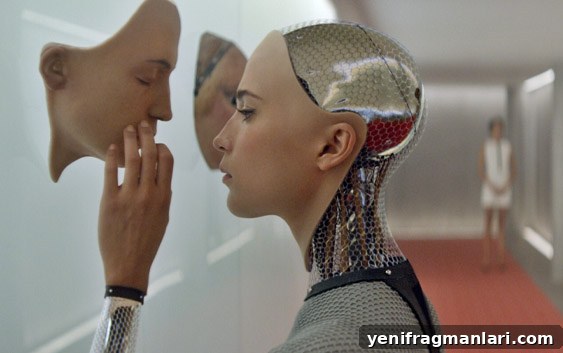
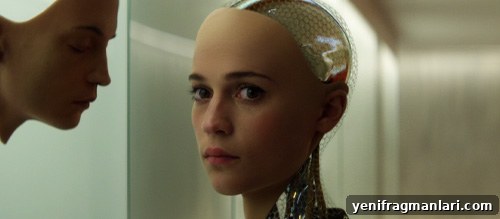
Visually, the film is restrained but memorable. Garland avoids showy effects in favor of compositions that emphasize isolation and clarity. One of the film’s most enduring images is Ava’s initial walk into frame: seen in profile against a bright pane of glass, her inner mechanical structure illuminated. That moment is both elegant and unsettling, a quiet demonstration of the film’s ability to fuse design and theme. The production uses modest resources intelligently; moments where Ava’s artificial body is concealed are motivated by narrative logic rather than budgetary necessity, and when the film chooses to bare her constructed form, the effect is more impactful for being sparing.
Garland’s screenplay is economical and sharp, focused more on the interpersonal and philosophical consequences of his premise than on technical exposition. The dialogue is nimble and precise, often reducing complex ideas into concise, resonant lines. The film refuses to spoon-feed answers, instead creating a rich seam of moral ambiguity and allowing viewers to draw their own conclusions about consciousness, deception, and agency. Garland also builds tension steadily, employing moments of dark humor and genuine horror to guide the story toward a climax that feels both inevitable and viscerally shocking.
Because the film deliberately places the audience in a position of discovery, it rewards minimal prior knowledge. Ex Machina works best when experienced with as little expectation as possible—its pleasures and provocations compound on repeat viewings, revealing new layers of character intent, cinematic craft and thematic complexity. It invites discussion about the ethics of creation, the dynamics of power in technological relationships, and the ways in which humanity recognizes itself in the machines we build. For viewers interested in intelligent science fiction that foregrounds character and idea over spectacle, Ex Machina remains a modern touchstone.
23/24
Recommended for you: Alex Garland Directed Films Ranked