
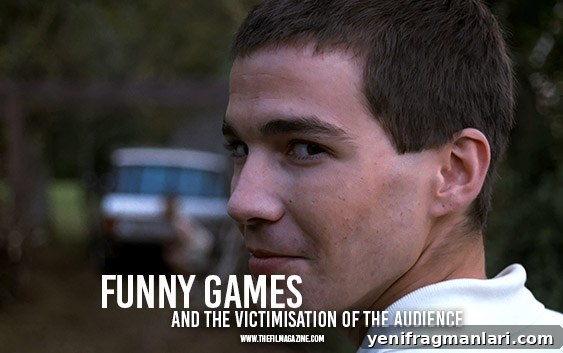
Michael Haneke’s Funny Games: A Horror That Confronts Its Own Audience

Do films exist without spectators? If no one is present to witness the images projected on the screen, why are they recorded at all? Is a horror movie successful if no one in the theater lets out a single scream? These questions sit at the core of Michael Haneke’s Funny Games, a film that interrogates not only the events it shows but the reasons audiences choose to watch them.
The relationship between cinema and its viewers has always been fundamental, but in recent years studio trends—fan service, meta jokes, and deliberate fourth-wall breaks—have blurred that connection and made it easier to manipulate. Horror, more than most genres, depends on provoking the spectator, implanting dread, nightmares and uneasy thoughts. On the surface Funny Games fits the familiar home-invasion template: a married couple and their young son have their holiday violently interrupted by two well-dressed, sadistic young men who force them into perverse “games.” The cruelty is obvious, but it’s not the shock alone that defines Haneke’s work.
Haneke produces dread by turning the camera toward his audience and asking a hard question: why does this film exist? Rather than hiding behind loud theatricality or stylized excess, Funny Games insists on a harsh, stripped-down realism. Where some contemporary horror relies on neon palettes and exaggerated effects, Haneke refuses to soften what he shows. The editing is minimal and purposeful, with long, static takes that make each cut feel earned. This patient approach mirrors the director’s work in other films, such as Cache, whose notorious opening shot establishes a mood of unease and suspicion without conventional jump scares. The deliberate lack of momentum in Funny Games creates an intimacy that is uniquely uncomfortable.
The film’s sustained cruelty is often suffocating, and Haneke uses long stretches of relative calm to intensify the audience’s complicity. Near the transition between the second and third acts there is a long sequence—roughly twenty minutes—where the protagonists, Anna and Georg, appear to recover, and the film slows to focus on their healing. That pause functions as a psychological mirror: do viewers empathize with the characters, or do they simply await the next violent payoff? Most horror films assume an appetite for constant thrills once blood is shed; franchises like Friday the 13th and A Nightmare on Elm Street bank on relentless shocks and escalating kills to satisfy that craving. Funny Games dismantles that assumption, exposing the scaffolding that keeps such films comfortable and collapsing it in startling fashion.
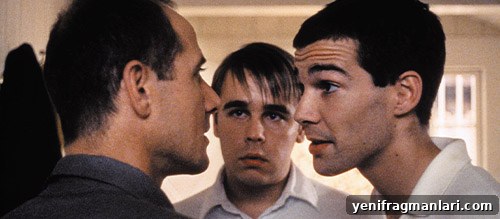
This structural audacity succeeds because the performances and the screenplay are precise and controlled. Susanne Lothar and Ulrich Mühe bring a raw, human dignity to Anna and Georg, making their suffering palpably real. But it is Arno Frisch and Frank Giering as Paul and Peter who steal the film; their calm, sociopathic manner turns casual cruelty into a chilling performance. Frisch’s direct-to-camera asides are particularly unnerving—not playful asides but deliberately hostile addresses that implicate the viewer. He becomes, in effect, Haneke’s surrogate, punishing the audience for choosing to continue watching. A fourth-wall rupture in the final act is deliberately transgressive and makes clear that Funny Games plays by no conventional rules: the viewer is not a safe observer but a participant in a moral experiment.
Haneke has described Funny Games as less a straightforward horror film and more of a nihilistic critique aimed at revealing spectators’ attitudes toward on-screen violence. That reading is accurate, yet it does not diminish the film’s power as horror. Funny Games functions on two levels: it is a terrifying home-invasion story and a meditation on the nature of cinematic pleasure. One of the film’s most provocative images lingers on a blood-smeared television broadcasting a seemingly ordinary sporting event, the gore half-obscuring a familiar spectacle. The image asks why we enjoy seeing violence presented as entertainment and suggests the uncomfortable answer: audiences are drawn to the spectacle, even when it is clearly exploitative.
Because Funny Games challenges conventions deliberately and relentlessly, it remains a touchstone for discussions about violence, spectatorship and the ethics of entertainment. It is both an exemplary horror film and a provocative critique of cinema itself: a work that forces viewers to examine why they watch, what they derive from on-screen brutality, and how easily art can be turned into a consumable thrill. Haneke doesn’t offer comforting answers; he forces reflection. The film’s lasting provocation is simple and stark: the gory veil we pull over familiar images reveals as much about the audience as it does about the filmmakers who present them.
Written by Jacob Heayes
You can support Jacob Heayes in the following places:
Twitter – @heyimjay_cob
Medium – @jacobheayes