
Mulholland Drive (2001)
Director: David Lynch
Screenwriter: David Lynch
Starring: Naomi Watts, Justin Theroux, Laura Elena Harring, Ann Miller, Robert Forster
Hollywood is a place of dazzling promises and constructed myths: its glamour, bright lights, and immaculate costumes sell a fantasy that often hides the grimmer realities behind the scenes. David Lynch’s Mulholland Drive confronts that duality, offering a film that privileges mood, texture, and ambiguity over straightforward explanation. More art than commercial entertainment, the movie resists tidy answers and instead invites the viewer into a shifting, dreamlike landscape where interpretation is part of the experience.
Lynch has long been fascinated by the darker corners of American life, and his work often reveals a surreal underside to familiar scenes of Americana. In Mulholland Drive that sensibility is on full display: the film oscillates between luminous, Hollywood-style fantasy and menacing, nightmarish undertones. At its center is Betty, an aspiring actress full of optimism and wide-eyed ambition, who becomes involved with Rita, a woman suffering from amnesia. Parallel to their story is a bleaker Hollywood subplot about a filmmaker pressured by studio executives to compromise his vision. Along the way the film includes car accidents, waking nightmares, theatrical allusions, and an eerie, mythic cowboy figure — all arranged into a mosaic that deliberately resists conventional narrative logic.
Visually, the film aims to unsettle. Lynch and his collaborators use framing and composition to create disorientation—scenes frequently place characters awkwardly within the frame or leave vast negative spaces that interrupt our comfortable expectation of cinematic realism. Mary Sweeney’s editing bolsters this effect with disjunctive cuts and surprising juxtapositions that break classical continuity and reinforce the film’s dreamlike quality. These stylistic choices are not merely decorative: they underscore the film’s themes about reality, illusion, and the ways cinema manufactures identity and myth.
Sound design plays an equally crucial role. Lynch often builds atmosphere through carefully layered audio, and Mulholland Drive is no exception. Although the costumes and settings suggest a contemporary timeframe, the jazz-inflected score and nostalgic musical cues give the film a slightly out-of-time quality. Ambient noises frequently creep in to signal a shift from whimsy to dread, and moments where sound is intentionally detached from visible cause—such as a club scene in which music is mimed while a tape provides the soundtrack—intensify the sense that reality in this world is always mediated, always slightly off.
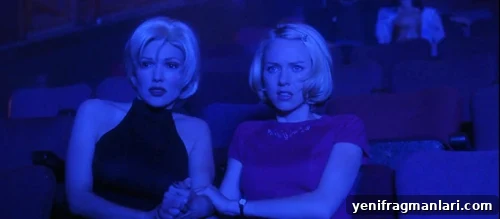
Performances help anchor the film’s more abstract impulses. Naomi Watts brings an irresistible, energetic charm to Betty: she is both the archetypal hopeful newcomer and a performer capable of startling intensity. Laura Elena Harring’s Rita is measured and enigmatic, conveying vulnerability and an old-Hollywood glamour even while she grapples with confusion and loss. The supporting cast supplies memorable, eccentric character work—Lynch’s affinity for unusual, magnetic performers gives many small scenes a distinct life. One particularly striking presence is the cowboy figure, whose cold, enigmatic authority contrasts sharply with the fragile dreams and ambitions of the film’s central characters.
Narratively, the movie refuses a single, definitive reading. Some viewers interpret nearly the entire film as a dream or fantasy; others see it as a fractured reality in which dream sequences are interspersed with more literal scenes. There are deliberate signs and motifs that can be used to build interpretive frameworks—clues suggesting which moments are dreamlike and which belong to a more concrete world—but Lynch seems to embrace ambiguity rather than resolve it. As a result, the story can feel disorienting and unresolved, but that very refusal to close the loop is part of the film’s power: like real dreams, it leaves impressions, feelings, and questions more than clear explanations.
Two sequences in particular function as emotional and thematic anchors while remaining bewildering in their own right. In one, two men in a roadside diner discuss a dream that begins to unfold around them, a scene that plays with the boundary between premonition and performance. In another, Betty and Rita attend Club Silencio and witness an unnerving, highly staged illusion that moves them to tears, underscoring the film’s fascination with performance, authenticity, and the thin line between artifice and truth. Other moments — such as a comic, bungled assassination attempt — balance menace and absurdity in ways that keep the viewer uncertain whether they are watching satire, horror, or melodrama.
Whether you read Mulholland Drive as a meditation on Hollywood, an exploration of desire and identity, or simply an extended, beautifully crafted nightmare, its artistic ambitions are unmistakable. Lynch offers not answers but experiences: moments that linger and invite repeated viewings and fresh interpretations. The film remains provocative and emotionally resonant precisely because it resists tidy closure, instead holding up a fractured mirror to dreams, fears, and the stories we tell ourselves. For many viewers, Mulholland Drive stands as one of Lynch’s finest achievements in surrealist cinema.
Score: 22/24
Recommended reading: Where to Start with David Lynch (a guide to exploring Lynch’s work)