
Godzilla vs. Kong (2021)
Director: Adam Wingard
Screenwriters: Max Borenstein, Eric Pearson, Michael Dougherty, Terry Rossio, Zach Shields
Starring: Alexander Skarsgård, Millie Bobby Brown, Rebecca Hall, Brian Tyree Henry, Julian Dennison, Kaylee Hottle, Damián Bichir, Eliza González, Shun Oguri, Kyle Chandler, Lance Reddick, Hakeem Kae-Kazim
Godzilla vs. Kong is the blockbuster culmination of Legendary’s shared MonsterVerse, following Godzilla (2014), Kong: Skull Island (2017) and Godzilla: King of the Monsters (2019). Directed by Adam Wingard, it leans into spectacle and unashamed, large-scale entertainment — a film clearly designed to deliver thrilling monster battles while giving fans the satisfying payoff of two titans finally meeting in combat.
The story picks up five years after the events of King of the Monsters. Kong, now fully grown, is held and studied by the covert organization Monarch on a remote island, while Godzilla unexpectedly attacks Apex Cybernetics’ flagship research facility with devastating force. Monarch, alongside Apex, sponsors an expedition into the mythical Hollow Earth — a subterranean world that conceals a vast energy source — guided by Kong’s instincts and overseen by scientists Dr. Nathan Lind (Alexander Skarsgård) and Dr. Ilene Andrews (Rebecca Hall). Meanwhile, Apex CEO Walter Simmons (Damián Bichir) pursues his own agenda, and Maddison Russell (Millie Bobby Brown), daughter of Monarch scientists, teams with whistleblower Bernie Hayes (Brian Tyree Henry) to expose the company’s darker plans.
From the outset the film frames the two creatures differently. Kong receives a tender, almost heroic introduction on his island, presented with warmth and musical cues that underline his connection to the human characters — especially Jia, a deaf girl who forms a poignant bond with him. Godzilla, by contrast, surfaces with an awe-inspiring atomic display and destructive force, his presence underscored by a booming, ominous score from Tom Holkenborg. The early positioning casts Kong as the sympathetic protagonist and Godzilla as the fearsome antagonist, although the film complicates those roles as it progresses.
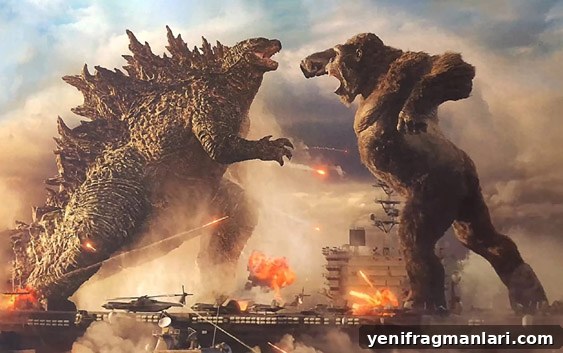
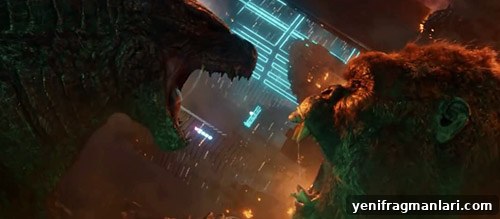
Where Godzilla vs. Kong truly excels is in its fight choreography and visual imagination. The battles are staged with cinematic flair: an early clash on an aircraft carrier is jaw-dropping, but the film saves its most spectacular confrontation for the neon-lit streets of Hong Kong. There, under glowing skyscrapers, the choreography becomes almost balletic — Kong uses agility and improvisation, redirecting Godzilla’s atomic breath and wielding a makeshift axe formed from Godzilla’s own spines, while Godzilla relies on raw power and his atomic pulse. These sequences are visceral, inventive and unafraid to commit to the physicality of these enormous combatants.
Between the clashes, the film embraces pulp sci-fi adventure. The Hollow Earth sequences are a highlight: gravity-inversion passages and towering, prehistoric vistas create a sense of wonder that nods to classic adventure fiction and earlier science-fiction films. This subterranean world is sumptuous and imaginative, delivering on the long-promised idea of hidden realms beneath our feet.
Human characters serve mostly as guides and emotional anchors rather than the primary focus. The film splits them into functional teams: scientists accompanying Kong, and Maddison with tech-savvy ally Josh (Julian Dennison) and Bernie infiltrating Apex. Their missions provide exposition and occasional levity, while also reminding viewers of the ethical and corporate conflicts at the story’s core. The human drama is intentionally straightforward — the script avoids overcomplicated subplots and instead uses these characters to humanize the stakes and provide moments of humor and heart.
As a genre piece, Godzilla vs. Kong asks audiences to suspend disbelief. The film contains technobabble, sudden plot conveniences and a relaxed approach to realism — but that’s part of its charm. It operates on the logic of monster cinema: the spectacle, the emotional beats, the roar and the smash are the point. Viewers who accept that framework will likely enjoy the ride; those seeking something cerebral or tightly realistic may be less satisfied.
The film balances tone well: it is neither grim nor overly jokey. It approaches its material with affection rather than irony, delivering scenes that are vibrant, colorful and often playful — including moments of physical humor and bold action, such as Kong resetting a dislocated shoulder using a skyscraper. The movie doesn’t pretend to be anything other than a celebration of gigantic creature filmmaking: ambitious, loud and unapologetically fun.
There are surprises that will thrill Kaiju fans, and the climactic set pieces are crafted to leave an impression long after the credits roll. While it may not break new thematic ground, Godzilla vs. Kong accomplishes what it sets out to do: provide a high-energy, crowd-pleasing spectacle that honors its monsters and delivers some of the most exciting creature battles in modern cinema.
16/20