
Good Grief (2023)
Director: Daniel Levy
Screenwriter: Daniel Levy
Starring: Daniel Levy, Ruth Negga, Himesh Patel, Luke Evans, Arnaud Valois, Celia Imrie, David Bradley
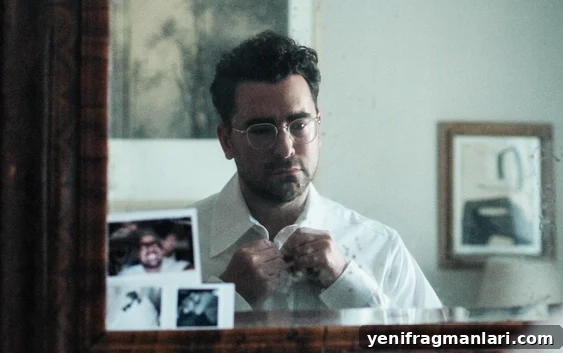
Marcus (Daniel Levy) and Oliver (Luke Evans) appear to have a charmed life: a loving relationship, close friends and a successful literary career. Their world is comfortable and bright, until a single tragic event—a collision caused by a drunk driver—shatters Marcus’s life and leaves him to navigate an unfamiliar landscape of grief. Close friends Thomas (Himesh Patel) and Sophie (Ruth Negga) stand by him, but their support often feels inadequate and uneven, revealing the limits of goodwill when confronted with deep emotional distress.
As the anniversary of Oliver’s death approaches, Marcus finally opens what he believes is the last Christmas card his husband intended for him. The content upends everything: it is not a festive note but a confession. Oliver had met someone else and had been preparing to explore that relationship outside the marriage. This revelation complicates Marcus’s mourning, introducing a layer of betrayal and unanswered questions that transforms familiar grief into something more ambiguous and hard to name.
Without an opportunity to argue, reconcile or gain closure, Marcus drifts. To steady himself and to follow a thread of curiosity about the life Oliver may have been imagining, he proposes a trip to Paris with Sophie and Thomas. The journey becomes an attempt to piece together a version of the future Oliver had hinted at, even as Marcus struggles to accept new truths about their relationship.

This film marks Daniel Levy’s feature directorial debut. Fans of his earlier television work know him for the warmth and gentle humor of Schitt’s Creek, where stories of LGBTQ+ characters were treated with ease and normalcy rather than being defined by struggle. In contrast, Good Grief centers on trauma and the messy, uneven process of mourning. Levy’s intention to treat grief with honesty is clear, but some of his creative choices make the movie feel emotionally distant at times.
One stylistic decision that weakens emotional impact is the frequent use of silent montages to show the friends bonding. These sequences are often accompanied by sentimental music, but they keep the audience at arm’s length rather than inviting us into the intimacy of those relationships. We are told repeatedly how close this group is, yet their on-screen interactions rarely demonstrate the depth of connection necessary to make their reactions to loss fully convincing.
The characters occupy a very specific social and economic milieu—affluent, artistic and comfortably secure. This choice allows the film to focus on emotional transformation without external pressures such as financial strain or childcare, but it also narrows the film’s reach. For some viewers, the insular world of writers, publishers and creatives may make the story feel less relatable or less urgent.
Performances are a strong point. Levy gives a nuanced portrayal of a man under the weight of grief, balancing fragility and an occasional brittle defensiveness. Ruth Negga stands out as Sophie, channeling self-destructive impulses and an unpredictability that adds necessary tension to the trio. Himesh Patel brings warmth and awkwardness to Thomas, whose history with Marcus as an ex adds an undercurrent that the script never fully explores. Supporting veterans like Celia Imrie and David Bradley lend gravitas in smaller moments, anchoring the film when it risks drifting.
Where Good Grief falters is in its dialogue and emotional architecture. Many of the characters are unguardedly earnest, offering little subtext or contradiction. The result is that exchanges sometimes feel less like lived conversation and more like direct exposition. The film’s pacing is deliberate—some viewers will appreciate the slow, contemplative rhythm, while others may find the narrative too thin to sustain its length.
There is nothing fundamentally wrong with the film, but it does feel like a work that doesn’t quite fulfill its promise. Levy’s direction shows sensitivity and an eye for small, revealing moments; the actors provide heartfelt, committed performances. Yet the movie rarely attains the emotional specificity it needs to turn its grief into something that feels both authentic and revelatory. The title suggests an embrace of hope or healing, but the balance between sorrow and consolation remains ambiguous.
Ultimately, Good Grief is a thoughtful, well-acted exploration of loss that sometimes struggles to connect all its parts. It will resonate with viewers who appreciate character-driven, introspective dramas and who don’t mind a film that favors subtlety over plot. For others, the film’s restraint and insular focus may leave them wanting more clarity, sharper conflict and deeper access to the relationships at its core.
Score: 15/24
Explore more about Netflix Originals and related films in the same genre.