

Good Grief (2023)
Director: Daniel Levy
Screenwriter: Daniel Levy
Starring: Daniel Levy, Ruth Negga, Himesh Patel, Luke Evans, Arnaud Valois, Celia Imrie, David Bradley
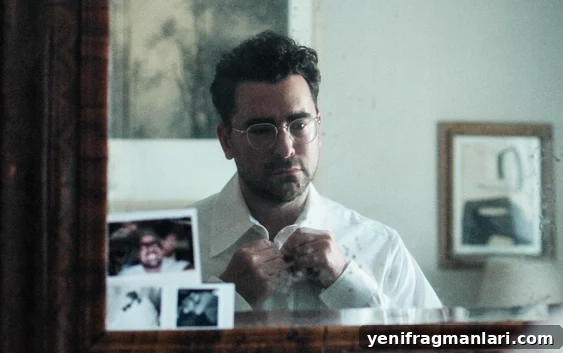
Daniel Levy’s feature directorial debut, Good Grief, follows Marcus (Daniel Levy) as he attempts to navigate life after a shocking loss. At the start, Marcus and his partner Oliver (Luke Evans) appear to have a nearly perfect life: successful careers, close friends, and comfortable routines. That illusion shatters when a drunk driver causes an accident that takes Oliver’s life, leaving Marcus to cope with profound grief and the sudden absence of his partner.
Marcus is supported by friends Sophie (Ruth Negga) and Thomas (Himesh Patel), but their well-meaning presence doesn’t always translate into useful help. As Marcus tries to process his grief, he discovers something that complicates his mourning: the final note Oliver left is not a Christmas card at all but a confession that he had begun seeing someone else and wanted to explore that relationship outside the marriage. That revelation forces Marcus into a different, more tangled experience of loss — a grief complicated by questions of betrayal, unfinished conversation, and the lack of closure.
Unable to debate or reconcile with Oliver, Marcus drifts. In search of a way to understand the life Oliver might have built without him, Marcus invites Sophie and Thomas on a trip to Paris. The journey is meant to be both a literal and emotional pilgrimage, a chance for Marcus to look closely at the possibilities Oliver hinted at and to try to reconstruct his own identity in the aftermath.

Levy’s strength with character-driven comedy and heart was clear in his television work, where he created narratives that highlighted joy and acceptance without making characters’ identities the sole focus. In Good Grief, he shifts to a quieter, melancholic tone, exploring sorrow and the ways friends respond when someone close to them is grieving. That shift is ambitious and occasionally affecting: Levy delivers scenes of genuine vulnerability and allows his lead to reveal nuanced emotional states.
However, the film’s choices sometimes distance the viewer. The principal characters are presented as affluent and culturally privileged, a deliberate decision that allows the story to concentrate on internal states rather than external pressures. While this can create space for introspection, it also frames the film’s suffering in a specific cultural context that may feel remote to some viewers. The central quartet—Marcus, Oliver, Sophie and Thomas—operate within a narrow social bubble, and much of the film’s grief is filtered through that lifestyle.
Another recurring stylistic decision is Levy’s tendency to show the friends bonding through montages accompanied by sentimental music. These sequences tell the audience that the group is close but often keep us at arm’s length, substituting montage for the more revealing, unvarnished moments of shared life. As a result, we are told how strong these relationships are more often than we are shown. This is particularly noticeable in the dynamic between Marcus and Thomas; the film hints at a past intimacy between them, but the subplot never develops into anything that alters the main emotional arc in a meaningful way.
The screenplay leans heavily on earnestness. Almost every character is emotionally transparent; subtext is sparse, and much of the dialogue explains feelings rather than letting them emerge naturally. That directness will appeal to viewers who prefer clarity and emotional honesty, but it can undercut dramatic surprise and make some interactions feel staged. There is also a familiar trope at play: many characters work in creative fields, which simplifies the film’s emotional language but narrows the range of perspectives on grief.
Despite these limitations, the performances are a strong asset. Levy embodies Marcus with a subtlety that captures both numbness and the fragile returns of feeling. Ruth Negga brings complexity to Sophie, portraying someone who is self-destructive and fiercely human. Himesh Patel and Luke Evans add texture to the ensemble, and veteran actors Celia Imrie and David Bradley provide reliable support in smaller but resonant moments.
Good Grief is not a flawed film so much as one with unrealized potential. It aims for tenderness and reflection, and it occasionally lands moments that feel raw and true, but the overall pacing is slow and the emotional architecture is sometimes laid out in places where subtlety would have served better. Viewers seeking a film that interrogates grief with surprising insight may find it wanting; those who appreciate patient, character-focused dramas will find rewards, particularly in the central performance.
The film delivers grief in abundance, and it promises warmth through its cast and premise. Yet the question that lingers is where the “good” in the title truly resides — part of the answer is present in the performances and in a few scenes of genuine tenderness, but much of the film’s promise remains just out of reach.
Score: 15/24
Rating: 3 out of 5.
Explore more Netflix Originals