
This article was written exclusively for The Film Magazine by George Forster.
This is not a guilty-pleasure confession — not a shameful admission that I secretly enjoy something trashy. Yet, based on much of the existing commentary about Green Street (2005), you might expect it to be. Many commentators treat it as a run-of-the-mill football hooligan movie, but I think that response overlooks what the film is trying to do.
Green Street follows Matt (Elijah Wood), an American journalism student whose life unravels after he takes the blame for a classmate’s drug stash. Exiled from his Harvard life, he lands in London and becomes entangled with a football firm — the Green Street Elite (GSE) — a tight-knit group of men whose loyalty, rituals and violence reshape him. The film charts Matt’s personal development and offers a critique of the toxic dynamics that can arise in male social groups. If you haven’t seen the film, note there are spoilers ahead.
Violence
One of the most frequent criticisms of Green Street is its depiction of violence: that the film glorifies inter-firm fighting and frames hooliganism as something admirable. That critique is understandable, but it simplifies the film’s treatment of violence. Violence here is not presented as an end in itself; it functions as a rite of passage, a test of belonging and an expression of identity. When Matt first fights, he discovers he is “not made of glass” — he learns he can defend himself, and that realization empowers him.
Still, the film does not present combat uncritically. Unlike narratives that equate masculinity with a primal need to fight, Green Street shows the seductive and corrosive sides of this transformation. The rivalries between firms — GSE and Millwall’s NTO — are absurd in their origins, sometimes reduced to little more than postcode rivalries. Pete, the GSE leader, even compares the feud to “Israelis and Palestinians,” underlining how irrational and entrenched the hatred has become.
The film allows moments of pathos to puncture the bravado. After a petty clash claims the life of NTO leader Tommy Hatcher’s child, former GSE leader Steve (Marc Warren), known as “The Major,” abandons the firm life and retreats to a quieter, safer existence. Later, a dockside battle intended to settle scores spirals into tragedy: Hatcher kills Pete in a blind rage. That murder stops everything — fighters freeze and recognize, too late, how far they have let petty loyalties and tribalism carry them. Green Street resists simple moralizing; it treats violence as both a tool and a vice, showing its power and consequences rather than merely celebrating it.
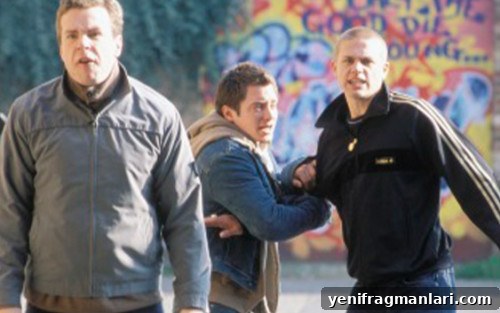
Charlie Hunnam as Pete (left) and Elijah Wood as Matt (right).
Toxic Masculinity and Male Relationships
Green Street explores male identity with nuance, often missed by critics who read the film as an unapologetic exaltation of hooligan culture. The characters are not glorified uncritically; rather, their motivations are made sympathetic and complex. Pete (Charlie Hunnam) starts off brusque and dismissive toward Matt, the outsider, but his relationship with Matt becomes the film’s emotional core. Pete is protective, charismatic and genuinely brave — not merely reckless — and his loyalty gives Matt a sense of belonging he was missing.
Bravery and fraternity are central themes. For young men, finding a group offers kinship, purpose and emotional refuge. The film acknowledges those positive aspects while also exposing the dangers: when loyalty and masculinity become rigid codes, they can spiral into violence and tragedy. Pete’s courage is admirable, but it also leads him into lethal conflict. Green Street neither fully endorses nor wholly condemns these masculine traits; it presents both sides, showing how fraternity can heal and damage in equal measure.
Conclusion
Green Street treats its audience as adults capable of drawing their own conclusions. It avoids heavy-handed preaching about violence or male behavior, preferring to present events and let viewers interpret them. That approach can frustrate critics who want clearer moral judgment, but it also allows the film’s emotional truth to emerge: the story is about belonging, identity and the fine line between courage and self-destruction.
The film is not without flaws — some accents are uneven, female characters are noticeably underwritten, and certain technical elements feel rough — yet its core themes are strong. Read on for flaws in performance or pacing if you wish, but don’t dismiss Green Street outright as low-rent trash. Looked at seriously, it is an affecting and surprisingly Shakespearean tale about loyalty, violence and what it costs to belong.
Written by George Forster
You can support George Forster in the following places:
Twitter – @georgeforster48