
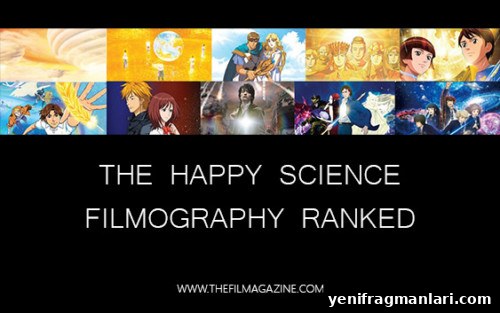
Happy Science is a New Age religious movement that emerged in Japan in the 1980s. Its core belief is that the spirit world is real and active, and that all religions are ultimately united under a single divine intelligence. The movement’s founder, businessman Ryuho Okawa, is presented by followers as the latest incarnation of a ninth-dimensional spiritual being often referred to in movement materials as El Cantare. According to those materials, Okawa/El Cantare has authored hundreds of books, established a political party, and claims to channel various historical and spiritual figures.
Happy Science has produced a number of feature films that dramatize its cosmology, ethics, and worldview. These films range in tone from earnest doctrinal exposition to ambitious science fiction and fantasy. They depict multiple eras—past, present, and future—and repeatedly return to the movement’s layered cosmology of spiritual dimensions and reincarnation. Below is a ranked overview of the available Happy Science films, ordered by their entertainment value for viewers who are not adherents of the movement.
8. The Terrifying Revelations of Nostradamus (1994)

The movement’s first film is a live-action presentation of prophecy and doctrine. It introduces Happy Science’s layered cosmology—ninth-dimensional creators, reincarnation, spiritual levels—and connects those ideas to historical events from the 1930s through a speculative near future. The narrative is straightforward and didactic, showing how the spirit world interacts with the physical world and offering guidance on how to live in order to progress spiritually.
The film’s staging is often static: spirits and celestial beings sit or stand and deliver dialogue more than act, and large swaths of exposition are presented in meditative sequences. The production leans on early CGI which now looks dated and occasionally unintentionally comical, as in scenes where spiritual forces are depicted with crude visual effects. The plot also foresees global catastrophe in the 1990s, a prediction that did not come to pass. As an introduction to the movement’s worldview it is useful, but as cinema it remains the least entertaining entry in this lineup.
7. Hermes: Winds of Love (1997)

This historical fantasy follows an incarnation of El Cantare in ancient Greece, portraying the life of a figure named Hermes and his confrontation with King Minos. The film mixes mythological elements—Theseus and the labyrinth, journeys to the underworld—with spiritual instruction about prayer, faith, and the nature of reality.
Pacing is the film’s main weakness: long stretches of reflection and exposition interrupt action sequences, and the story frequently switches focus without clear transitions. Still, those interested in the movement’s mythic retellings and its take on classical mythology will find moments of interest. The film reads like a cinematic scripture, heavy on contemplation and symbolic episodes.
6. The Laws of the Sun (2000)

This film delves deeper into Happy Science’s cosmology and origin story. It offers a detailed account of creation, the evolution of spirit groups, and many of El Cantare’s purported past incarnations—figures who reappear across different cultures and eras. The narrative spans from cosmic creation through the rise and fall of ancient civilizations, touching on lost continents like Mu and Atlantis.
At its best the movie blends adventure with imaginative worldbuilding, including antagonists such as reptilian beings who schematically plan to deceive humanity. Some of the film slows into extended sermons, but overall it sustains a brisk pace and supplies the viewer with a clearer map of the movement’s theological claims.
5. The Rebirth of Buddha (2009)

This film centers on a high school girl who becomes aware of the spirit world and works to expose an impostor claiming to be the reincarnation of Buddha. The story mixes everyday teen drama with supernatural conflict: possessions, alien interventions, and televised manipulation all appear alongside moral and spiritual lessons.
The climax stages a literal magical duel between two figures who claim Buddhist authority, ending in a dramatic exorcism and conversion. The mix of domestic realism and fantastical spectacle makes this one of the more consistently entertaining entries, even if its protagonist’s powers and motivations feel unevenly developed.
4. The Mystical Laws (2012)

Set in a speculative near future, this film depicts the rise of a militarized empire that invades Japan and imposes authoritarian rules. The antagonist regime is portrayed as influenced by alien technology and xenophobic ideology. The protagonist’s spiritual journey introduces extraterrestrial mentors and culminates in large-scale supernatural confrontations in stadium-set sequences.
The film blends political allegory with metaphysical preaching: after the action concludes it offers an extended sermon about spiritual values over material power. Visually, the movie relies on CGI spectacle and symbolic set-pieces; narratively, it mixes social commentary with the movement’s doctrine about belief and spiritual law.
3. The Laws of the Universe Part 0 (2015)

This animated feature focuses squarely on UFOs and alien contact. A group of students investigates the abduction of a classmate and encounters a wider galactic order: a “Galactic Federation,” hostile reptilian factions, and legalistic interstellar constraints. The film describes how minds on similar wavelengths can communicate across species and how moral states attract certain spiritual consequences.
The animation here is among the strongest in the Happy Science catalogue, and the story moves with tension and curiosity. While it includes some familiar melodramatic subplots, the film is notable for making extraterrestrial politics central to its religious narrative.
2. The Golden Laws (2003)

Stylistically reminiscent of time-travel adventures, this film opens in the twenty-fifth century and follows travelers whose malfunctioning device propels them through key moments in spiritual history. They witness events from ancient Greece to biblical episodes, and the storyline frames these visits as part of a larger, revealed plan.
The film’s appeal lies in its ambitious scope: it links disparate religious traditions and historical episodes into a single narrative that reinforces Happy Science’s claim of continuity across reincarnations and ages. The plot can be convoluted, and the film sometimes favors exposition over emotional development, but it remains a creative and energetic entry.
1. The Laws of Eternity (2006)

By many measures, this is the most engaging and fast-paced Happy Science film. It follows four friends who invent a device that allows communication with the spirit world, launching an adventure across multiple dimensions and afterlife realms. Guided by a shamanic figure, the protagonists travel through layered spiritual zones—the posthumous fourth dimension, ethical realms of light, realms reserved for advanced souls, and even hell—learning the movement’s metaphysical rules along the way.
The film mixes imaginative spectacle with doctrinal exposition: it explains concepts such as soul advancement, spiritual screening of one’s life, and how moral choices influence one’s afterlife destination. Historical figures and industrial pioneers are depicted among the higher souls, while familiar philosophers and antagonists appear in darker realms. Its brisk tempo, variety of set-pieces, and relatively accessible storytelling make this an excellent starting point for viewers curious about Happy Science’s cinematic output.