
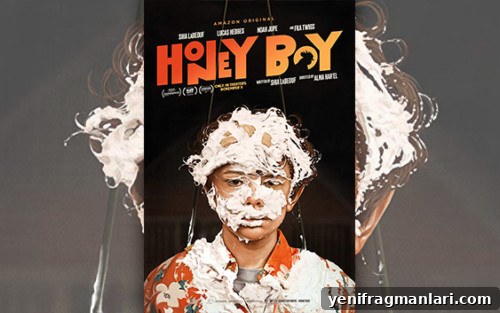
Honey Boy (2019)
Director: Alma Har’el
Screenwriter: Shia LaBeouf
Starring: Shia LaBeouf, Lucas Hedges, Noah Jupe, FKA Twigs
To Honey Boy, with love.
On paper, Alma Har’el’s Honey Boy could have easily misfired. The film is semi-autobiographical, written by and starring Shia LaBeouf, and it traces a difficult childhood alongside a ten-week, court-ordered rehabilitation period. That combination might have produced a self-indulgent or overly private piece, but instead the film emerges as a candid, searching attempt at personal healing. LaBeouf uses the screenplay and his performance to work through trauma, and the movie aims to invite the audience into that process rather than simply demand sympathy.
Honey Boy alternates between two timelines and relies on two actors to portray Otis at different stages of life. Lucas Hedges gives a grounded, deliberate performance as the older Otis — the version of the actor we have come to recognize in public and on screen — carrying the weight of a man still raw from his past. Noah Jupe, as twelve-year-old Otis, anchors the film with a vivid vulnerability; his scenes, especially those opposite LaBeouf, form the emotional core of the story. Hedges brings a steady gravitas that underscores the darker arcs of adult Otis, while also offering moments of dry humor through his interactions with Percy, a fellow patient in rehab.
Shia LaBeouf’s portrayal of James, Otis’s father, is fearless and multifaceted. As a veteran and former rodeo rider, James is volatile and fiercely charismatic; LaBeouf layers the character with both tenderness and menace. The father-son exchanges between LaBeouf and Jupe are magnetic — one instant marked by explosive anger, the next by spontaneous playfulness. The film treats addiction with empathy rather than sensationalism: we see James struggle in meetings, push away a mentor, and inadvertently shape his son’s instability. Those scenes feel lived-in and raw, not rehearsed.
Director Alma Har’el’s documentary background is visible in the film’s textured visual language. The handheld camerawork and an observant, almost intimate filming style give many sequences the feel of unscripted memory. Cinematographer Natasha Braier bathes Los Angeles in warm, often dreamlike hues, producing images that are both beautiful and slightly disorienting — a fitting match for a film about fractured memory and emotional repair. Comparisons may arise with Andrea Arnold’s American Honey for its sun-bleached, wandering look, but Har’el and Braier bring their own rhythmic sensibility to the cityscape and to Otis’s inner life.
The film’s greatest strengths lie in its honest depiction of addiction and in the performances of its leads. The screenplay is brave in its willingness to expose flaws and contradictions, and the actors respond with layered work that avoids melodrama. That said, not every subplot lands with equal force. FKA Twigs appears as Shy Girl, a neighbor and sex worker who becomes part of young Otis’s world. The character is written with hints of mystique and tenderness, but the film never fully explores her role or motivations. As a result, the Shy Girl storyline occasionally reads like a partially sketched figure rather than a fully integrated element of Otis’s emotional universe.
Despite that unevenness, Honey Boy succeeds as an intimate, self-reflective piece that balances introspection with genuine cinematic craft. The film doesn’t offer easy closure, and it doesn’t overstate its therapeutic aims; instead it functions as both a personal reckoning for LaBeouf and a moving portrait of a troubled father-and-son relationship. Moments of humor and human connection punctuate the tension, giving the story a lived-in texture rather than a purely confessional tone.
Ultimately, Honey Boy feels like a form of cinematic exorcism — an attempt by its creator to name and contain painful memories while inviting viewers to reflect on their own. The result is not always comfortable, but it is consistently honest, and it remains compelling because of the trust it places in its performers and in its audience.
20/24
Written by Pagan Carruthers
Support Pagan in the following places:
Twitter – @PaganCarruthers
Letterboxd – /pagancarruthers