
This article was written exclusively for The Film Magazine by Sam Sewell-Peterson.
This piece contains spoilers for Spider-Man: Far From Home.
I loved Far From Home — not only for its warm, endearing teen relationship drama but for its confident superhero spectacle. After a second viewing, one recurring idea stood out: Mysterio throws deliberate shade at the culture of modern superhero movies. The film cleverly uses that character to critique both the blockbuster machine and the audience appetite that fuels it.
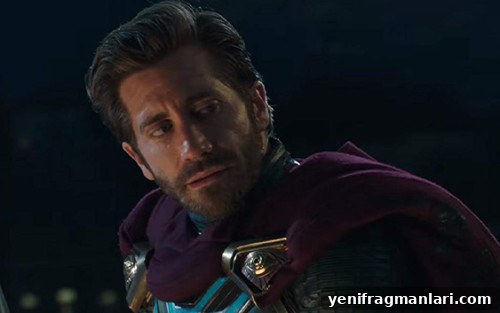
Director Jon Watts and writer Chris McKenna’s key stroke is how they stage Mysterio’s reveal. The midpoint scene in which he lays out his scheme — delivered in a bar, in classic Disney-villain fashion, step-by-step to his cronies — isn’t plot-wise revolutionary, but Jake Gyllenhaal sells it. What the movie makes clear is that this villain’s greatest weapon is cinematic illusion: he and his effects team weaponize blockbuster technology to deceive the world and mask their crimes.
The conceit is smart and meta. Mysterio’s operation feels like Hans Gruber’s robber crew if they had day jobs at a top visual effects house. The plan depends on a modern audience’s familiarity with the filmmaking process — with motion-capture suits, compositing, plates and rendering — so that when Mysterio’s grand illusion is pulled back, the film can show the scam being built almost like a behind-the-scenes special feature. We see the blocking for action, the stitching together of VFX elements, the rendering process all choreographed as part of a supervillain’s scheme to create the next blockbuster showdown.
That relies on viewers having seen enough making-of footage to recognise the telltale signs: A-listers prancing in matte-gray suits with tracking markers, actors in mocap, and the technology that turns those markers into comic-book heroics. When Mysterio’s ploy collapses, he ends up battling Spider-Man while wearing what looks like an unflattering leotard — because, in truth, his “suit” is itself a projected illusion. The film cleverly literalizes the idea that some superhero glamor exists only because of post-production wizardry.
At one point Mysterio laughs at how easy it was to invent a backstory about a dimension-hopping savior “named Quentin” — something that could never have worked in a pre-Avengers world. With wizards, space raccoons and demi-god Vikings flying around the MCU, almost anything can be believable. That ubiquity of spectacle becomes a tool for manipulation: when audiences accept the absurd as ordinary, any fabricated tale can gain traction.
Reading Mysterio as a metaphor, he is the frustrated visual effects artist who resents being invisible. He and his team build the spectacular images that make heroes into household names while others take the credit. Tony Stark, in this reading, has been both director and star of his own myth, and the people who supported that myth rarely receive lasting recognition. Mysterio’s hypocrisy — exploiting his crew’s craft while courting the spotlight himself — is precisely what makes him a believable comic-book antagonist and a pointed commentary on authorship in blockbuster cinema.
The film’s line about how people now only believe you if you “shoot lasers and wear a cape” is a wry observation about contemporary cinema culture. Superhero success, especially Marvel’s, has reshaped Hollywood economics and audience expectations. Avengers: Endgame demonstrated how rewarding serialized storytelling and spectacular payoffs can be, and it set a very high bar for what counts as satisfying blockbuster entertainment. In that environment, relying solely on bigger effects and louder action is no longer guaranteed to win hearts or minds; audiences want invention beneath the gloss.
Far From Home quietly teaches us not to take spectacle at face value. The film delights in the visual quality of its illusion sequences, but it also insists that blockbusters must keep evolving if they hope to matter. The movie suggests that VFX magic and ever-larger set pieces must be paired with fresh ideas and emotional stakes. Otherwise viewers are simply paying to be dazzled by an empty trick.
The movie also reminded me how important the human side of these stories remains. The decision to close this chapter of Peter Parker’s school life is an exciting narrative cliffhanger, but it carries a twinge of sadness: those small, messy moments at school and the slow bloom of Peter and MJ’s relationship are what give the film its heart. If Marvel wants to maintain audience engagement long-term, it needs to keep character-driven emotion front and centre — compelling people first, spectacle second.
Written by Sam Sewell-Peterson
You can support Sam at the following links:
Website – SSP Thinks Film
Twitter – @SSPThinksFilm