
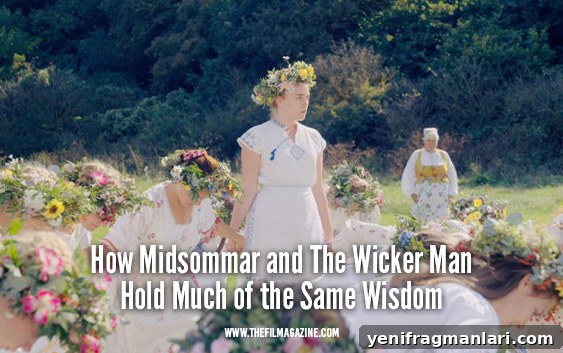
“I tried to avoid it as much as I could.” Ari Aster’s remark, made shortly before the 2019 release of his acclaimed horror film Midsommar, acknowledged the shadow cast by Robin Hardy’s 1973 cult classic The Wicker Man. Both films helped define the modern folk horror landscape. While Aster may have tried to steer clear of direct imitation, the two films share fundamental themes and visual language that reveal much about how folk horror explores community, ritual, and belief.
By definition, folk horror emphasizes folklore and communal traditions, usually viewed from the perspective of outsiders who become subject to an isolated, ritual-driven society. This formula isn’t absolute—films like The VVitch show that folk horror can operate without a cohesive cult—but community remains central to both The Wicker Man and Midsommar.
Both films open with atmospheric prologues that signal something ancient and inevitable. The Wicker Man greets the viewer with a whistling wind and the image of a green man, while Midsommar begins amid a stark Swedish winter. Those early moments tell us that events are already unfolding; when the protagonists appear in their ordinary worlds, their paths toward fate are already set—though the films establish a key distinction in how those paths begin.
The Wicker Man introduces Sergeant Howie (Edward Woodward), a devout Christian police officer whose life is anchored by faith, community, and his fiancée. His investigation into a missing girl on an isolated Scottish island upends everything he believes. In Midsommar, Dani (Florence Pugh) is already in crisis: a family tragedy and a tenuous relationship with her boyfriend Christian (Jack Reynor) leave her emotionally vulnerable. Christian’s cowardice—and his friend Pelle’s invitation to a Swedish commune—set Dani on a very different but equally inexorable trajectory.
The films diverge in tone and sound—Paul Giovanni’s folky soundtrack for The Wicker Man contrasts sharply with Bobby Krlic’s unsettling drones in Midsommar—but converge again once the protagonists arrive at their destinations. Hardy frames pagan iconography with close-ups of sun flags, painted eyes on dinghies, maypoles, costumes, and monstrous door knockers. Aster deploys similar visual cues: runic symbols, tapestries, carved temples, and aerial shots that reveal ritual geometry. Both directors use a dense iconography to suggest an older, living tradition beyond the protagonists’ comprehension.
Sometimes characters explain the symbols to each other—Howie’s outrage at a teacher describing the maypole’s phallic echoes this tendency. Other times the meanings are dramatized: in Midsommar, a series of paintings foreshadows events in which ritual and sexuality become intertwined. Often, though, the symbols are left to speak, displayed as if they carry their own authority. Like sacred paintings or stained glass, these images supply much of the world-building, implying that the films are chapters of a longstanding cultural saga rather than isolated horror stories.
Both films also offer a surprising measure of sympathy for their antagonists. Many folk-influenced horror films present cults as purely deluded or monstrously violent, but The Wicker Man and Midsommar allow their communities to speak lucidly about their values. In Hardy’s film, Lord Summerisle—played by Christopher Lee in what he regarded as one of his finest roles—calmly explains his people’s fertility rites to a stunned Howie, laying out his philosophy and inviting the audience to judge. Ari Aster gives the Hårga elders a similar voice, and his film goes further by showing how the younger visitors sometimes respond receptively to those traditions.
Dani, unlike Howie, is drawn toward community. Where Howie remains a resolute outsider, Dani finds comfort and belonging among the Hårga after her relationship collapses. The tribe’s interventions in Midsommar are ambiguous: are they orchestrating events or simply easing an inevitable breakup? The film suggests both. The Hårga tempt Christian and give Dani a space where her grief is mirrored and supported—an emotional catharsis that, in the film’s logic, can be as binding as any ritual.
The films also explore the mechanics of collective control. Lord Summerisle’s line—“You have come of your own free will to the appointed place”—is followed by an admission of how thoroughly the islanders have shaped Howie’s experience since his arrival. Like the Hårga, they function as a communal mind, facilitating and restricting movement, communications, and choices. Yet both films allow room for ambiguity: to what extent are events preordained by culture, and to what extent do individuals bring about their own fates?
That question returns us to sacrifice—the practical and moral currency of these communities. The islander who tells Howie, “You’ll simply never understand the true nature of sacrifice,” points to a cultural logic that values communal continuity above individual claims. Midsommar complicates the matter by portraying ritual suicide as a dignified alternative to suffering. An elder explains their practice as a deliberate gesture: “Instead of getting old and dying in pain and fear and shame, we give our life, as a gesture.” The film forces us to weigh the apparent cruelty of these acts against a broader sense of cultural coherence, functionality, and even beauty.
Once the credits roll, it’s easy to condemn these communities from the safety of modern life. But for the duration of each film, Hardy and Aster invite us into worlds where grotesque rites have a purpose: to strengthen the group, preserve an order, or restore an individual’s belonging. That balancing act—between horror and a strange, seductive communal logic—is where the real terror lies. While Midsommar is an original and powerful work in its own right, it shares much of the same insight that made The Wicker Man enduring. Together, the films complement one another: different protagonists, different journeys, but both swept into the orbit of an ancient plan that absorbs them whether they consent or not.
Written by Louis B Scheuer
You can support Louis B Scheuer in the following places:
Twitter – @louisbscheuer
Instagram – @louisbscheuer