
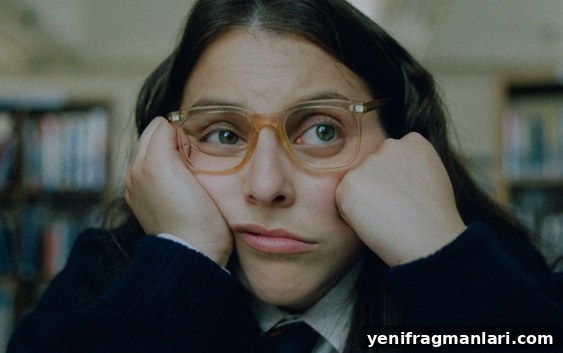

How to Build a Girl (2019)
Director: Coky Giedroyc
Screenwriter: Caitlin Moran
Starring: Beanie Feldstein, Alfie Allen, Cleo, Dónal Finn, Paddy Considine
How do you build a girl? In Coky Giedroyc’s film adaptation of Caitlin Moran’s semi-autobiographical novel, the answer begins with a train journey and a temporary job in Wolverhampton. The movie follows sixteen-year-old Johanna Morrigan, played with bracing energy by Beanie Feldstein, as she leaves her council estate life in the English Midlands and attempts to remake herself through music journalism, ambition and invention.
Johanna is a bookish, vividly imaginative teenager growing up in a chaotic, loving family. When she spots an advertisement seeking fresh voices for a pop culture magazine, she submits a piece and, despite initial skepticism from editors, earns a place writing music reviews for the fictional magazine D&ME. Her new role quickly makes her the family’s main breadwinner and opens the door to a heady mix of confidence, notoriety and self-invention.
With her bright red hair and a take-no-prisoners attitude, Johanna initially embraces success. A heartfelt profile of John Kite (Alfie Allen), a melancholic Welsh musician, marks a turning point: her piece attracts attention but also ridicule from the magazine’s older, male writers. Faced with dismissal by the industry’s gatekeepers, Johanna adopts a sharper persona—Dolly Wilde—and begins writing cruel, sensationalist reviews that win her public recognition and the dubious honour of being labelled an “arsehole” by a flash awards ceremony.
The film traces Johanna’s growth and contradictions. On one hand it is an energetic coming-of-age story about identity, sexual discovery and the desire to rise above the limits set by class and geography. On the other hand, it interrogates the cost of success when it depends on performing a persona. Caitlin Moran’s script, co-written with John Niven for the screen, supplies a stream of memorable lines—snappily funny and often self-aware—that give Johanna an oddball charm even when she’s at her most irritating. Lines like “Don’t you know who I thought I was six weeks ago?” and “I love doors, they make the outside stop” convey both humour and a searching sensitivity.
Beanie Feldstein anchors the film. Following her acclaimed turns in Greta Gerwig’s Lady Bird and Olivia Wilde’s Booksmart, she brings warmth, intensity and comic timing to the role. Feldstein’s performance makes Johanna feel alive: whether she’s carrying a pint of Guinness home from Dublin for her father or hiding under her bed with a jar of jam, Feldstein creates a teenager who is simultaneously lovable, awkward and relentless. Occasionally her accent slips, but those moments do little to diminish the performance’s overall authenticity and force.
Where the film falters is in some of its more fanciful stylistic choices. Johanna’s bedroom wall, populated by animated portraits of writers and cultural icons who appear to advise her, can feel gimmicky. Familiar British personalities play these imagined mentors, and while the conceit aims for comic absurdity, it sometimes reads as an overplayed device that interrupts the emotional flow rather than enhancing it. Similarly, a sequence in which Johanna’s crush, John Kite, steps out of an advertisement to walk her home in the rain plays as a literalization of teenage fantasy that clashes with the film’s otherwise grounded moments.
Those whimsical touches also dilute some of the film’s sharper themes. Issues of sexism and class—central to Johanna’s experience—are often softened by witty retorts and comic beats. The consequence is a film that raises important questions about who gets to speak in culture and who is heard, but then skirts the deepest consequences of those questions in favour of lightness and charm.
Despite these flaws, the film succeeds when it slows down and lets Johanna be a young woman rather than a theatrical act. Tender scenes with her exhausted mother, affectionate squabbles with her brother, and honest late-night conversations with John Kite reveal the film’s truer intentions. Those quieter moments give Johanna the space to reckon with her mistakes and rethink the persona she has created.
Ultimately, How to Build a Girl is a celebration of teenage imagination and the complicated work of becoming oneself. The movie suggests that reinvention is possible, but that real change comes from learning to be honest about who you are rather than performing a version designed to win approval. The final message is simple and humane: you don’t build a girl from the outside—you give a girl room to build herself.
16/24