
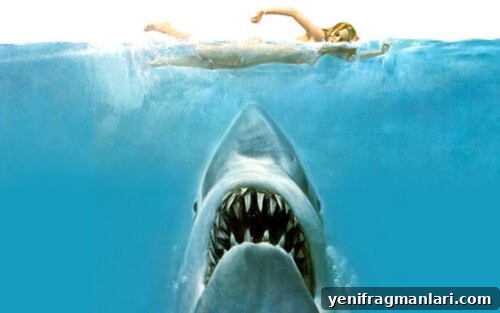
Jaws (1975)
Director: Steven Spielberg
Screenwriters: Peter Benchley, Carl Gottlieb
Starring: Roy Scheider, Robert Shaw, Richard Dreyfuss, Lorraine Gary, Murray Hamilton, Carl Gottlieb and Jeffrey Kramer
Plot: When a great white shark terrorizes the shores of a quiet town, the local sheriff forms an unlikely team to hunt the man-eating shark down, before it hunts them.
Jaws (1975): A Timeless Thriller That Redefined Summer Cinema
Steven Spielberg’s Jaws is widely regarded as the film that launched the modern summer blockbuster and reshaped how audiences experience on-screen dread. Set in the fictional island community of Amity, the film follows Chief Martin Brody (Roy Scheider), a local lawman who, despite his fear of the water, confronts a series of brutal shark attacks that threaten the town’s seasonal livelihood. Faced with political pressure, commercial concerns, and growing panic, Brody forms an uneasy partnership with the grizzled shark hunter Quint (Robert Shaw) and the young, scientifically minded marine biologist Matt Hooper (Richard Dreyfuss) to confront the predator.
At its core, Jaws is an exercise in escalating suspense. Spielberg combines restrained visual storytelling with John Williams’ simple, menacing two-note motif to turn the ocean into an arena of unseen menace. The score and the sound design work in tandem to hint at danger long before the shark appears, creating prolonged tension that pays off precisely and powerfully. That economy of musical and visual cues remains one of the film’s most influential techniques.
Performances and Character Dynamics
The central trio—Brody, Quint, and Hooper—offers a masterclass in character contrast. Brody’s moral responsibility and fear anchor the film’s emotional stakes, Quint’s hardened, practical brutality brings a human menace that counterbalances the animal threat, and Hooper injects curiosity, intellect, and youthful energy. The chemistry among Roy Scheider, Robert Shaw, and Richard Dreyfuss provides constant friction and camaraderie, turning what could have been a straightforward monster movie into a study of how different personalities respond to fear.
Direction, Technique, and Practical Effects
Spielberg’s direction emphasizes suggestion over spectacle. Known for his ability to manipulate audience emotion, he often shoots from the waterline or uses obscured, partial views to keep the shark unseen. Practical effects—especially the mechanical shark used on set—forced creative solutions. Technical challenges with the animatronic creature led Spielberg to imply more than to show, a choice that intensified dread rather than diminishing it. The combination of location shooting, tight pacing, and inventive camera placement creates an immersive, claustrophobic atmosphere on the open sea.
Thematic Resonance and Cultural Impact
Beyond its immediate thrills, Jaws explores deeper themes: the tension between safety and profit, the failure of civic leadership under pressure, and the human impulse to control nature. The film also had far-reaching cultural consequences. It changed how studios scheduled and promoted major films, turned the summer season into the primary window for tentpole releases, and left an enduring mark on the public imagination regarding sharks. The film’s impact on public perception of great white sharks—and the subsequent reactions toward those animals—illustrates how powerful cinema can be in shaping real-world attitudes.
Technically polished and emotionally precise, Jaws balances blockbuster ambition with the intimate terror of a small town under siege. It remains not only a blueprint for commercial success but also a peerless example of how craft—direction, editing, score, and performance—can combine to produce sustained suspense.
Score: 23/24
Recommended for you: Where to Start with Steven Spielberg