
This article was written exclusively for The Film Magazine by Sophia Patfield.
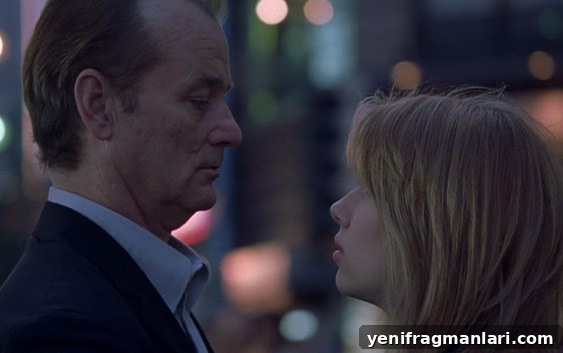
Sofia Coppola’s 2003 breakout film Lost in Translation stands as a defining work of modern independent cinema: a quietly powerful portrait of loneliness, unexpected connection, and the unusual intimacy that can form between strangers. Starring Scarlett Johansson as Charlotte, a young woman who begins to question her marriage and place in life, and Bill Murray as Bob, an aging actor grappling with career fatigue and personal distance, the film traces a fragile friendship that grows into a tender, ambiguous romance set against the electric backdrop of Tokyo.
Coppola’s sensitive direction and original screenplay earned her historic recognition at the Academy Awards—she became the first American woman nominated for Best Director—and the screenplay won the Oscar in 2004. The film also collected multiple BAFTAs and Golden Globes and remains a touchstone for critics and audiences. Bill Murray has frequently called it one of his favorite films, and viewers continue to return to its delicate themes and distinctive mood.
The film’s depiction of Tokyo is integral to its emotional core. Coppola transforms the city from a potential anxiety-inducing labyrinth into a cityscape that balances anonymity with intimacy. Tokyo’s contrasts—ancient temples and neon-lit skyscrapers, crowded subways and quiet hotel rooms—accentuate the characters’ separations and the moments when they find warmth together. In what follows I examine how cinematography, dialogue, and performance combine to create the film’s signature tone, exploring how the environment shapes the characters and their relationship.
Relationships With and Without Romance
Lost in Translation is driven by its network of relationships, but the emotional heart lies in the contrasting partnerships of Charlotte and John, and Charlotte and Bob. Coppola renders Charlotte’s marriage to John as quietly unraveling rather than explosively failing. Their distance grows through absence and misalignment more than through betrayal; John’s frequent travel and immersion in his own career leave Charlotte alone in the hotel and increasingly removed from his world. Small moments—Charlotte becoming invisible in a conversation, her discomfort at social gatherings—accumulate to reveal that the two are no longer on the same path.
Kelly, the flirtatious actress in John’s circle, functions less as an explicit antagonist and more as a mirror for Charlotte: Kelly highlights how little Charlotte shares with John’s life. That contrast sharpens the emotional gap and opens space for Charlotte’s connection with Bob.
The friendship between Bob and Charlotte begins with an explicit pact: they will be friends, not lovers, two people seeking company in a strange city. Their chemistry, however, grows organically. Coppola encouraged improvisation, allowing Murray and Johansson to build spontaneous, realistic exchanges that feel lived-in rather than scripted. The result is an intimacy that reads as mutual refuge rather than manipulation; their bond is based on honesty, humor, and shared solitude. Importantly, the film resists a conventional Hollywood ending. Instead of a romantic reunion, Coppola gives us an emotionally honest farewell—an intimate, ambiguous goodbye that respects the characters’ lives outside Tokyo.
Romantic Feelings from Isolation to Togetherness
Coppola’s film articulates two forms of isolation. Charlotte’s loneliness is physical and existential: newly married, far from home, and uncertain of her role, she wanders hotel rooms and tourist sites with a sense of detachment. Even her attempts to explore Tokyo—such as visiting a temple—are more observant than integrated; she watches culture instead of being a part of it. Bob’s solitude is different: he is surrounded by people and attention but remains emotionally distant. The public sees a star persona; the private man feels disconnected from his wife and family, his phone calls underscoring gaps he cannot bridge.
When the two meet, their shared detachment becomes the basis for togetherness. Small encounters—an elevator glance, a chance meeting in a bar, quiet conversations in hotel corridors—build trust. Their first night out is both a playful immersion in Tokyo and a respite: Charlotte experiences community and a sense of belonging she has been missing, while Bob experiences an ordinary anonymity he rarely feels in public life. The night’s loose, drunken abandon reveals them at their most human, revealing how companionship can temporarily soften isolation into something warm and reciprocal.
A Romantic Vision of “Real Tokyo”
Coppola’s cinematography reframes Tokyo as a city capable of intimacy and romance. Instead of the hyperbolic neon spectacle so often portrayed in Hollywood, the film finds quieter, communal spaces: subway cars crowded with commuters, local arcades, a small apartment lit with warm lamps. Coppola’s pre-production photography informed a vision that emphasizes everyday humanity over spectacle. Her “outside-of-the-car” shots—rain-speckled windows reflecting neon—soften the city’s glare and suggest a mood of contemplation rather than sensory overload.
The film’s color palette and lens choices contribute to its romantic feel. Soft focus, warm hues in bars and apartments, and subtle lighting craft a homely, inviting atmosphere. Even moments of sharp visual contrast—like the sudden green laser from a BB gun—serve as deliberate stylistic notes rather than narrative shocks, reminding viewers that Coppola’s colors and textures are intentional tools for tone and emotion.
Shot on film rather than early digital formats, Lost in Translation retains a grain and warmth that reinforces its nostalgic, softly romantic aura. That tactile quality deepens the film’s sense of memory and longing, making the city and the characters feel lived-in.
Ultimately, Lost in Translation endures because it trusts subtlety. It avoids melodrama—there are no melodramatic confrontations or contrived resolutions—and instead honors small gestures, quiet conversations, and imperfect endings. Coppola’s film offers a realistic, compassionate view of two people who, for a brief time in a foreign city, find a companionship that changes them. Nearly two decades on, it still stands as an influential, tender exploration of loneliness, connection, and the cinematic possibilities of place.
Written by Sophia Patfield