
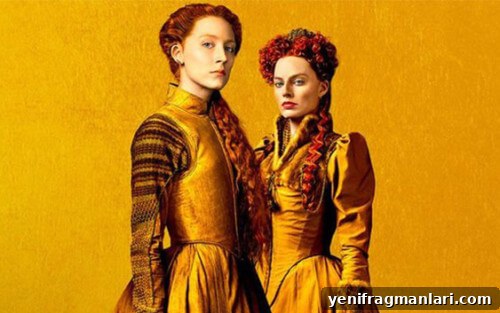
Mary Queen Of Scots (2019)
Director: Josie Rourke
Screenwriter: Beau Willimon
Cast: Saoirse Ronan, Margot Robbie, Jack Lowden, Joe Alwyn, David Tennant, Guy Pearce.
Plot: In 16th-century Britain, two queens clash in a high-stakes struggle for power, survival, and legacy.
Josie Rourke’s Mary Queen of Scots centers on Mary Stuart, cousin to Elizabeth I and the Stuart claimant to the English throne. The film opens with a jolting flash-forward to Mary’s execution, immediately drawing the viewer into the emotional and political turmoil of 16th-century Scotland. From that frame the narrative moves backward, using flashbacks to trace Mary’s return to Scotland and the chain of events that ultimately lead to her downfall. This framing creates a circular structure that underscores the inevitability of her fate and gives the story a tragic symmetry.
After the death of her husband, Francis II of France, Mary returns to Scotland to rule the land of her birth. The film follows her efforts to secure the crown amid internal rebellion and a bitter religious split between Catholics and Protestants. At the same time, Mary’s claim to the English throne places her in direct and dangerous competition with Elizabeth I. Rather than presenting a one-sided account, the film attempts to balance the perspectives of both queens, portraying each woman as a capable, constrained ruler navigating a male-dominated political world.
The film excels when it captures the political intrigue: plotting at court, betrayals, and the ever-present threat of violence. These scenes emphasize how precarious power was for any ruler, especially a woman. The screenplay, however, occasionally leans heavily on the brutality of the period, at times emphasizing grotesque episodes that distract from deeper psychological exploration. A more focused examination of Mary’s inner life — her doubts, ambitions, and private grief — could have enhanced the emotional impact of the film’s key moments.
Mary Queen of Scots takes artistic liberties with history, and the filmmakers acknowledge some of these choices with title cards. Still, viewers should be aware that the film prioritizes dramatic storytelling over strict historical accuracy. The depiction of sexual violence and graphic injury in certain scenes is likely to divide audiences; some viewers may feel the film would have been more effective by implying rather than explicitly showing those moments.
Visually, the movie cultivates a dim, somber atmosphere that fits the narrative’s tone. However, the cinematography sometimes confines itself to interiors and candlelit rooms, giving only fleeting glimpses of the Scottish landscape that Mary often invokes in the dialogue. The contrast between the wild Scottish Highlands and the cultivated palaces of England is an important thematic element that could have been emphasized further to deepen the characters’ differences and motivations.
Ultimately, the film’s strongest asset is its cast. Saoirse Ronan brings intelligence and resilience to Mary, while Margot Robbie offers a quieter, more restrained portrayal of Elizabeth—vulnerable yet calculating, shaped by a council of male advisors. Their relationship, developed through parallel experiences rather than extended direct conversation, becomes the emotional core of the film. The much-publicized confrontation between the two queens is the standout sequence, delivering the tension and complexity the trailers promised. In that scene, the actresses reveal a sisterhood and rivalry that feels both personal and political.
Mary Queen of Scots frames its central conflict as more than a dynastic struggle: it’s a meditation on leadership, gender, and power. The film pits the ideals of kinship and feminine responsibility against the harsh, often brutal demands of male-dominated statecraft. While it does not always fully realize the emotional depth it aims for, the thematic ambition and the committed performances make it a memorable historical drama.
17/24