
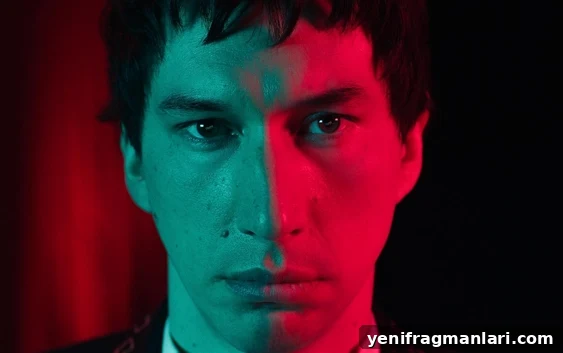
Megalopolis (2024)
Director: Francis Ford Coppola
Screenwriter: Francis Ford Coppola
Starring: Adam Driver, Giancarlo Esposito, Nathalie Emmanuel, Aubrey Plaza, Shia LaBeouf, Jon Voight, Laurence Fishburne
It’s rare these days for a filmmaker to be given the space and resources to produce a sprawling, personal project. For cinephiles, the excitement of seeing a legendary director pursue a long-gestating vision is understandable. That anticipation makes the letdown all the sharper when the film does not fulfill the promise. In the case of Francis Ford Coppola’s Megalopolis, a project decades in the making and billed by some as a magnum opus, the result is deeply disappointing.
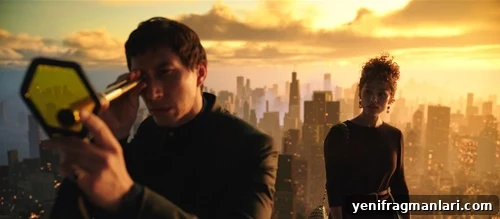
At its core, Megalopolis follows Cesar Catalina (Adam Driver), an ambitious architect-scientist who discovers or champions a super-material called “megalon.” He imagines building Megalopolis: a new neighborhood in New Rome designed around interconnectedness, eventually a model for a city-wide utopia. Opposing him are entrenched interests personified by Mayor Cicero (Giancarlo Esposito), Cesar’s volatile cousin Clodio (Shia LaBeouf), and the manipulative Wow Platinum (Aubrey Plaza). Cesar finds an ally in Julia (Nathalie Emmanuel), Cicero’s daughter, whom he pulls away from a life of privilege and social performance.
The film aims for philosophical breadth but rarely reaches depth. Its central ideas come across as loosely sketched aphorisms rather than a sustained interrogation of how a visionary project shapes society. Cesar’s ideals are presented as axiomatic: his success equates to a better world. There is little examination of the complexities, trade-offs, or moral ambiguities that such an undertaking would entail. Instead of exploring the tension between idealism and practical politics, the narrative tends toward binary oppositions—good versus bad actors—without offering persuasive stakes or emotional payoff.
The opening sequence creates a poor first impression. Where classic films might introduce a protagonist with a single compelling image or scene, Megalopolis begins with expository text and a string of disjointed vignettes. These early scenes suffer from awkward sound mixing, distant crowd audio, and uneven performances that undermine immersion. At times the delivery feels like a staged rehearsal rather than a completed film: actors occupy the same frames without convincing rhythm or chemistry.
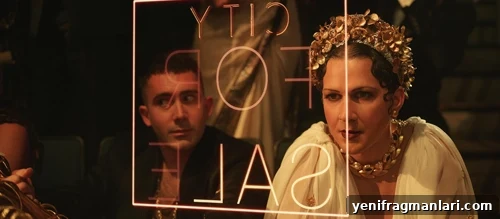
Visually, Coppola does attempt experiments. The film’s triptych montages are among the stronger elements: visually striking, thematically suggestive, and sonically layered in ways that stand out against otherwise flat sequences. These sequences hint at a director still willing to experiment with form and to push cinematic language. Unfortunately, they feel intermittently applied, as if introduced late in the process and not fully integrated with the film’s narrative flow.
Performances vary. Adam Driver brings a magnetic, stubborn presence to Cesar; he can sell the grandiose rhetoric and make the character watchable, even when the lines are thin. Shia LaBeouf and Aubrey Plaza inject volatility and dark charisma into their roles, each reveling in scenes that allow them to go big. Nathalie Emmanuel is sympathetic and grounded as Julia, though the script gives her limited room to fully develop beyond an archetype. Supporting players, including Giancarlo Esposito, lend weight to the political machinations but are often underused.
Where the film falters most is in structure and clarity. Events unfold in montages, proclamations, and abrupt leaps rather than through persuasive cause and effect. Major developments—Cesar’s plans, the construction of his exhibit, the political fallout—arrive with insufficient explanation, leaving viewers to infer motivations and outcomes. The film’s intellectual ambitions would benefit from a more rigorous dramatic backbone; as it stands, thematic gestures are made without being tested or dramatized.
There are moments that reveal Coppola’s cinematic instincts: bold visual compositions, moments of tonal daring, and sequences that linger in the memory. But they are not enough to salvage the broader work. Megalopolis reads like a director’s personal manifesto that was not fully realized as a coherent, audience-accessible film. Its grand intentions are undermined by uneven execution, and the film ultimately feels more like a curiosity than a triumphant late-career statement.
Score: 8/24
For viewers interested in Coppola’s career or in ambitious, experimental filmmaking, Megalopolis offers moments worth studying. For most audiences, however, the film will likely disappoint: an uneven, overreaching work that never quite coheres into the visionary urban fable it seeks to be.