
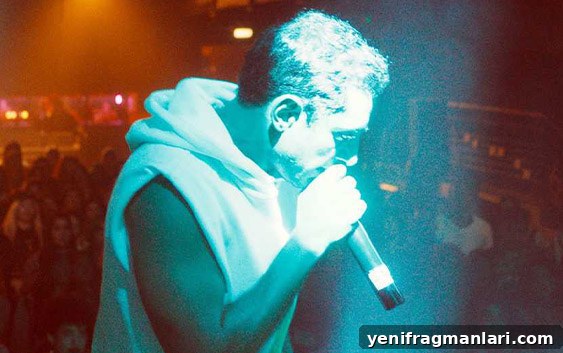
Mogul Mowgli (2020)
Director: Bassam Tariq
Screenwriters: Riz Ahmed, Bassam Tariq
Starring: Riz Ahmed, Alyy Khan, Anjana Vasan, Aiysha Hart, Kiran Sonia Siwar, Nabhaan Rizwan
Riz Ahmed brings to Mogul Mowgli the same urgency and lyricism that have made him notable both as an actor and as a musician. His career straddles rap, jungle, hip-hop and electronic music, and his albums and collaborations demonstrate a fierce command of language and rhythm. That musical sensibility informs this film, co-written and produced by Ahmed and directed by Bassam Tariq, a debut feature that uses performance, sound and poetic imagery to explore cultural identity, illness and belonging.
At its core, the film follows Zaheer Anwar—Zed—an emerging British-Pakistani rapper on the brink of greater success. About to join a major tour, Zed returns to his family home in Wembley after a two-year absence. There he confronts the gulf between his public persona—MC Zed, confident and combative onstage—and his private life with parents who see many of his choices as alien or forbidden. A violent encounter leads to hospitalization and the diagnosis of an aggressive autoimmune condition. Pulled from the road and placed in the care of his family, Zed must face the vulnerabilities his illness exposes: a loss of control, mounting anxiety and the weight of expectations from a family rooted in tradition.
The screenplay mines Zed’s interior life for its drama. The film frames his crisis as both physical and psychic: his body, described by clinicians as attacking itself, becomes a metaphor for the division experienced by many children of immigrants—torn between cultural inheritances and the pressures of assimilation. Tariq and Ahmed dramatize this split with sequences of magical realism. A mythic Eastern figure and references to Toba Tek Singh and Partition echo through Zed’s fevered hallucinations, personifying a historical and generational rupture that complicates his search for identity.
Language and small domestic details reveal the distance between Zed and his parents. Even when he understands his parents’ native tongue, he answers in English, a pattern that highlights an awkward bilinguality and a choice about how to present himself to the world. Clothing, prayer rituals and the tactile close-ups of fabric stitching in the film function as visual metaphors for how culture and faith are woven into daily life—choices that shape public identity as much as private belief.
Stylistically, Mogul Mowgli is a blend of textures. Paul Corey’s sound design often strips scenes down to hollow, unsettling silences or abrasive pulses that underscore Zed’s isolation. Annika Summerson’s cinematography favors intimate framing, while the editing—fast and sometimes jagged—captures the clash between performance and corporeal decline. At times the film’s dreamlike sequences and aesthetic choices risk feeling indulgent, and the grainy, surreal imagery can be distancing. Yet that distance can be read as deliberate: it mirrors Zed’s emotional withdrawal and the estrangement central to the story.
Humour is threaded through even the most fraught moments. Brief comic exchanges—family banter, wry observations about trends and cultural fads—provide warmth and a sense of everyday reality that balances the film’s heavier themes. These moments help humanize the family around Zed, preventing the narrative from becoming purely allegorical.
Ahmed’s lead performance anchors the film. He convincingly shifts from swaggering, press-ready performer to a man made small by illness and fear, allowing the audience to inhabit Zed’s changing interior landscape. His background as a lyricist informs the film’s cadence: line readings and rhythmic beats feel intentional, creating a tonal link between music and cinema. The result is a portrait of contemporary selfhood that feels both specific and resonant.
Mogul Mowgli interrogates questions of cultural appropriation, othering and the politics of belonging without offering tidy resolutions. Instead, it stages those tensions inside one body and one family, using sound, image and performance to map the fractures that migration and history leave behind. For viewers interested in films about identity, illness and the frictions of modern multicultural life, the film offers a provocative, often moving experience.
17/24