
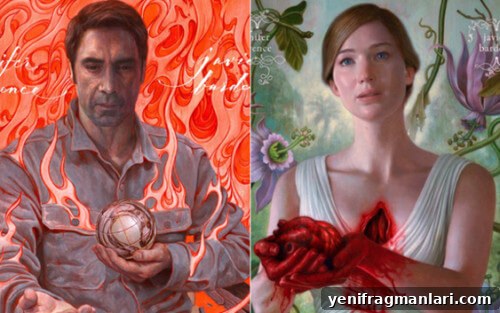
Mother! (2017)
Director: Darren Aronofsky
Screenwriter: Darren Aronofsky
Starring: Jennifer Lawrence, Javier Bardem, Ed Harris, Michelle Pfeiffer, Brian Gleeson, Domhnall Gleeson
Darren Aronofsky, the director behind some of the most provocative films of the twenty-first century such as Requiem for a Dream (2000) and Black Swan (2010), returns with perhaps his most divisive work yet. More ambitious and polarising than The Fountain (2006) or Noah (2014), Mother! (2017), starring Jennifer Lawrence and Javier Bardem, split audiences sharply: viewers tend to either praise it passionately or reject it entirely. Regardless of opinion, the film provoked widespread discussion and intense critical debate.
— WARNING: SPOILERS AHEAD —
Mother! is a deliberate descent into the emotional and sensory extremes that define Aronofsky’s cinema. Paranoia functions as the film’s core feeling, and the sound design relentlessly amplifies that sensation, placing the viewer inside an escalating state of anxiety. The director leaves no room for comfort or casual contemplation. Instead, he crafts a claustrophobic, often punishing experience that refuses to relent, building tension through image and sound until a wrenching, extended sequence erupts in the film’s final act.
On its surface, the story follows the mounting unrest of Jennifer Lawrence’s character, who becomes increasingly alienated and endangered by her poet husband’s (Javier Bardem) disregard for her needs. Yet, as with much of Aronofsky’s output, the film operates primarily as an allegory. Mother! can be read as a layered meditation on creation, worship, and destruction. In this reading, Bardem’s character represents a God-like creator, Lawrence embodies Mother Earth, their home symbolizes the planet, and the stream of visitors and intruders stand in for humankind—from archetypal Adam and Eve figures to contemporary humanity. Aronofsky and producers have endorsed this allegorical interpretation, and the film consistently supports that thematic mapping.
Because the allegory reaches into gender dynamics and power, Mother! also invites readings about patriarchy, abuse, and objectification. Jennifer Lawrence has discussed how those issues shaped her decision to take the role. The story’s emotional impact emerges from this intersection of the cosmic and the personal: an intimate domestic crisis refracted into an apocalyptic metaphor about the relationship between people, the divine, and the natural world.
Aronofsky’s stylistic choices are integral to the film’s force. The cinematography, editing, and especially the aggressive soundscape fuse to create a single oppressive atmosphere. Visually, Mother! is precise and striking, producing images that linger long after they pass. A few digital effects are slightly less convincing, but the vast majority of the film’s visual design is meticulous. Musically and sonically, the film’s choice to push viewers to the edge of endurance is deliberate: the sound cues and mixing heighten dread and agitation rather than comfort.
Recommended for you: What Does the Crystal Mean in Darren Aronofsky’s ‘Mother!’?
At the center of the film is Jennifer Lawrence’s performance, arguably the most fully realized of her career to date. She brings a fragile yet resilient presence to the role, balancing quiet nuance with raw physical and emotional strain. Reports that Lawrence injured her diaphragm during a climactic birth sequence underline the physical intensity demanded by the part and underscore the commitment behind her performance. Javier Bardem delivers a measured and commanding turn that supports the film’s allegorical ambitions, while Michelle Pfeiffer makes a memorable impact in a brief but pivotal role, embodying a world-weary, almost predatory glamour.
From a performance perspective, Mother! is primarily Lawrence’s showcase. Her portrayal holds the film’s emotional core together and gives the allegory a human center. Despite strong individual contributions across the cast, public reaction to the film was far from unanimous. Mother! underperformed at the box office and drew sharp criticism from many viewers who labelled it pretentious or needlessly provocative. That backlash diminished the film’s visibility during awards season and among mainstream audiences, even as critics and cinephiles continued to debate its artistic merits.
Artistically, Aronofsky delivers something audacious and uncompromising. Mother! is constructed to be demanding: it asks an audience to accept repeated shocks and to engage with uncomfortable symbolic readings. For viewers willing to meet it on those terms, the film offers multiple levels of meaning and impressive technical achievements—especially in sound and cinematography. For others, these same qualities read as excess or self-indulgence. Time may prove decisive: like many polarizing works, Mother! could gain broader appreciation as its themes are reconsidered and debated.
Score: 21/24
Recommended for you: Every Darren Aronofsky Directed Film Ranked