
One Fine Morning (2022)
Director: Mia Hansen-Løve
Screenwriter: Mia Hansen-Løve
Starring: Léa Seydoux, Melvil Poupaud, Pascal Greggory, Camille Leban Martins
When asked about the inspiration behind her 2022 Cannes entry One Fine Morning, writer-director Mia Hansen-Løve explained that the film grew out of her observation that opposing feelings can coexist: a strange morning can feel like a rebirth. That tension—grief and renewal, loss and desire—runs through the film, producing a delicate, observant drama that favors realism over melodrama.
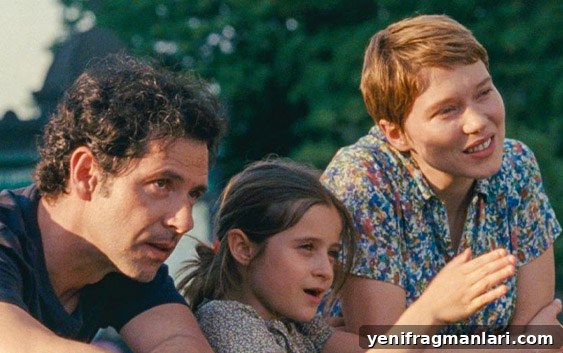
The film centers on Sandra (Léa Seydoux), a Parisian single mother who, five years after her husband’s death, unexpectedly meets Clément (Melvil Poupaud). Their chance encounter opens an emotional door for Sandra, and the relationship that follows sparks a sexual and emotional reawakening. Clément’s gentleness with Sandra’s young daughter Linn (Camille Leban Martins) makes him an initially seamless addition to Sandra’s daily life. Linn is a vivid presence—funny, curious, and old enough to recognize that her mother’s world is changing, even if she cannot fully understand it.
Hansen-Løve resists easy romance: the affair is complicated by Clément’s own existing marriage, and the film shows how quickly private joy can collide with uncomfortable realities. The moments of elation—Sandra lighting up at a text, the ache of a goodbye—are portrayed with subtlety, revealing the volatility of human longing and the quiet intensity of ordinary relationships.
Parallel to this new intimacy is Sandra’s role as caregiver to her father (Pascal Greggory), who suffers from Benson’s syndrome, a progressive condition that erodes both sight and cognitive function. The film depicts the slow, heartbreaking logistics of care as Sandra navigates hospitals and care homes, trying to find the right place for him. Greggory’s performance captures the disorienting sense of memory slipping away; he has said this role required a deep immersion into a character losing himself, and his portrayal adds a layer of restrained sorrow to the film.
A defining moment comes when Sandra sorts through her father’s books and tells her daughter she feels closer to him through those volumes than she does during hospital visits: “There is his envelope body, here is his soul.” The line is quietly poetic and crystallizes the film’s view that objects, habits, and passions can preserve a person’s interior life. For Sandra’s father, language and books were once central—so the shelves become a truer portrait of him than his weakened physical presence. That insight underpins much of the film’s emotional power.
The tone of One Fine Morning mirrors Sandra’s emotional swings, blending sorrow with moments of warmth and humor. Small scenes—children laughing as their parents stage a makeshift Santa visit, friends creating a festive illusion—lend the film a humane texture and remind the viewer that life often contains both grief and joy at once. Hansen-Løve’s direction privileges quiet gestures and everyday detail, allowing the audience to inhabit Sandra’s interior life rather than signaling drama with cinematic flourishes.
Visually, the film contrasts the muted, institutional spaces of care facilities with the luminous beauty of sunlight-drenched Parisian streets. Hansen-Løve shot most of the film on 35mm film stock, a choice she felt added soul to settings that might otherwise appear unattractive. The tactile quality of 35mm complements the director’s interest in the physical traces of memory—books, rooms, domestic routines—so that the city itself becomes part of the story’s emotional geography.
At Cannes, Léa Seydoux remarked that this role allowed her to play an ordinary woman, someone audiences could immediately recognize. That ordinariness is the film’s strength: Sandra is not an archetype but a particular, lived figure whose grief, desire, and resilience feel true and relatable. Seydoux’s performance is versatile and grounded, a contrast to some of her more stylized previous roles.
One Fine Morning is a quietly moving exploration of transition: how love can arrive unexpectedly in the middle of loss, and how endings often contain the seeds of new beginnings. The film refuses tidy resolutions but offers a gentle, life-affirming perspective on how people adapt to change and seek connection amid difficulty.
Score: 22/24
Written by Gala Woolley
You can support Gala Woolley in the following places:
Twitter – @GalaWoolley
Blog – screenqueens.co.uk