
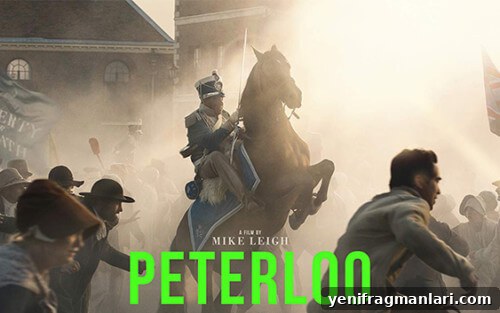
Peterloo (2018)
Director: Mike Leigh
Screenwriter: Mike Leigh
Starring: Rory Kinnear, Maxine Peake, Pearce Quigley, David Moorst, Rachel Finnegan, Tom Meredith, Simona Bitmate, Robert Wilfort, John-Paul Hurley, Victor McGuire
Mike Leigh’s Peterloo is an ambitious historical drama that revisits the St. Peter’s Field massacre in Manchester, August 1819. The film dramatizes a mass rally of working-class people demanding parliamentary reform that was violently suppressed by cavalry and militia — an event that helped shape the movement leading to the Great Reform Act of 1832 and the expansion of the franchise to many urban areas. Leigh uses the period event to probe class, power and political entitlement, aiming to connect the past to contemporary social concerns.
One of the film’s most striking qualities is its commitment to authenticity. The production design, costuming and makeup are detailed and lived-in; actors wear the grime and imperfections of daily life rather than a glossed, cinematic veneer. Leigh also leans into local speech and dialects, using authentic regional voices to distinguish motives and social standing. This linguistic realism helps anchor the perspective of ordinary people and foregrounds the class divisions at the heart of the story.
That same fidelity to detail, however, sometimes works against the film’s momentum. Leigh fills the narrative with a very large ensemble of characters, ranging from grassroots organizers to landed gentry. While this scope conveys the breadth of perspectives present around Peterloo, it also diffuses emotional focus. Several subplots and marginal characters receive considerable screen time yet add little to the central through-line. As a result, the film can feel bloated and episodic, and several well-acted scenes struggle to accumulate into an urgent, single dramatic thrust.
Maxine Peake delivers a commanding performance that anchors many moments, and many supporting players contribute memorable turns. But the sheer number of faces and narrative threads makes it difficult to form lasting attachments. At times Leigh’s language for the upper classes leans toward ornate and pompous, which is clearly a deliberate choice to contrast ruling elites with the plainly spoken masses; still, that stylistic decision can slow the film’s rhythm and create a distancing effect for viewers seeking a more intimate emotional entry point.
Leigh’s intention is not subtle: he wants audiences to understand the political stakes of Peterloo and to see the massacre as part of a longer story about repression and reform. The film succeeds in illuminating context and connecting the historical moment to enduring themes of representation and power. But the storytelling approach often reads like a measured history lesson rather than a streamlined narrative drama, with long stretches of exposition that can feel didactic. For some viewers this will be enlightening; for others it will reduce the film’s dramatic urgency.
Where the film truly breaks free is in its depiction of the massacre itself. The climactic sequence is brutal, unflinching and devastating — a sustained emotional and sensory assault that makes the consequences of the preceding debates unmistakably real. That section of the film crystallizes Leigh’s moral perspective and delivers the film’s most powerful, unforgettable filmmaking.
Visually, Peterloo shares moments of painterly composition reminiscent of Leigh’s earlier work, particularly in frames that recall the texture and tone of period painting. These visual passages are often beautiful and formally rich, even when the pacing or structure elsewhere falters. The film’s ambition — both political and aesthetic — ensures it will be a subject for discussion and analysis among critics and scholars interested in historical cinema and political filmmaking.
Ultimately, Peterloo is a film of contrasts: meticulous historical detail and occasional narrative excess; moving performances and a sprawling cast that undermines focus; striking visual tableaux and dense, at times ponderous, dialogue. It may not rank among Mike Leigh’s most concise or emotionally immediate works, but it is ambitious and consequential, and its final act delivers a moral clarity that justifies the director’s lengthy build. For viewers drawn to politically engaged historical drama, Peterloo offers powerful moments, even if its scope sometimes overreaches.
15/24