
Raging Bull (1980)
Director: Martin Scorsese
Screenwriter: Paul Schrader, Mardik Martin
Starring: Robert De Niro, Joe Pesci, Cathy Moriarty, Frank Vincent
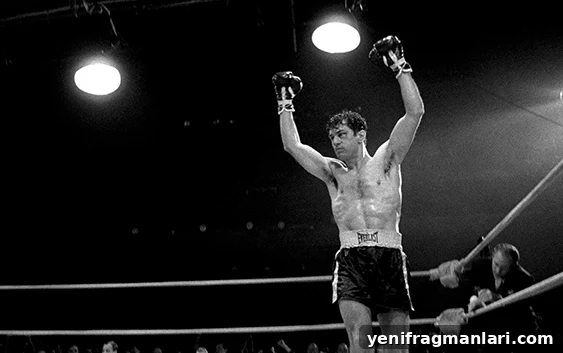
In a dimly lit gym, ropes cut across the foreground and a solitary boxer moves through a silent ritual of shadowboxing. Flashes from cameras in the distance capture a public memory, a distilled nostalgia for a man whose life never really settled into peace. In a small club’s backroom he practices a poem, a private performance that contrasts sharply with the raw athleticism of his youth. Jake LaMotta, the real-life man at the center of Raging Bull, is an unsettling figure whose life undermines the usual clean narratives of American sports legends. The violence he brings into the ring is only one facet of an existence defined by relentless conflict—particularly within his family and close relationships. Distrust and an inability to connect make solitude the default state for LaMotta, so even his memories are haunted by isolation and combat.
Raging Bull is widely regarded not only as one of Martin Scorsese’s finest films but as a high point of American cinema. For Scorsese it marked a creative maturation: a director confronting mortality and creating an antihero sports picture that deliberately subverts genre expectations. Robert De Niro’s immersive Method performance drew significant attention at the time and remains one of the film’s central features. Editor Thelma Schoonmaker’s work also announced her as a leading force in film editing; her precise, inventive cuts garnered an Academy Award and helped shape the film’s intense rhythm. Together, performance, editing, and direction cohere into what many view as a modern impressionist masterpiece of filmmaking.
The project itself owes much to Robert De Niro, who championed LaMotta’s autobiography and persuaded Scorsese to make the film. Scorsese eventually connected with LaMotta’s self-destructive tendencies and agreed to direct. The film’s production and post-production were lengthy, reflecting Scorsese’s meticulous approach to crafting each scene and shaping the overall story. Drawing from childhood memories of boxing newsreels, Scorsese sought to transform the conventions of mid-century boxing pictures into something darker and more immediate, reflecting the sensibilities of the American New Wave.
Plotwise, the movie resists neat summaries beyond the basic contour of Jake LaMotta’s life. The narrative moves largely chronologically, yet it does not aim for a single culminating triumph or moral resolution. Instead, the film charts LaMotta’s rage and paranoia, exposing the emotional logic that drives his behavior. It is a portrait of how aggression and a competitive ethos corrode relationships and warp the human self, a look at the costs of achievement when it becomes an end in itself.
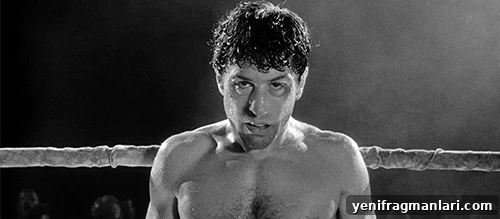
De Niro’s performance anchors that portrait. He immersed himself in LaMotta’s habits and speech, trained as a boxer, and committed to physical transformations that tracked the character’s arc from young fighter to an older, heavier man. The result is both visceral and unsettling: De Niro’s shifts from tender to violent, from insecurity to rage, feel internal and earned. Scenes where Jake confronts his brother display this volatility—small talk dissolves into suspicion and then into brutal confrontation—capturing how ordinary moments can become catastrophic for a man driven by jealousy and self-loathing.
The film’s emotional rawness separates it from earlier, more sanitized Hollywood boxing dramas of the 1940s. Where classic films often presented choreographed, morally framed versions of violence, Scorsese’s approach is grittier and less apologetic. The brutal honesty with which LaMotta’s cruelty is presented—both inside and outside the ring—offers a more faithful reflection of the era’s tensions and a stronger, if harsher, realism than sentimentalized portrayals. That unflinching stance elevates the sports drama into something closer to serious character study.
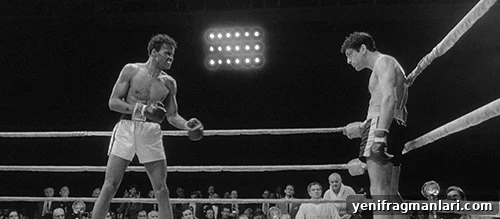
Visually and rhythmically the film is innovative. Cinematography and editing collaborate to convey LaMotta’s inner life through daring choices: disorienting cuts, altered focus, and carefully timed slow motion produce a subjective intensity during the fights. At moments the film deliberately destabilizes spatial logic—cuts and shot choices that confuse direction or perspective, producing the sensation of being inside a fractured consciousness. These more expressionistic techniques sit alongside stark black-and-white photography and documentary-style passages, creating a balance between experimental flair and a documentary-like immediacy. The result is a visual language that both honors the traditions of earlier boxing pictures and expands them.
Casting choices also contribute to the film’s strength. The relative unfamiliarity of key cast members helps keep the focus on De Niro’s transforming presence. Cathy Moriarty, in her first major role, brings a poised, ambiguous vulnerability to Vickie LaMotta; her performance captures both youthful glamour and the wear of difficult circumstances. Early appearances by Joe Pesci and Frank Vincent established performers who would go on to become recurring collaborators with Scorsese, their grounded performances complementing De Niro’s intensity and reinforcing the film’s world.
For viewers and film lovers, Raging Bull remains a must-see: a film where image, performance, and editing work together to create a powerful, unsettling portrait of a flawed man. It stands as a singular achievement in Scorsese’s diverse body of work and a landmark of auteur-driven cinema from the era. Whatever one’s taste in movies, this film rewards careful viewing and offers a vivid example of how cinema can probe human darkness without compromise.
Score: 24/24
Rating: 5 out of 5.
Recommended reading: The Importance of Expressionism in ‘Raging Bull’