

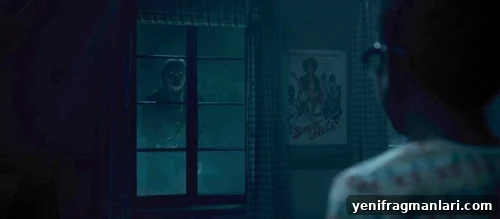
Salem’s Lot (2024)
Director: Gary Dauberman
Screenwriter: Gary Dauberman
Starring: Lewis Pullman, Makenzie Leigh, Alfre Woodard, John Benjamin Hickey, Bill Camp, Alexander Ward
Remaking a beloved adaptation of a classic Stephen King novel carries a heavy burden: fans expect reverence for the source material and enough fresh insight to justify revisiting the story. The track record of recent King remakes has been mixed, with a number of high-profile efforts failing to capture the atmosphere, emotional depth, or narrative cohesion of their originals. Into that fraught landscape comes Gary Dauberman’s 2024 take on Salem’s Lot, a film that tries to honor the novel’s essentials while making distinct creative choices—some of which succeed and many of which undermine the whole.
At its core, this version keeps the basic framework: a mysterious antique shop appears in the small Maine town of Jerusalem’s Lot, run publicly by the smooth-talking Richard Straker and by the remote figure Kurt Barlow, who resides in the Marsten House on the hill. Writer Ben Mears returns to town and becomes entangled with locals as a string of bizarre deaths reveals victims drained of blood and reanimated with a hunger for human flesh. Those elements are intact and recognizable, giving viewers familiar beats to latch onto.
Where the film falters is in what it omits and how those omissions hollow out essential character and atmosphere. Many of the novel’s crucial backstories and motivations are trimmed or excised entirely: the Marsten House’s full, unsettling history is treated lightly; Ben Mears’ deeper personal ties and emotional scars receive only perfunctory attention; Father Callahan’s spiritual crisis and struggle with alcoholism—central to his arc in the book—are reduced to a brief outline rather than a lived, complicated process. Those cuts shrink the emotional stakes and turn complex relationships into shorthand, leaving the narrative feeling like an outline rather than a fully realized town under siege.

The adaptation’s runtime—just under two hours—compounds the problem. The 1979 television miniseries needed roughly three and a half hours to breathe and develop, and this film’s compressed pace often reads like a movie that had to sprint through scenes. Transitions feel abrupt, and several key moments are sketched rather than dramatized. Scenes that should accumulate dread and character depth instead jump from one beat to another, which can make the town’s fall to vampirism feel like a series of isolated incidents rather than the slow, suffocating takeover the novel depicts. At times the film seems both rushed and truncated: entire layers of meaning are missing while others drag on without payoff.
Dauberman, primarily known for his screenwriting work on other horror franchises, makes some competent directorial choices—there are moments of visual ambition and careful framing—but the overall effect is inconsistent. Repeated visual motifs, such as mirrored reflections, are introduced with promise but rarely lead anywhere resonant; they become stylistic gestures rather than thematic anchors. Nighttime cinematography, which could have been a major asset, often lacks texture and fails to generate the claustrophobic gothic mood the story demands. Even an iconic sequence — the floating child — loses much of its impact because the surrounding build-up and atmosphere aren’t fully realized.
Performances sit in a middling zone: competent, occasionally effective, but rarely transcendent. Lewis Pullman and the supporting cast deliver serviceable portrayals, and there are moments when characters cut through the script’s thinness, but these instances aren’t frequent enough to salvage the film. The score drifts into the background; it is unobtrusive but forgettable, offering little in the way of memorable thematic material to anchor the film’s tension.
In short, this Salem’s Lot preserves enough of the book’s iconography to be recognizable but strips away much of what made the original story resonant: history, character depth, and slow-building dread. The result is a technically competent adaptation that rarely becomes genuinely terrifying or emotionally engaging. For viewers new to the tale, it offers a brisk vampiric thriller; for long-time fans, it will likely feel like a hollowed-out version of a richer, darker novel.
Score: 9/24