
SATISFACTION Film Review – A Haunting Exploration of Power, Silence, and Reclamation

What is Satisfaction About?
Satisfaction is one of the most compelling films to emerge from SXSW 2025. Set on a remote Greek island, the film follows two British musicians, Lola and Philip, who retreat from London in an attempt to reconnect. Instead, the island’s beauty and isolation reveal the quiet fractures and unspoken tensions in their relationship. Told through a dual timeline, the narrative alternates between the present strain of their partnership and the early days of their romance in London, gradually exposing the emotional distance that has grown between them.
Director Alex Burunova uses the island as both refuge and pressure cooker, allowing personal history and unresolved power dynamics to surface. At its core, Satisfaction is about how neglect, dismissal, and subtle control can calcify into a form of domination that is easy to overlook until it becomes unbearable. Emma Laird’s performance as Lola anchors the film, giving its psychological complexity a human and urgent center.
The Making of Satisfaction
Satisfaction evolved from a stage play into a carefully crafted film. Alex Burunova spent nearly a decade shaping the story, writing and refining more than a hundred drafts while developing the film’s visual language through watercolor keyframes. That patient, iterative process is evident in the film’s deliberate pacing and precise composition.
The cast and crew committed to building authentic relationships. Emma Laird and co-star Fionn Whitehead lived together for a time to establish the small, shared habits that would inform their onscreen chemistry. Laird trained in piano with East London composers and a music coach to inhabit Lola’s artistic life convincingly. On set, Burunova encouraged improvisation, balancing rigorous preparation with moments that felt spontaneously lived-in.
The project also functions as a personal reclamation for Burunova, a film that wrestles with pain and recovery rather than resolving it neatly. That emotional honesty informs every decision, from performance to visual design, making the film feel intimate and hard-won.
The Cinematography and Music of Satisfaction: Beautifully Discordant
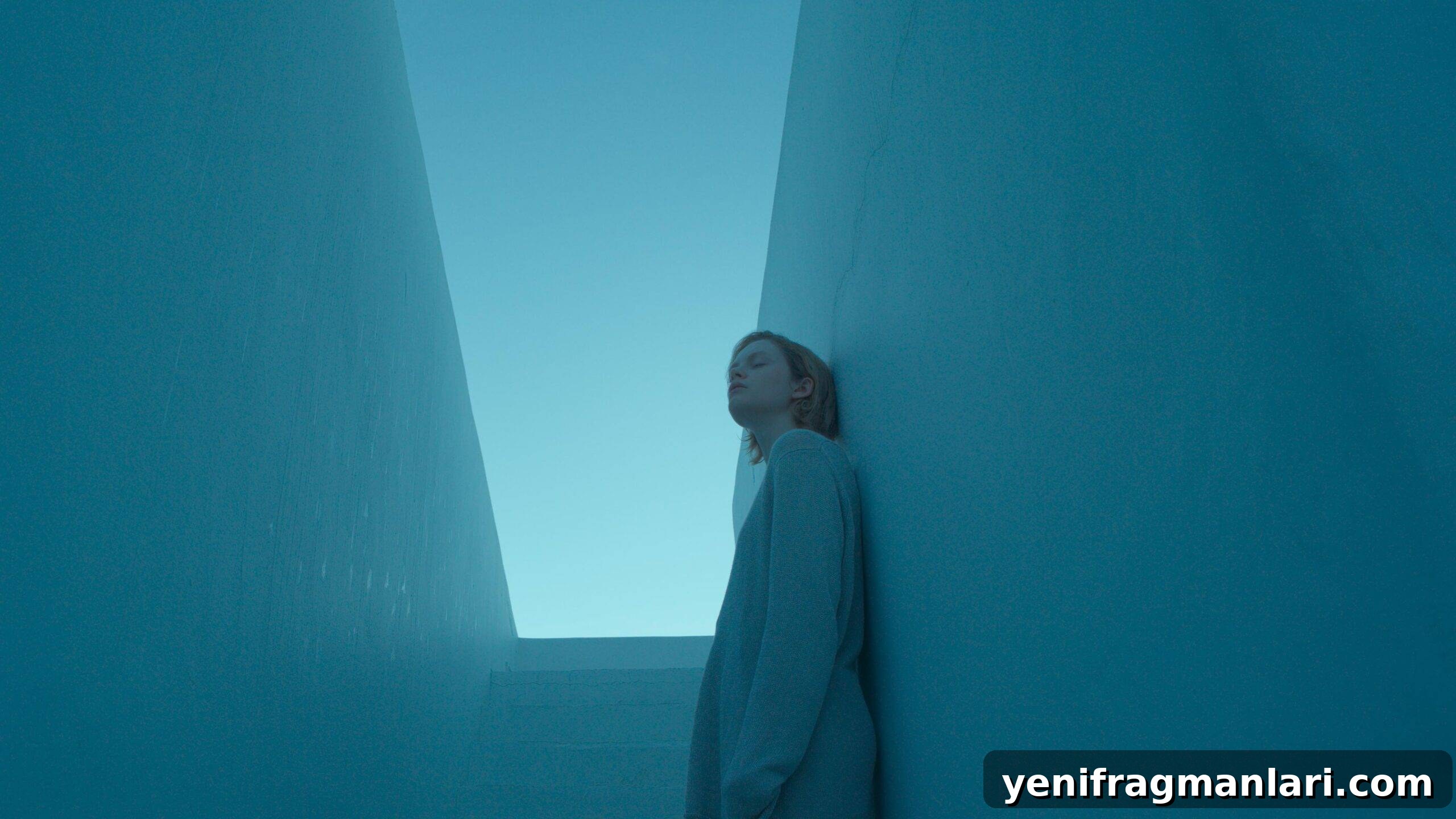
Cinematographer Mate Herbai and director Alex Burunova build a visual language that reflects Lola’s interior life. The island’s stark white architecture, sharp lines, and cool blue hues mirror the isolation and constraint Lola experiences. Recurrent images—most notably Lola submerged underwater—operate as motifs, returning throughout the film to underline themes of suffocation, rebirth, and reclamation.
Framing is used as a storytelling device: Lola is often placed low in the frame or shot from high angles to emphasize vulnerability, while Philip is frequently shot from below to suggest a subtle, pervasive dominance. When Elena, played by Zar Amir, arrives, she is introduced through low angles that convey a different form of authority—self-possession rather than entitlement—creating a striking contrast in the film’s power dynamics.
Music is integral to Satisfaction. Composer Midori Hirano provides a score that is haunting and at times intentionally discordant, mirroring Lola’s fractured psyche. The film foregrounds sound design as well: sequences on the island often use natural, ambient sounds instead of a traditional score, and tighter piano moments reveal that Hirano’s hands perform the music we hear on screen. Chants and ritualistic elements in the soundtrack deepen the film’s sense of psychological unspooling.
Satisfaction is Unflinching in Its Exploration of Pain
Burunova refuses to soften the film’s most difficult moments. Rather than cutting away from traumatic scenes, she forces viewers to remain present, aligning the audience with Lola’s experience in a way that can be deeply uncomfortable. This unflinching approach treats trauma as a reality to be witnessed, not a plot device to be neatly resolved.
In the present-day sequences, the film shifts toward the surreal to externalize Lola’s dissociation. Dreamlike imagery—such as moments when Lola appears translucent behind a balcony window—blur the lines between memory and lived moment. These visual choices convey how trauma fragments identity and perception, complicating the possibility of straightforward healing.
Emma Laird’s Career-Best Performance

The emotional core of Satisfaction is Emma Laird’s performance. Restrained yet searing, Laird conveys a character whose inner life is rich with memory, shame, longing, and quiet resistance. Much of her work happens in silence—small gestures, a shift in posture, a look that conveys years of accumulated hurt. Those moments allow the audience to inhabit Lola’s experience and to feel the slow, painful process of reclaiming agency. This performance marks Laird as an actor to watch.
Final Thoughts on Satisfaction
Satisfaction is a bold, meticulously made film that challenges viewers with its emotional honesty. Burunova’s direction, supported by strong contributions from Mate Herbai’s cinematography and Midori Hirano’s score, fashions a work that interrogates power, silence, and the long, complicated path toward self-reclamation. It does not offer tidy catharsis; instead, it asks audiences to sit with discomfort and to confront the quiet violences that can shape relationships. For those prepared to engage, Satisfaction is a haunting and ultimately rewarding cinematic experience.
Read More
- Interviews
- Film Reviews