
The Boy and the Heron (2023)
Director: Hayao Miyazaki
Screenwriter: Hayao Miyazaki
Starring: Soma Santoki, Masaki Suda, Aimyon, Yoshino Kimura, Takuya Kimura, Shōhei Hino, Ko Shibasaki, Kaoru Kobayashi, Jun Kunimura
After a period in which Hayao Miyazaki appeared to be stepping away from filmmaking—following 2013’s The Wind Rises and the wider perception that Studio Ghibli’s era of hand-drawn wonders might be winding down—both the director and the studio quietly returned with a project that feels like a late-career marvel. The Boy and the Heron was released with minimal promotion, trusting Miyazaki’s reputation and the devotion of animation fans to create anticipation. The result is a film that stands alongside the studio’s best work: richly drawn, emotionally stirring and frequently strange in the most purposeful ways.
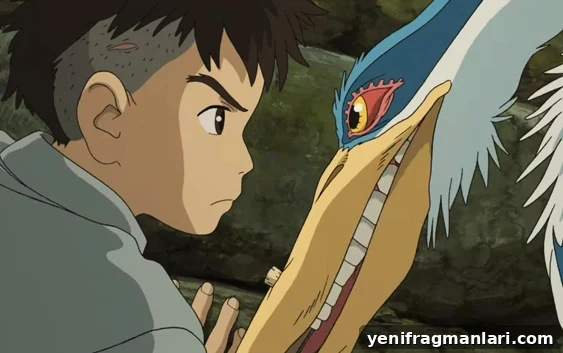
The film follows Mahito (Soma Santoki), a young boy uprooted from wartime Tokyo and taken to a rural estate owned by his father and his new wife, Natsuko (Yoshino Kimura). The move is meant to offer safety and stability, but grief and displacement follow Mahito. He is pursued by a talking grey heron (voiced by Masaki Suda) whose behavior is unsettling rather than comforting. Soon Mahito is transported to another plane of existence—a surreal realm that folds memories, loss and imagination into a single landscape.
Miyazaki’s later films have never shied away from dark or complicated themes, and this one is no exception. Like Isao Takahata’s heartbreaking wartime drama Grave of the Fireflies, this story centers on a child who must confront suffering at an age when innocence should prevail. Rather than presenting trauma in straightforward terms, Miyazaki frames Mahito’s journey as part dream, part fable—an otherworldly response to the upheaval he faces. The film is full of bizarre, unforgettable imagery: a heron with teeth, a chorus of chanting carp, vertically swarming frogs, and many more surreal set pieces that test the boundary between wonder and unease.
In its second half, the movie often reads like an extended children’s tale embroidered with increasingly strange episodes. That diversity of imagination keeps the narrative unpredictable: Mahito follows his pregnant stepmother through the floor of an ancient library into another realm; a mystical fisherwoman teaches him how to nourish spirits so they can become living souls; a descendant of a wizard must literally hold reality together with a child’s building blocks; and, at one point, a regiment of fascist parrots turns up to complicate matters further. These episodes combine whimsy with darkness, frequently balancing on the edge of coherent logic in a way that feels deliberate rather than careless.
The other world Mahito enters seems to exist outside ordinary categories of life and death and may be populated by figures frozen at different points in their personal timelines. This ambiguity is a strength: the film doesn’t force a single interpretation but instead invites the viewer to consider the realm as a psychological and emotional space where a grieving child can process loss. By the film’s end, the journey reads less like a literal destination and more like the internal work Mahito needs in order to accept change and find meaning after loss.
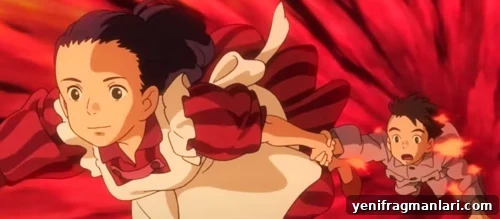
Visually, the hand-drawn animation is immaculate. Studio Ghibli’s craft is on full display in detailed backgrounds and imaginative creature design, with a particular emphasis on contrasting the ordinary, lived-in world with the impossible architecture of the other plane. The film also leans into more expressionistic techniques than many earlier Ghibli works, especially during sequences depicting a Tokyo ablaze: fire, shadow and distorted figures blend into nightmarish tableaux that are some of the most visceral the studio has ever produced. Those images of danger and trauma may trouble younger viewers; Miyazaki asks audiences to live with discomfort long enough for it to become meaningful.
Birds and avian motifs recur throughout the film as symbolic presences—totems, omens and representations of life’s cycles. They are rarely benevolent. From a cunning, human-like heron to pelicans that threaten the newly forming souls of the living, and finally an aggressive army of parakeets with ambitions beyond simple mischief, the birds in this story often stand in for forces Mahito cannot yet understand or trust.
Alongside its darker themes, the film retains Miyazaki’s trademark blend of charm and the grotesque. He populates his world with creatures that are both endearing and unsettling: blotchy, floating souls that crave sustenance and instantly lodge themselves in the viewer’s memory, as well as strong, capable female characters who intervene to protect or guide the protagonist. That childlike curiosity—an openness to beauty, terror, and everything between—remains central to the film’s tone.
The storytelling style is unapologetically elliptical. Miyazaki often favors emotional truth and thematic resonance over tidy exposition, and The Boy and the Heron works in much the same way. Like Spirited Away and other works that call to mind Lewis Carroll’s dream logic or L. Frank Baum’s Oz, this is a fable in which the rules of reality shift to reflect the protagonist’s inner life. The film delays the arrival of its main antagonist and more explicit existential threats until late in the narrative, creating a rush toward a cathartic conclusion that feels earned rather than contrived.
In delaying retirement to make this film, Hayao Miyazaki has delivered another major achievement. The movie is a richly imagined, often unsettling fable that moves between grief, wonder and the fierce need for understanding. It challenges viewers emotionally and visually, and it leaves a lingering sense of awe at what traditional animation can still achieve. Whether or not it is the director’s final work, it stands as a powerful testament to his creative vision and to the enduring strength of hand-drawn storytelling.
Score: 23/24
Rating: 5 out of 5.