

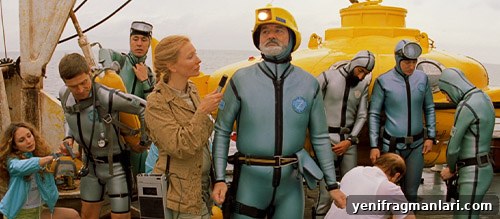
The Life Aquatic with Steve Zissou (2004)
Director: Wes Anderson
Screenwriters: Wes Anderson, Noah Baumbach
Starring: Bill Murray, Anjelica Huston, Cate Blanchett, Willem Dafoe, Owen Wilson, Jeff Goldblum, Michael Gambon
Following the critical breakthroughs of Rushmore and The Royal Tenenbaums, Wes Anderson had become a widely recognized filmmaker by the time The Life Aquatic with Steve Zissou arrived in 2004. The film has always been one of Anderson’s most divisive works: critics and audiences often split between admiration for the film’s visual inventiveness and reservations about its emotional depth and character development. Even in reviews that praised its aesthetic and wit, the familiar criticism surfaced that something vital—often described as “heart”—felt missing from the picture.
The Life Aquatic draws clear inspiration from real-life oceanography, most notably the work of Jacques Cousteau, and nods to classic seafaring literature such as Jules Verne’s Twenty Thousand Leagues Under the Sea. Bill Murray plays Steve Zissou, an eccentric marine filmmaker and oceanographer determined to document a mysterious creature he names the “jaguar shark,” which he believes was responsible for killing a crew member on an earlier voyage. Zissou’s hunt for the creature is, in part, a quest for professional vindication and an attempt to secure his place in scientific history.
On the surface the film is a playful pastiche of adventure and exploration cinema, and it stands as Anderson’s most overtly adventurous work to that point. The second act, in particular, contains several memorable set pieces that lean toward action and episodic exploration rather than the tightly wound family drama of some of his earlier films. Anderson uses these sequences to showcase both his comedic sensibility and his eye for carefully constructed, storybook tableaux at sea.
As with many of Anderson’s films, The Life Aquatic relies heavily on an ensemble cast. Regular collaborators like Owen Wilson, Jeff Goldblum, Anjelica Huston and Willem Dafoe populate the Belafonte, the idiosyncratic ship that serves as the film’s central stage. Cate Blanchett and Michael Gambon also appear, each bringing a distinct presence that complements Murray’s dry, self-aware central performance. While many actors deliver committed and appealing turns, some viewers felt characters were sketched more as stylized archetypes than fully rounded people, and certain performances lack the sharper emotional contours seen in Anderson’s earlier work. Still, Bill Murray’s lead role remains a highlight—melding world-weary comedy with subtle poignancy at a peak period of his career.
A frequent point of praise for the film has been its production design. Anderson’s meticulous attention to detail and carefully calibrated color palette transform the Belafonte and its world into something almost like a living diorama. Every prop, costume and set decoration contributes to a recognizably Andersonian atmosphere—simultaneously whimsical and precise. While his aesthetic has been widely imitated and parodied since, the visual ambition of The Life Aquatic remains one of the most striking achievements of his filmography up to that time.
Music plays a vital role in shaping the film’s distinct tone. The soundtrack blends familiar David Bowie songs with Portuguese-language covers performed by Brazilian musician and actor Seu Jorge. This unexpected mix produces both a wistful and playful sonic backdrop that amplifies the film’s oddball charm and gives key scenes an emotional lift beyond the surface irony.
Initial reactions to The Life Aquatic were mixed, and the film’s reputation has grown more affectionate over time. As Anderson continued to evolve his craft, later successes encouraged viewers and critics to revisit earlier, more polarizing projects with fresh appreciation. Today the film is often celebrated for its adventurous spirit, visual originality and singular tone. It may not offer the same emotional intimacy that anchors some of Anderson’s finest work, but it compensates with imaginative world-building, memorable performances and a distinctive, offbeat sense of fun.
Whether you respond to its quirks or find them distancing, The Life Aquatic with Steve Zissou remains an essential piece in understanding Wes Anderson’s development as a filmmaker. It’s an escapist, playful voyage that pays tribute to maritime myth and cinematic adventure while remaining unmistakably personal and stylized.
21/24