
The Little Mermaid (2023)
Director: Rob Marshall
Screenwriter: David Magee
Starring: Halle Bailey, Johan Hauer-King, Daveed Diggs, Awkwafina, Jacob Tremblay, Noma Dumezweni, Art Malik, Javier Bardem, Melissa McCarthy
Disney promoted its 2023 live-action The Little Mermaid as a modern, feminist reimagining of the 1989 animated classic. That marketing message followed a familiar pattern: present a remake as corrective, socially aware, and necessary. But the finished film struggles to deliver on those promises. Rather than feeling like a thoughtful update, this version often reads as surface-level revisioning, more concerned with appearing contemporary than actually offering new emotional or narrative insight. The result is an uneven film where some individual elements shine, but the whole rarely coheres.
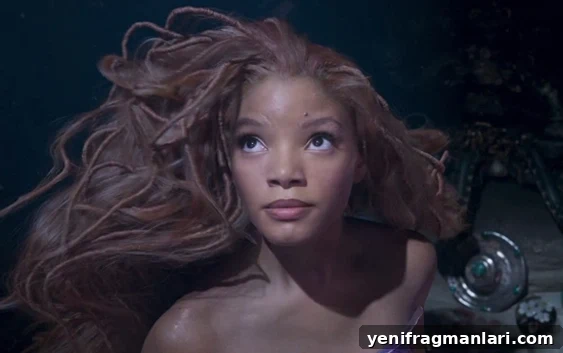
At the center of the film is Halle Bailey, whose vocal talent and presence are both undeniable strengths. Bailey’s renditions, especially of “Part of Your World,” are a highlight — her voice brings genuine warmth and a fresh interpretation that distinguishes her from the original animated performance. In those musical moments, the film briefly captures the wonder and longing that define Ariel’s character. Outside of song, however, the movie too often leaves her underwritten. Many scenes find Ariel oddly passive or emotionally muted, a choice that undermines the curiosity and fierce desire that once defined her journey.
The remake largely adheres to the original story beats, but without the same emotional momentum. Changes meant to modernize Ariel’s motivations often create ambiguity rather than clarity. In the attempt to avoid portraying Ariel as a young woman who leaves her world for love, the filmmakers strip some urgency from her choices. The character’s yearning for the human world — a central theme in the original — is softened here, leaving key decisions feeling less urgent and, at times, less believable. Ariel’s decision to accept Ursula’s bargain should feel risky and driven by deep longing; in this version, it reads more like a misstep that the script has difficulty explaining convincingly.
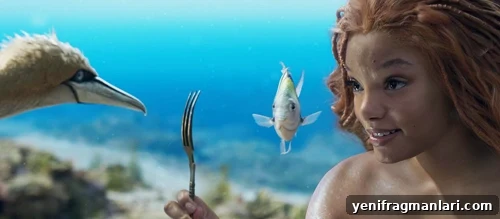
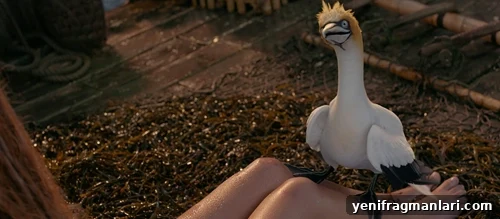
Supporting performances vary. Javier Bardem’s King Triton barely registers as a commanding presence; the role feels flattened in this adaptation. Melissa McCarthy, stepping into a performance that once relied on distinct vocal charisma, offers a different take but lacks the whimsical menace that made the animated Ursula memorable. Awkwafina and Daveed Diggs provide comic energy as Scuttle and Sebastian, respectively, but the film’s oddly realistic animal designs often limit the characters’ expressiveness, dulling their impact. Ariel’s sisters are present more as background figures than developed characters, which undercuts attempts to expand Ariel’s world.
The film’s approach to the romance between Ariel and Eric is cautious to the point of restraint. By downplaying their chemistry, the movie avoids a critique that the original sometimes faced but loses something vital in the process: the sense that Ariel is actively pursuing a dream that includes another person. Romance and agency are not mutually exclusive, and the film’s attempt to navigate that balance ends up rendering both characters emotionally distant in many of their scenes together. Johan Hauer-King’s Eric has moments of warmth, but the connection never achieves the kind of spirited bond that enriches the stakes.
Musically, the film takes risks by reworking classic lyrics and introducing new songs by Lin-Manuel Miranda alongside Alan Menken’s familiar material. Some of these new additions land unevenly. Miranda’s style, energetic and idiosyncratic, doesn’t always blend seamlessly with the original score’s tone. Ensemble numbers are pared down compared to the animated film, changing the pacing and diminishing the communal joy that defined many of the original musical moments. Certain lyric changes and new sections feel unnecessary, and a few of the fresh songs interrupt rather than enhance the narrative flow.
Visually, the production offers attractive underwater sequences but often favors a muted, shadowed palette that drains some of the ocean’s expected color and vibrancy. The undersea world is passable, yet it lacks the luminous, vibrant sense of wonder that made the animated kingdom so captivating. At times, the darkened visual choices hinder clarity during key set pieces, and the pseudo-photorealistic creatures struggle to convey the expressive charm of their animated counterparts.
Director Rob Marshall’s experience with musical cinema is evident in certain staged moments, but overall the film’s pacing and editing rarely capture the kinetic energy those numbers demand. What could have been a bold reinterpretation instead plays it safe, producing a remake that feels safer than subversive.
In the end, The Little Mermaid (2023) has moments of genuine beauty — largely thanks to Halle Bailey’s vocals — but as a whole it is a cautious and inconsistent reworking of a beloved classic. The movie’s attempt to modernize and diversify is commendable in intention, but the execution often falls short, delivering a version that lacks the emotional force and imaginative spark of the original. For audiences seeking a faithful update that also rethinks the story, this film may leave some longing for more fully realized choices and bolder storytelling.
Score: 6/24