
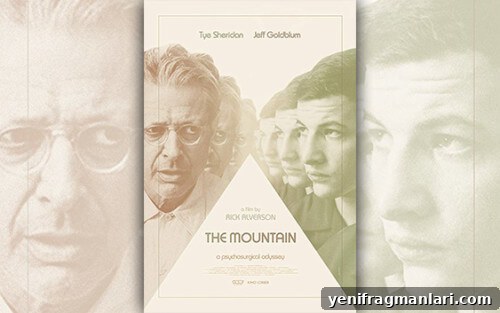
The Mountain (2019) — Film Review
Director: Rick Alverson
Screenwriters: Rick Alverson, Dustin Guy Defa, Colm O’Leary
Starring: Tye Sheridan, Denis Lavant, Hannah Gross, Udo Kier, Jeff Goldblum
The Mountain (2019) is a contemplative, visually driven film that feels more like a series of evocative tableaux than a conventional narrative. Director Rick Alverson constructs a slow-burning, dreamlike atmosphere to explore themes of obsession, control, and the ethics of psychiatric treatment during the 1960s. The film centers on Andy (Tye Sheridan), a young man whose longing for his estranged mother sets him on a disorienting journey alongside Wally (Jeff Goldblum), a charismatic neurosurgeon and advocate for lobotomy as a treatment for institutionalized patients.
Dream Logic and Narrative Style
From its opening image — a skater gliding while the crunch of her skates punctuates a quiet voiceover — The Mountain establishes its tone: spare, elliptical, and deliberately ambiguous. Scenes often shift without traditional connective tissue; characters drift in and out of focus, and moments of dialogue are sparse. Rather than relying on exposition, Alverson uses composition, light, and blocking to communicate emotional states and power dynamics. This approach makes the film feel like an extended reverie, where meaning emerges through repetition, visual parallelism, and contrast.
Visual Storytelling and Cinematography
Visual storytelling is one of the film’s chief strengths. The cinematography emphasizes space and depth, often framing characters within frames to underline their isolation or entrapment. Shots are carefully composed to guide the viewer’s gaze while preserving mystery; long takes and subtle camera moves allow performances to play out in physical detail. The result is a film that rewards attentive viewing — its aesthetic choices function as narrative devices, shaping how we interpret the characters’ interior lives without spelling everything out.
Performances
Tye Sheridan delivers a quietly compelling lead performance. His Andy communicates as much through posture, micro-expressions, and silences as through dialogue. Sheridan’s ability to inhabit moments of restrained longing and confusion anchors the film’s emotional core. Jeff Goldblum provides a magnetic, unsettling presence as Wally, bringing charm and menace in equal measure. Supporting actors — including Denis Lavant, Hannah Gross, and Udo Kier — contribute memorable, often unnerving turns that reinforce the film’s surreal atmosphere. Collectively, the cast helps make the film’s sparse script feel rich and textured.
Themes and Ethical Questions
The Mountain interrogates the ethical implications of psychiatric interventions, particularly lobotomy, which is depicted in both procedural and symbolic terms. Set against the backdrop of midcentury medical optimism, the film contrasts the supposed scientific certainty of practitioners with the messy, human consequences experienced by patients and their families. Alverson is interested in perfection and the ways people attempt to enforce it on others; he shows a fascination with the “messy” aspects of humanity and suggests that attempts to sterilize or eliminate that messiness can be violent and dehumanizing.
Pacing and Audience Reception
Because of its measured pacing, minimal dialogue, and episodic structure, The Mountain is not a film for viewers seeking immediate narrative clarity or fast-moving plot beats. For audiences willing to engage with its contemplative rhythm and visual metaphors, the film offers a rich, thought-provoking experience. For others, its ambiguity and reluctance to resolve thematic threads may feel frustrating or pretentious. The film’s polarizing nature is part of its identity: it invites interpretation rather than delivering simple answers.
Why Watch It
If you appreciate films that privilege atmosphere and image over straightforward storytelling, The Mountain is worth seeing. It stands out for its rigorous visual design, committed performances, and willingness to probe uncomfortable ethical questions about psychiatric care. The film is best approached with patience and an openness to ambiguity; viewers who enjoy unpacking symbolic connections and thematic echoes will find much to consider.
Score: 21/24