
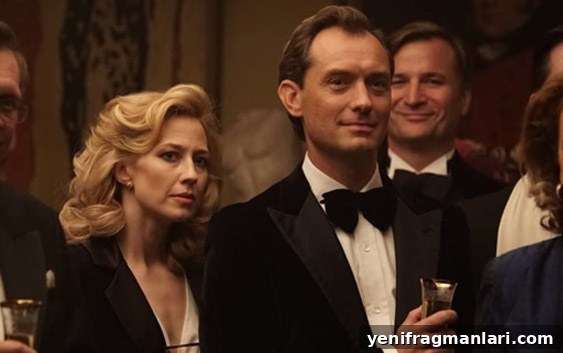
The Nest (2021)
Director: Sean Durkin
Screenwriter: Sean Durkin
Starring: Jude Law, Carrie Coon, Charlie Shotwell, Oona Roche
The Nest unfolds as a tense, intimate drama that traces the unraveling of a family driven by ambition, greed, and the desire for social standing. What begins as a bold, hopeful relocation soon turns into a claustrophobic descent where comfort, trust, and identity are gradually eroded.
A gloomy, timeworn mansion in the English countryside provides the film’s atmospheric backdrop. Rather than relying on plot twists, the movie builds its power through sustained performances and carefully calibrated mood. Jude Law and Carrie Coon anchor the film with compelling portrayals of Rory and Allison O’Hara, a couple whose once-passionate relationship strains under the weight of Rory’s compulsive decisions. They uproot their family from the United States to Britain to pursue perceived opportunities and elevated status — a move that sets into motion a series of emotional fractures.
Carrie Coon delivers a career-defining turn as Allison, a wife and mother attempting to preserve dignity and happiness in the face of mounting humiliation and isolation. Her portrayal charts a convincing arc: patience and quiet endurance give way to mounting desperation as her marriage, children’s wellbeing, and sense of self come under attack. The film captures Allison’s waning control with close, lingering shots that let Coon’s expressions convey exhaustion, disillusionment, and simmering fury. These moments are quietly devastating, and they anchor the movie’s emotional core.
Opposite her, Jude Law plays Rory as a charismatic, self-deluding man who prioritizes appearances and financial success above honesty and family stability. Law imbues Rory with a slippery charm: he’s persuasive, opportunistic, and at times almost pitiable in his need to be admired. Whether inventing stories to impress colleagues or manipulating situations to keep up appearances, Rory’s actions ripple outward, harming those closest to him. Law’s performance is carefully modulated, allowing viewers to sympathize at moments and recoil at others.
The supporting performances are also notable. Charlie Shotwell as the troubled son and Oona Roche as the increasingly rebellious daughter both evoke believable adolescent strain in a household under stress. Their reactions to the adults’ choices feel authentic, grounding the film’s broader themes in familial reality.
Director Sean Durkin, who previously made an impact with his debut, stages the material with restraint and a sharp eye for psychological detail. He resists melodrama, instead emphasizing atmospherics, domestic discomfort, and the unseen consequences of social ambition. The film borrows the visual sensibility of classic thrillers — dark interiors, a pervasive sense of unease, and deliberate pacing — while remaining primarily a character study. This balance allows the movie to be suspenseful without forsaking emotional depth.
Visually, the film is striking: production design, cinematography, and costume work combine to create a world that feels both luxurious and suffocating. The mansion itself becomes a character, its rooms and hallways echoing the family’s disconnection and the deteriorating facade of success. The soundtrack and sound design further enhance the tension, often amplifying silence and small domestic sounds to unsettling effect.
The Nest ultimately succeeds as a sobering portrait of aspiration gone awry. It examines how the pursuit of status can corrode intimacy and ethics, and how deception — whether self-inflicted or directed at others — can dismantle a family’s foundation. With powerful central performances, meticulous direction, and a strong visual identity, the film rewards patient viewing and lingers in the mind long after it ends. This is a film best experienced on a large screen where its subtle details and emotional intensity can be fully absorbed.
21/24