
The Nightmare Before Christmas (1993)
Director: Henry Selick
Screenwriter: Caroline Thompson
Starring: Danny Elfman, Chris Sarandon, Catherine O’Hara, William Hickey, Glenn Shadix, Paul Reubens, Ken Page, Edward Ivory
If a single word could describe The Nightmare Before Christmas, it would be “alternative.” Released two years before Pixar’s Toy Story, it was Disney’s first feature-length animated film not produced in the studio’s traditional hand-drawn style. Disney initially released the film through its Touchstone label because executives feared its tone was too dark for young children. Over the past three decades, however, the film has become a seasonal favorite—an unconventional pick for Christmas viewers who prefer something spikier, and an accessible, spooky choice for Halloween audiences who shy away from outright horror.
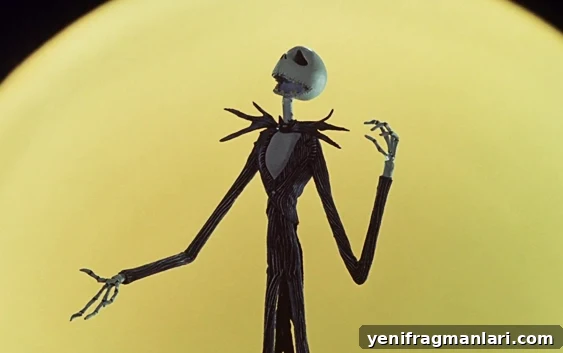
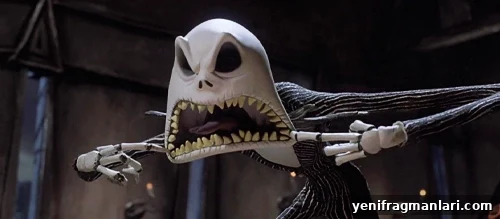
The film’s lead, Jack Skellington, has evolved into an iconic figure in alternative and goth subcultures, his skeletal visage adorning clothing, accessories, and household items. Ironically, the studio that once hesitated to fully embrace the project later capitalized on Jack’s popularity through merchandising.
The Nightmare Before Christmas began as a poem by Tim Burton, inspired by a department store’s abrupt swap of Halloween decorations for Christmas displays. Burton pitched the idea while working as an animator at Disney in the 1980s, but the studio initially rejected it. After Burton left Disney and achieved mainstream success—most notably with his visual contributions to Batman (1989)—the project was revived. Michael McDowell adapted Burton’s poem, and Caroline Thompson expanded that skeletal framework into a richer, almost mythic narrative.
A brief prologue explains that we will learn where holidays come from before opening on a pumpkin-emblazoned door. Jack Skellington reigns as the Pumpkin King of Halloweentown, the town responsible for organizing Halloween festivities in the human world. After another triumphant Halloween, Jack finds himself hollowed out by his own success. Unmoored and restless, he wanders the woods and discovers a hallway lined with doors to other holidays. One door, with a Christmas wreath, draws him into a bright, snowy Christmastown.
Enchanted by Christmastown’s sights and sounds, Jack becomes obsessed with understanding the holiday. His naturally macabre perspective, however, prevents him from grasping the holiday’s true spirit. In his eagerness to recreate Christmas, Jack resolves that Halloweentown will take over this year’s celebrations, converting the season into something grotesque and bizarre instead of joyful and warm.
There is ongoing debate over how much of the film should be labeled “Tim Burton’s.” Burton is credited as the creator of the original idea and served as a producer, but director Henry Selick and screenwriter Caroline Thompson carried the project through production and daily direction. Burton visited the studio only intermittently. His poem initially identified just three characters—Jack, his ghost dog Zero, and Santa Claus—while McDowell, Thompson, and the film’s animators expanded the world with the many memorable monsters and townsfolk of Halloweentown. Nevertheless, Burton’s influence is unmistakable in the film’s gothic visual style, which derives from his original sketches and resonates with his other animated projects like Corpse Bride and Frankenweenie. Burton also had significant input on the final script, intervening when early versions of the ending did not sit right with him.
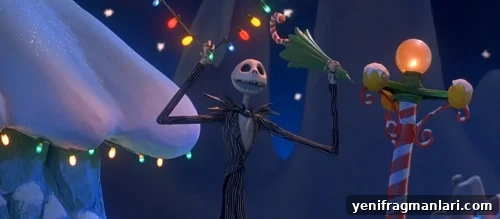
One of Burton’s most important decisions was entrusting the music to Danny Elfman. Working from Burton’s poem and early story notes, Elfman composed most of the film’s principal songs before the script was finalized. The result is nearly ten distinct musical numbers woven into a 76-minute film, giving the movie the feel of a compact, gothic opera. Elfman brought emotional insight to the score—he related deeply to Jack’s yearning—and his work transformed the film from a simple seasonal special into an ambitious piece of musical storytelling. As the film’s primary singer, Elfman also gave Jack a distinctive voice that helped define the character.
Because the film leans heavily on music, many of the key plot developments and character revelations are delivered through song. Crowd-pleasers like “This is Halloween” and “What’s This?” showcase the striking production design: Christmastown looks like something dreamed up by Dr. Seuss, full of bright shapes and color, while Halloweentown channels German Expressionist influences with delightfully grotesque characters and twisted architecture. The songs serve both as exposition and emotional expression, allowing the filmmakers to tell a mythic, economical story where feelings and intentions are often declared directly in musical moments.
That operatic approach gives the film the feel of a modern fairy tale. Characters are sketched with archetypal clarity: Jack longs for meaning as voiced in “Jack’s Lament”; Sally quietly reveals her love for Jack in “Sally’s Song.” Their simplicity reads like a folktale—straightforward but resonant. The vocal performances, especially Catherine O’Hara’s work as Sally (and other voices), bring warmth and personality to those archetypes. Ken Page’s rousing turn in “Oogie Boogie’s Song” exemplifies how voice acting and animation combine to create unforgettable moments—his villainous performance inhabits a memorable casino-style lair that remains one of the stop-motion medium’s most striking set pieces.
Over the last thirty years, stop-motion animation has advanced considerably. Compared with later studios, stop-motion today can appear smoother and more refined. Yet the perceived imperfections in The Nightmare Before Christmas only enhance its charm: the tactile textures and handcrafted details give the film an artisanal quality that supports its storybook atmosphere. The movie feels like a lightning strike in a bottle—a unique alignment of Burton’s creative vision, Henry Selick’s directorial skill, Danny Elfman’s heartfelt music, and a dedicated team of animators and performers.
Three decades after its release, The Nightmare Before Christmas remains a beloved holiday classic that comfortably sits between Halloween and Christmas. It introduced a singular visual and musical world and created a character—Jack Skellington—who has become an enduring cultural figure within alternative style communities. The film’s blend of dark whimsy, theatrical music, and handcrafted animation continues to captivate audiences of all ages.
Score: 23/24
Rating: 5 out of 5.