
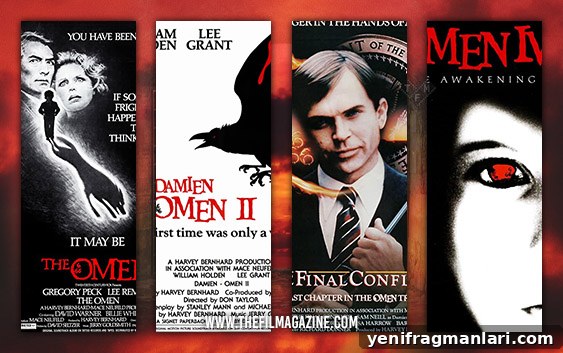
From its unsettling premise to its haunting visuals, The Omen is one of the most enduring and influential horror franchises of the 1970s. Its portrayal of the Antichrist and those who serve him, along with the lasting cultural impact of the name Damien, helped cement the series as a cornerstone of genre cinema. Nearly fifty years after the original film premiered, the franchise still unnerves viewers and continues to be discussed by horror fans and filmmakers alike.
Originally developed from a series of novels by multiple authors, The Omen films take inspiration from biblical prophecy and apocalyptic imagery to imagine how the devil might position himself to bring humanity toward ruin in the end times. Alongside contemporaries such as The Amityville Horror (1979) and Halloween (1978), the series helped define the 1970s as a pivotal decade for modern horror storytelling.
In this edition of Ranked, we revisit the original series—excluding the 2006 remake—and examine the arc of Damien Thorn. Below we rank the entries from least to most successful in terms of storytelling, atmosphere, and lasting impact. Share your own ranking in the comments at the end of the list.
Let us know your order in the comments at the end of this list, and make sure to follow us on Twitter for updates on more articles like this one.
4. Omen IV: The Awakening (1991)
Released roughly a decade after the prior entry, Omen IV: The Awakening struggled to match the tone and potency of its predecessors. The film borrows heavily from the original’s premise but adds a convoluted twist that stretches credibility. The story follows an affluent couple who adopt a girl named Delia, only to discover she has ties to Damien Thorn. The plot then introduces a vanishing twin element in which Delia is revealed to be carrying her twin brother’s embryo, which is later transferred to Delia’s adoptive mother, Karen. Karen eventually learns she has given birth to the next Antichrist, while her husband remains skeptical.
Many of the sequences that aim for dread end up feeling unintentionally campy, and the central biological twist lacks plausibility: in reality, an absorbed embryo could not be transplanted and magically thrive as portrayed on screen. Production troubles—most notably the departure of director Dominique Othenin-Girard midway through filming and his replacement by Jorge Montesi—left the movie uneven and disjointed. Released directly to television, it received substantial criticism and is widely regarded as the weakest installment in the franchise.
3. Damien: Omen II (1978)
The sequel functions as an unnerving coming-of-age story. Set approximately ten years after the events of the first film, Damien: Omen II tracks the young Damien as he matures under the care of his aunt and uncle. Enrolled in military school, Damien becomes increasingly aware of his identity and the devoted followers who shepherd his rise. Those who attempt to expose him or interfere often meet grisly ends, a pattern that emphasizes the escalating stakes.
This installment expands on the first film’s prophecy and shows how Damien’s nature shapes his decisions, including a harrowing sequence in which he kills his cousin. While some of the death scenes verge on the absurd, and the pacing slows toward the end, the movie effectively raises tension and sets up the final chapter. It may not be perfect, but it remains a compelling and essential bridge between the original and the trilogy’s conclusion.
Recommended for you: The ‘Halloween’ Franchise Ranked
2. The Omen III: The Final Conflict (1981)
Delivering a bold and cinematic third act, The Omen III: The Final Conflict tackles the difficulty of concluding a trilogy without merely rehashing earlier beats. Sam Neill portrays the adult Damien, now positioned as an influential political figure who steadily fulfills the prophecies introduced in prior films. When a second messiah is born in England, Damien responds with calculated brutality, attempting to eliminate potential rivals in a chillingly methodical campaign.
The film also introduces a romantic subplot, revealing a deceptive tenderness in Damien that he weaponizes to his advantage. The visual style is a major strength: with cinematography that emphasizes striking compositions and ominous lighting, the movie crafts an atmosphere that feels grand and inevitable. Had the series ended here, this entry would have been a fitting, powerful conclusion to Damien’s arc.
1. The Omen (1976)
The original The Omen remains the definitive film in the series. With a chilling score by Jerry Goldsmith and atmospheric cinematography from Gilbert Taylor, the movie combines mood, suspense, and ambiguity to unsettling effect. Director Richard Donner deliberately avoided overt supernatural exposition, leaving audiences to wonder whether Damien is truly the devil’s son or if a series of tragic coincidences, amplified by fear and paranoia, might explain the events.
The story follows a man who suspects his adopted son, Damien, is at the center of a deadly pattern. As evidence mounts and those around him fall victim to inexplicable accidents, the father resolves to stop his child. The premise provoked controversy among religious groups at the time, which only increased public curiosity. Tales of a supposed cast-and-crew “curse” further heightened the film’s notoriety.
Perfect casting elevates the material: Gregory Peck delivers gravitas as Damien’s adoptive father, while a young Harvey Stephens—styled with dark hair and contact lenses—imbues Damien with an unnerving, inscrutable presence. Billie Whitelaw’s portrayal of the sinister Mrs. Baylock adds another layer of menace, especially in scenes that underline how deeply devoted followers can be. The original film’s careful construction of dread and ambiguity makes it the standout entry in the franchise and a landmark of 1970s horror.
Recommended for you: Nightmare on Elm Street Films Ranked
There you have a ranked overview of one of the most iconic horror series to arise from the 1970s. While the franchise’s quality fluctuates across its installments, the original film’s influence and the trilogy’s thematic scope remain significant. Many fans feel the series achieved its most effective moments within the first three films, and the fourth entry is generally seen as an unnecessary extension.
How would you rank these films? Would you have stopped at three entries or left the franchise as a single classic? Share your thoughts and your own order in the comments below.