
The Wolf of Wall Street (2013)
Director: Martin Scorsese
Screenwriter: Terence Winter
Starring: Leonardo DiCaprio, Jonah Hill, Margot Robbie, Matthew McConaughey, Kyle Chandler, Rob Reiner, Jon Bernthal, Jon Favreau, Jean Dujardin, Joanna Lumley, Cristin Milioti
Martin Scorsese’s three-hour portrait of excess, The Wolf of Wall Street, arrived in 2013 as a cultural event as much as a film. It captured a particular moment in American life — a time when the appetite for wealth, spectacle and celebrity clashed with the moral questions that followed the 2008 financial crisis. For many viewers, especially younger audiences at the time, the film became shorthand for an era: its music, its tone, and its look were absorbed into popular culture, and performances such as Margot Robbie’s helped launch careers while Leonardo DiCaprio’s central turn came to define a certain kind of charismatic, reckless antihero.
Scorsese stages the story of Jordan Belfort — a real-life stockbroker who rose to enormous wealth through fraudulent and aggressive sales tactics — with both brio and an ironic distance. The movie trades in excess: loud editing, energetic camera work, a score that amplifies every beat, and narration that keeps us inside Belfort’s voice, braggadocious and unapologetic. Yet within the noise there is also a clear line of commentary about greed and consequence. Scorsese’s method is to let us revel in the spectacle while simultaneously exposing how empty and self-destructive that spectacle really is.
Set against the backdrop of post-crisis America and the public debates about corporate greed, the film invites the audience to witness how those at the top manipulate systems and people to sustain their lifestyles. Belfort’s world is alluring: oversized yachts, nonstop parties, and the thrill of illicit gains. But the cost is repeatedly shown, both in legal terms and in the physical and emotional toll it takes on the people involved. The film rarely moralizes in a straightforward way; instead it uses excess as its own indictment, letting the audience decide whether they are entertained, horrified, or complicit.
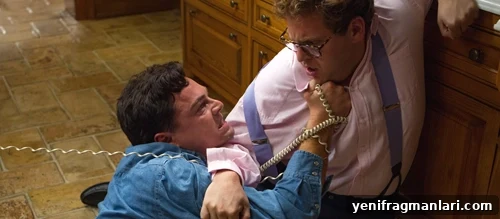
One sequence stands out as emblematic of Scorsese’s balancing act between comedy and tragedy. In a scene that has become iconic, Belfort finally grasps the magnitude of his crimes while simultaneously succumbing to the effects of quaaludes he took long before. The result is a darkly comic and painfully human image: a powerful man reduced to crawling toward his car, humiliated and helpless. That physical collapse crystallizes the film’s central irony — the image of someone who once seemed untouchable brought painfully low by his own choices. Scorsese frames the moment with careful tension and misguided hope; the viewer is drawn into a strange mixture of empathy and judgment.
The screenplay by Terence Winter provides a tight, energetic framework for the film’s sprawling episodes. It gives actors space to inhabit their roles vividly, and the result is one of DiCaprio’s most memorable performances. He captures Belfort’s magnetic charm and moral bankruptcy in equal measure, making the character both repellent and compelling. DiCaprio’s delivery — a torrent of profanity, bravado, and occasional vulnerability — helps make the film feel immediate and alive.
An early scene in which Belfort meets his mentor, Mark Hanna (played by Matthew McConaughey), sets the tone for the film’s mixture of improvisational energy and studied chaos. The two actors feed off one another, creating an improvised rhythm that feels dangerously authentic: champagne midday, drug use, and sudden eruptions into song. Those moments of loose, risky performance are precisely what give the film its sense of living, breathing disorder.
Supporting performances — from Jonah Hill’s volatile partner to Margot Robbie’s luminous presence — round out the cast and add texture to the world of Stratton Oakmont, Belfort’s brokerage. The ensemble helps show that the story is not just about one man’s moral failures but about an entire culture of excess that enabled and rewarded those failures. Scorsese’s camera moves through that culture with fascination and disgust, often in the same shot.
A decade after its release, The Wolf of Wall Street remains a film that entertains while provoking thought. It is energetic, sharply directed, and frequently hilarious, but its humor never quite lets the viewer forget the human costs behind the spectacle. The movie’s pacing, editing, and performances make three hours feel brisk; its satirical edge ensures it continues to spark conversation about class, power, and accountability in American life.
Score: 23/24
Rating: 5 out of 5.
Recommended reading: Where to Start with Martin Scorsese