
Score: C+
Director: Olivier Assayas
Cast: Kristen Stewart, Lars Eidinger, Sigrid Bouaziz
Running Time: 105 min
Rated: NA
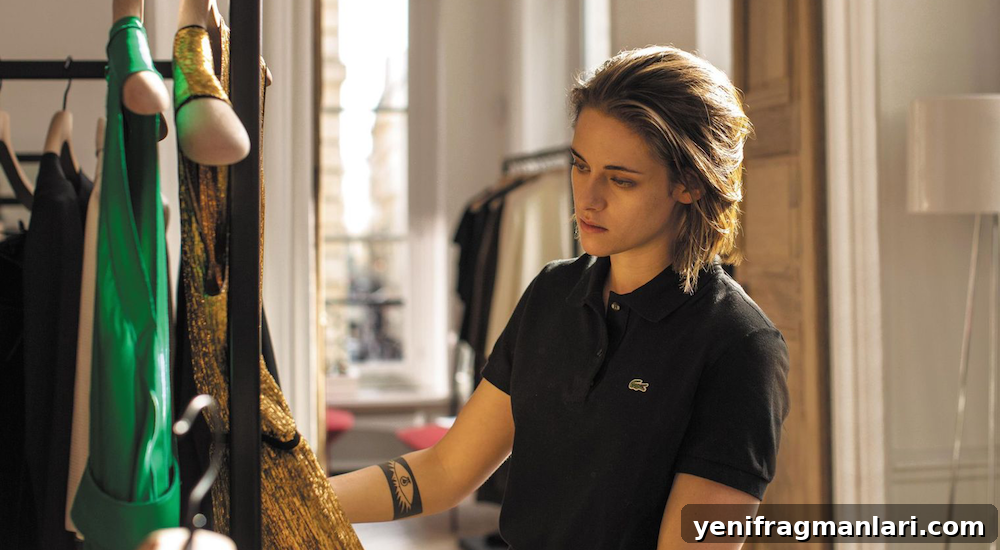
“We made this oath. Whoever died first would send the other a sign.” Set against the elegant, sometimes chilly backdrop of Paris, Personal Shopper follows Maureen (Kristen Stewart) as she struggles to find closure after the death of her twin brother. Part supernatural thriller, part intimate character study, the film blends modern technology and ghostly suggestion with a close focus on grief and identity.
From the opening scenes, Maureen’s life feels paused. She sleeps in her late brother’s spacious, quiet home and divides her days between attempting to contact him and working as a personal shopper for a high-profile socialite who has little time to choose her own wardrobe. Maureen’s twin had been a medium as well, and the shared family history of a heart condition adds an undercurrent of urgency: she worries the same fate could await her. Desperate for a “sign from beyond,” Maureen waits, watches, and listens while navigating the small, exacting demands of her job.
As the story develops, Maureen begins receiving cryptic text messages from an unknown sender. The messages could be a paranormal communication, a prank, or something more sinister—this ambiguity is central to the film’s tension. The supernatural aspects are deliberately understated at times, and at others they veer into more conventional genre beats. That tension between subtle unease and overt hauntings is both a strength and a weakness: it keeps you guessing, but it can also feel uneven, as if the film is balancing two different impulses.
Where Personal Shopper succeeds most is in its portrayal of Maureen’s interior life. Kristen Stewart gives a performance rooted in small, precise choices: micro-expressions, nervous energy, measured silences. She embodies a character who is guarded and brittle, whose grief has calcified into a kind of watchful inertia. Stewart’s Maureen is a person caught between skepticism and longing—someone who both needs a sign and fears its consequences. The film often allows these moments of emotional truth to take precedence over the mechanics of the plot.
The screenplay and direction emphasize mood and atmosphere over tidy explanations. Paris here is not merely a postcard city; it’s a series of empty rooms, late-night streets, and high-fashion appointments that reflect Maureen’s isolation. The film also taps into contemporary anxieties: the way mobile phones and instant messaging mediate modern relationships, including those that reach beyond the grave. When the anonymous texts begin to feel flirtatious, threatening, or consoling, the effect is disorienting—and that disorientation is part of the point.
Yet the film’s attempt to juggle genres—psychological drama, supernatural thriller, and social commentary on the fashion world—sometimes pulls it in too many directions. The ghost story elements can come across as slightly theatrical compared with the more restrained, human moments. Lines that aim for shock can jar when they follow quieter, more honest scenes of mourning, which undermines the emotional momentum at times.
Overall, Personal Shopper is an intriguing, often compelling film that doesn’t always land every choice it makes. It is rewarding when it stays close to Maureen’s interiority, letting Kristen Stewart’s nuanced performance and the film’s slow-burn atmosphere carry the audience. At its weakest, the supernatural framing feels tacked on and occasionally distracts from the more resonant exploration of loss and identity. Still, for viewers interested in a character-driven, mood-rich examination of grief filtered through contemporary trappings—social media, fashion, and the lingering question of what we owe the dead—the film offers a memorable, if imperfect, experience.
In short, Personal Shopper is worth watching for its central performance and its atmospheric approach to a modern ghost story, even if its genre-blending ambitions sometimes dilute the impact of its best moments.