
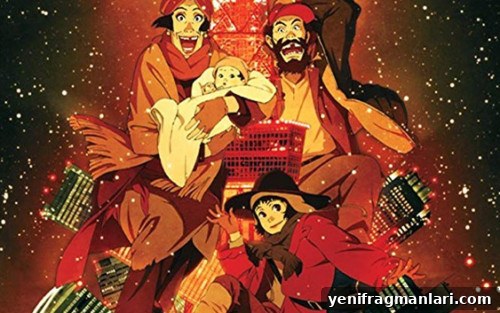

Tokyo Godfathers (2003)
Directors: Satoshi Kon, Shôgo Furuya
Screenwriters: Satoshi Kon, Keiko Nobumoto
Starring: Tôru Emori, Yoshiaki Umegaki, Aya Okamoto, Kyôko Terase, Hiroya Ishimaru
Christmas is often imagined as a season of warmth and family, yet for many it magnifies isolation and hardship. Tokyo Godfathers asks us to consider what that holiday looks like from the margins — on Tokyo’s streets, where three unlikely companions discover a discarded newborn and set off on a quest that is part road movie, part fable.
Satoshi Kon, an animation visionary, left an indelible mark with four singular feature films — Perfect Blue, Millennium Actress, Tokyo Godfathers and Paprika — plus the series Paranoia Agent, before his untimely death at 46. Among these, Tokyo Godfathers stands out as his most accessible and emotionally generous film, a Japanese Christmas story that borrows familiar tropes while remaining distinctly rooted in Tokyo’s urban reality.
The film opens on an unusual scene: a nativity play staged in Japan, observed by a mismatched trio who live on the streets. Gin (Tôru Emori), Hana (Yoshiaki Umegaki) and teen runaway Miyuki (Aya Okamoto) form a fragile, makeshift family. When they discover an abandoned infant they name Kiyoko, their small community must improvise love, shelter and a plan to reunite the baby with her parents. As they traverse wintry Tokyo, secrets from each of their pasts emerge and force them to confront who they are and who they might become.
Christmas in Japan is an intriguing backdrop: the familiar iconography is present, but the holiday is treated more as a cultural festival than a strictly religious event. Kon uses that distance to explore themes of belonging, ritual and hope. The combination of festive imagery and urban grit makes the movie feel both universal and specifically Japanese.
The film also gestures toward Japan’s complicated social attitudes toward homelessness and survival. Small acts of charity are complicated by notions of personal honor and social order. As a doctor tells Gin bluntly, “I can try to cure disease. Lifestyle is something you have to fix.” That line captures the film’s tension between compassion and societal expectations, a tension comparable in tone and empathy to Hirokazu Koreeda’s Shoplifters: both films resist easy judgments about people pushed to the edges of society.
Kon’s character design departs from idealized anime beauty; his figures are expressive, often rough-edged and unmistakably human. Rather than sanitizing their flaws, Kon makes them part of his storytelling — the characters’ emotional honesty becomes the film’s power.
Tokyo Godfathers functions on several levels: it is a Christmas movie, a bittersweet comedy-drama about chosen family, and an unconventional romance. One of the film’s protagonists is a gay transvestite who loves his divorced friend; their relationship is built not on physical attraction but on mutual care and a shared desire to nurture the young people in their lives. The movie champions foster families and nontraditional parenting, with Hana delivering one of the film’s most affecting lines: “Nothing should make you abandon a child! That means you’ve taken love and tossed it away, like trash.”
At times the film leans toward the sentimental — it nods to the spirit of It’s a Wonderful Life with moments of gentle magic and improbable coincidence — but those elements never fully detach the story from the streets. A memorable moment of comic realism occurs when an ‘angel’ appears and asks Gin, “What is it you desire, my magic, or an ambulance?” Gin chooses the ambulance without hesitation, grounding the scene in practical humanity rather than fantasy.
There are minor detours in the plot, such as an early diversion involving a gangster’s wedding that doesn’t fully pay off, but these do little to diminish the film’s overall coherence. Visually, Kon mixes rougher, energetic animation with moments of exquisite hand-drawn detail: a single gust of wind catching Hana’s hair on a bridge becomes quietly transcendent. Those contrasts enhance the film’s emotional textures and highlight the artistry at work.
Above all, Tokyo Godfathers is an ode to family in any form — chosen, improvised or imperfect. It demonstrates how kindness, responsibility and stubborn affection can create a home even in the least likely places. The film’s warmth is not confined to the holiday season; its themes of redemption and human connection resonate year-round.
23/24