
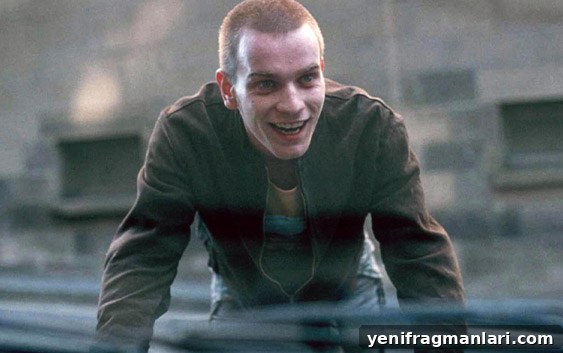
Trainspotting (1996)
Director: Danny Boyle
Screenwriter: John Hodge
Starring: Ewan McGregor, Ewen Bremner, Jonny Lee Miller, Kevin McKidd, Robert Carlyle, Kelly Macdonald
Trainspotting stands as a landmark British film and a quintessential work of Scottish cinema. Directed by Danny Boyle and adapted by John Hodge from Irvine Welsh’s novel, the film captures the grit, humor, and despair of 1990s Edinburgh through a raw, kinetic cinematic voice. Though it is a British production, its spirit and setting are deeply Scottish, and the movie transformed a modest, local story into an international cultural phenomenon.
The film’s release in 1996 felt like a counterpoint to the heightened romanticism of previous mainstream depictions of Scotland. Rather than offering sweeping heroic myths, Trainspotting thrust viewers into an urban reality marked by economic hardship and public-health crises, portraying the lives of a group of heroin addicts with unflinching honesty. Despite this bleak subject matter, the film is consistently electrifying and often funny; that contrast—ecstatic highs and devastating lows—defines its tone.
Much of the film’s energy comes from its viewpoint character, Mark Renton, played by Ewan McGregor. Renton’s narration and perspective color every scene, balancing the seductive appeal of drug use with an awareness of the ruin it brings. A line frequently quoted captures that tension: “Take the best orgasm you ever had, multiply it by a thousand and you’re still nowhere near it.” Renton’s insight allows the audience to feel both the allure and the toxicity of his world, and the film’s formal choices—sharp editing, inventive camera work, and quick pacing—extend that juxtaposition into every frame.
John Hodge’s script is tightly constructed, offering blackly comic episodes and memorable set pieces. Masahiro Hirakubo’s hyperactive editing amplifies the film’s urgency, while Boyle’s direction fuses punk energy with art-house sensibilities. For a second feature, Boyle’s control of tone, rhythm, and visual invention is remarkable; the film plays with tempo and mood, moving from manic set pieces to quiet, affecting moments with ease. At ninety-five minutes, the movie is economical and propulsive, never lingering unnecessarily yet always resonant.
The soundtrack and use of music are integral to the film’s identity. Boyle’s needle drops—most famously Iggy Pop’s “Lust for Life” over the opening sequence—announce characters and set mood in a way that feels both immediate and iconic. Other transitions, like the shift from Heaven 17’s “Temptation” to Sleeper’s “Atomic,” underscore character entrances and story beats with memorable precision, including the brief, luminous introduction of Kelly Macdonald’s Diane.
Performances are another cornerstone of the film’s success. The cast embodies their roles so fully that many of the actors became closely identified with these early career performances. Ewan McGregor’s Renton became a breakout role that helped launch him to international stardom. Robert Carlyle, Ewen Bremner, Jonny Lee Miller, Kevin McKidd, and Kelly Macdonald all deliver vivid, committed turns that feel lived-in rather than performative. The group chemistry sells their friendship and dysfunction, and the film cultivates a strange, sympathetic bond between the audience and this flawed ensemble.
Beyond its immediate impact, Trainspotting left a long-lasting legacy on filmmakers and popular culture. Its audacious combination of humor and horror, kinetic editing, and bold soundtrack choices inspired many later films and established a template for modern British cinema. While the movie has prompted imitators, its original voice remains distinct: a blend of grit, wit, and bravura filmmaking that continues to influence directors and writers.
Even decades after its release, Trainspotting feels both of its time and timeless. It captures a specific place and social moment while speaking to broader themes of addiction, friendship, and escape. For viewers who haven’t yet experienced it, the film still offers a startling, unforgettable ride. For those who know it well, it remains a reference point for how cinema can mix entertainment and urgency to powerful effect.
24/24
Recommended for you: T2 Trainspotting (2017) Review