
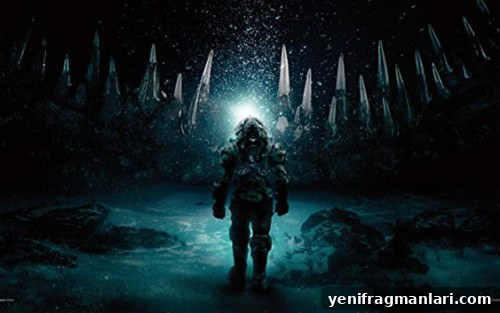

Underwater (2020)
Director: William Eubank
Screenwriters: Brian Duffield, Adam Cozad
Starring: Kristen Stewart, Vincent Cassel, Jessica Henwick, John Gallagher Jr., Mamoudou Athie, T.J. Miller
Underwater opens with a montage of headlines about a corporation’s decision to drill into the Mariana Trench and the looming suggestion that something dangerous may dwell in the depths. Though the film was shot in 2017, its premise feels unfashionably familiar by 2020, and the result is a high-budget production that recycles well-worn deep-sea horror beats without offering much fresh perspective.
The story centers on a small team stationed at the trench’s floor who must flee when their habitat begins to collapse. As they attempt to reach the surface in damaged escape pods and cramped corridors, they encounter predatory, otherworldly sea creatures that pick them off one by one. The film never fully explains why the company drilled so deep or what they hoped to find; corporate motive remains a background detail, and the narrative rarely bothers to interrogate the ethics or consequences of the operation.
Kristen Stewart plays Norah, a mechanical engineer defined by a quiet empathy—she rescues a spider from a sink and narrates fragments of her interior life in voiceover. Her backstory arrives late and feels shoehorned in to justify her compassion; it’s hardly necessary, since Norah’s instincts to help others are convincing without explanation. The supporting cast includes Vincent Cassel as Captain Lucien, a steady leader archetype, Jessica Henwick as research assistant Emily, and T.J. Miller in a more comic, disconnected register. The ensemble is serviceable, but most characters exist mainly to be separated and hunted, rather than to offer deeper thematic complexity.
Structurally, the screenplay leans on a predictable tension-relief cycle: a dangerous encounter, a brief lull, then another set piece. When quieter moments arrive, they often dissolve into perfunctory dialogue—small talk or obvious exposition—rather than probing conversations about culpability, environmental impact, or the psychological toll of living under extreme pressure. A single line acknowledging “This is our fault” gestures at responsibility but never develops into meaningful moral reflection. That thinness undercuts the film’s chance to explore the disturbing implications of deep-sea exploitation.
One scene captures the movie’s tonal imbalance: the team captures one of the creatures, and Emily marvels at its wonder even after narrowly escaping death. The sequence intends to balance awe with horror, but it reads as contrived—the characters’ scientific fascination feels out of place amid immediate danger, and the monster itself offers little in terms of unique biology or mythology beyond being a violent, screaming aggressor.
The film hints at Lovecraftian dread—vast, unknowable forces in the ocean deep—but largely avoids psychological or physiological consequences that could enrich the atmosphere. Potential elements such as mania, hallucination, or decompression effects receive only passing attention. A brief exchange about the captain’s deceased daughter flirts with disorientation, but the film does not pursue the ambiguity; loss is stated rather than explored. Director William Eubank has described the film as having Lynchian influences, invoking masters like David Lynch and Stanley Kubrick, but the finished movie is far more linear and conventional than those comparisons suggest.
Visually, Underwater performs more convincingly. The cinematography effectively conveys claustrophobia as characters crawl through tight, angular corridors, and the blue palette—both of their lights and the surrounding sea—creates a pervasive, chilling ambiguity about what counts as safety. The production achieved underwater sequences by introducing particles into the environment so visual effects could render a believable water density; these perspective-driven shots communicate the unknown and generate real tension. A few quieter, contemplative images—Norah collapsed and crying in a stark, monochrome bathroom, or silhouetted against the ocean in shadow—are more resonant than many of the film’s action beats and suggest that a slower pace might have served it better.
Ultimately, Underwater is a competent technical production hampered by a thin script and missed opportunities. It is neither the psychological disquiet of The Shining nor the surreal ambiguity of classic Lynchian work, and it doesn’t rework the deep-sea horror template in a memorable way. While the visuals and moments of atmosphere are effective, the film’s rapid-fire scares and formulaic plotting make it easy to forget once the credits roll. For viewers seeking thoughtful, unsettling takes on humanity’s intrusion into the deep, there are richer films; for those simply after a contained creature feature, Underwater delivers predictable thrills.
10/24