West Side Story (2021)
Director: Steven Spielberg
Screenwriter: Tony Kushner
Starring: Ansel Elgort, Rachel Zegler, Ariana DeBose, David Alvarez, Mike Faist, Rita Moreno, Brian d’Arcy James, Corey Stoll
Tackling an adaptation of the 1961 film version of Leonard Bernstein and Stephen Sondheim’s stage musical West Side Story was always going to be a formidable undertaking. That Steven Spielberg accepted the challenge felt appropriate: across a decades-spanning career he has repeatedly shown an ability to handle grand narratives with care, visual ambition, and emotional clarity. His 2021 rendition is unmistakably his own—ambitious, meticulously crafted, and reverent to its source while staking out a clear point of view.
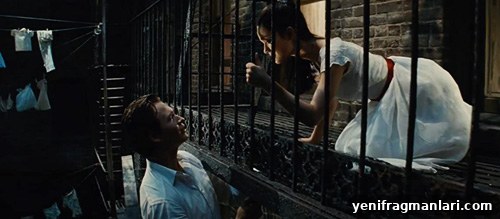
The story transposes the tragic framework of Shakespeare’s Romeo and Juliet to 1957 New York, where a turf war rages between two teenage gangs on the Upper West Side: the white Jets and the Puerto Rican Sharks. As the city begins to redevelop the neighbourhood and displace longtime residents, territory and identity become flashpoints for escalating violence. Into this tense, volatile world fall Tony (Ansel Elgort), a former Jet attempting to find a better way, and Maria (Rachel Zegler), whose brother Bernardo (David Alvarez) leads the Sharks. Their quick, intense love becomes a central, combustible force in the narrative.
What makes West Side Story powerful is how it ties the personal to the political: forbidden romance emerges amid economic displacement, cultural friction, and systemic marginalization. This production draws its urgency from being anchored in a particular time, place and community, and it refuses to sanitize the darker implications of its source material. Musicals are rarely so brutal and honest about violence and the human costs that follow.
Bernstein’s score and Sondheim’s lyrics remain foundations the film can’t help but rely on. Those elements lift the material—lush orchestration, memorable melodies, and razor-sharp lyrical turns. Spielberg and screenwriter Tony Kushner rethought several set pieces and staging choices to sharpen their thematic impact and to take advantage of contemporary filmmaking techniques while honoring the spirit of the original stage work.
Rachel Zegler makes an impressive film debut as Maria, bringing youthful intensity, emotional nuance, and a convincing vulnerability that anchors the film. Ansel Elgort’s Tony takes a little longer to settle, but he grows into the role as the relationship between Tony and Maria deepens. Among the ensemble, Ariana DeBose’s Anita is a showstopper—fierce, funny, and heartbreakingly real. Mike Faist’s Riff is emotionally raw and volatile, providing a convincing leader for the Jets. Rita Moreno, who famously appeared in the 1961 film, returns in a new and substantial role that leverages her experience and delivers a moving, layered performance.
Janusz Kamiński’s cinematography supplies many of the film’s most indelible images. One sequence that lingers in the memory frames the two gangs approaching an agreed-upon rumble in a city salt storage warehouse, an overhead shot that emphasizes elongated shadows and creates a visual motif of two monstrous hands reaching toward one another. It’s a vivid, expressionistic moment that signals the film’s willingness to mix cinematic stylistics with choreographic energy.
The fight choreography in Spielberg’s film deliberately veers away from balletic stylizations and opts for a grittier realism: the violence feels harsh, dangerous, and immediate. This choice reinforces the stakes and underscores how profoundly irreparable the consequences can be when young people are pushed to extremes.
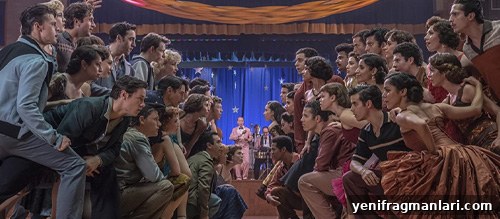
Color and production design also play important narrative roles. The film opens in muted tones as it introduces the gangs and the threat of urban redevelopment; later sequences embrace stronger, symbolic palettes. A dance-hall scene uses blue costumes for the Jets and warm oranges and reds for the Sharks, creating a visual metaphor of water meeting fire. From that point the visuals adopt more overt metaphor: reflections that reveal inner lives, barriers that separate lovers, and draped fabrics in symbolic hues that amplify emotion.
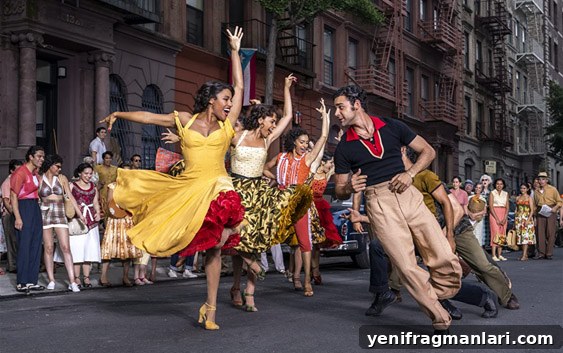
Several musical numbers are smartly reimagined. “America,” here set in the busy streets of a Puerto Rican neighbourhood rather than on a rooftop, becomes a fierce and comic exchange that highlights contrasting perspectives on opportunity and belonging. “Gee, Officer Krupke” is reframed to take place in a lockup, which gives the number an added edge. “I Feel Pretty” regains its palate-cleansing placement in a department store cleaning scene at night, and a newly poignant rendition of “Somewhere” is given to Rita Moreno’s character Valentina, deepening the film’s emotional resonance.
Importantly, casting choices correct longstanding problems from the original film: the Puerto Rican characters are played by Latino actors, and the film allows a natural interplay between English and Spanish in domestic settings. Spanish dialogue is often left untranslated, but context makes meaning clear, lending authenticity and respect to the characters’ linguistic reality.
The film also accentuates one core divide: the Jets largely represent young people rooted in street life with limited prospects, whereas many of the Puerto Rican characters are shown working to build lives and futures in a new country. That contrast—between those who feel pushed out and those trying to put down roots—complicates easy moral judgments and deepens the social commentary.
Spielberg’s West Side Story succeeds in updating the material for modern audiences while retaining the musical’s emotional core. It adds grit and moral urgency without losing the romance, the music, or the spectacle. Viewers attached to the choreography or specific performances of the original may compare the two versions, but approached on its own terms this film is a richly made, affecting reimagining that will leave many audiences moved and humming the melodies long after the credits roll.
22/24