
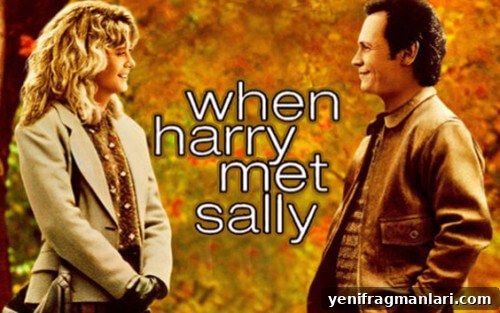

When Harry Met Sally (1989)
Director: Rob Reiner
Screenwriter: Nora Ephron
Starring: Billy Crystal, Meg Ryan, Carrie Fisher, Bruno Kirby
Nearly thirty-five years after its release, Rob Reiner’s When Harry Met Sally endures as a defining romantic comedy, often cited as the benchmark of the genre. Admitting a personal bias toward more serious, artful cinema, I approached the film skeptically. Like many who dismiss rom-coms as lightweight, formulaic entertainment, I expected a string of clichés and hollow laughs. Instead I found a meticulously crafted, emotionally truthful movie that earned its reputation by blending sharp writing, confident direction, and genuine performances.
The story covers roughly a decade in the lives of Harry Burns (Billy Crystal) and Sally Albright (Meg Ryan). They first meet in the summer of 1977, sharing a road trip from the University of Chicago to New York, where they part ways. Years pass; they cross paths at pivotal moments, each arriving with their own romantic disappointments. Eventually they form a friendship that challenges Harry’s earlier claim that men and women cannot be friends because “the sex part always gets in the way.” That friendship, built on witty banter and growing mutual affection, becomes complicated by timing, fear and the messiness of real life.
What distinguishes Ephron’s screenplay is its patience and emotional realism. Instead of forcing manufactured crises, the script earns its stakes through accumulated details and small, honest moments. Nora Ephron compresses ten years of relationship development into ninety minutes without resorting to implausible plot devices. Harry and Sally change in believable ways: Harry softens from a cocky cynic into a vulnerable man shaped by life and loss, while Sally moves from tightly controlled certainty to a more open, self-aware woman. Their growth is gradual, convincing and relatable.
Rob Reiner’s direction complements the script perfectly. His scenes are cleanly staged and often deceptively simple, allowing the characters to inhabit their world naturally. Reiner trusts his actors, leaving room for improvisation that resulted in some of the film’s most memorable moments. The use of New York—especially Central Park in autumn and intimate interiors—creates a warm, lived-in backdrop that reinforces the emotional texture of the story. Reiner balances humor and tenderness so the film never tips into sentimentality or cynicism.
The central performances are the engine of the movie. Billy Crystal brings a quicksilver wit and surprising emotional depth to Harry, while Meg Ryan crafts Sally as smart, guarded and slowly disarming. Their chemistry feels lived-in rather than staged; the gestures, pauses and glances convey as much as the dialogue. Small improvisations—well-known scenes like the deli moment—feel earned because the actors inhabit their characters fully. Supporting turns, including Carrie Fisher and Bruno Kirby, add texture and humor without distracting from the emotional core.
Structurally the film risks drifting into sweetness without consequence, but Ephron and Reiner introduce complications that matter. The characters face jealousy, bad timing and personal insecurities that put their bond to the test. These obstacles are not merely plot devices; they reveal inner truths about both characters and force them to confront what they value. When the film reaches its emotional peak—an honest, unadorned confession of feeling—the payoff resonates because the audience has been invited to care about every step along the way.
Beyond its craft, When Harry Met Sally remains relevant because it treats romantic relationships with a mix of humor, respect and clarity. It rejects melodrama in favor of small but meaningful moments, and it presents a relationship that feels reciprocal rather than one-sided. That mutual respect is crucial: the story never glamorizes cruelty or belittling as flirtation. Instead, it celebrates the evolution of two people who learn to be honest with themselves and with each other.
Watching the film as an adult who once dismissed such comedies was surprising and humbling. It reminded me that different kinds of cinema can offer real insight and emotional truth. There is pleasure in high art and value in films that simply capture human experience with intelligence and heart. When Harry Met Sally exemplifies that balance: it’s funny, touching and finely constructed, and it still rewards repeated viewing.
Score: 24/24
Recommended for you: 20 Best Movies to Watch in Autumn (list title)