
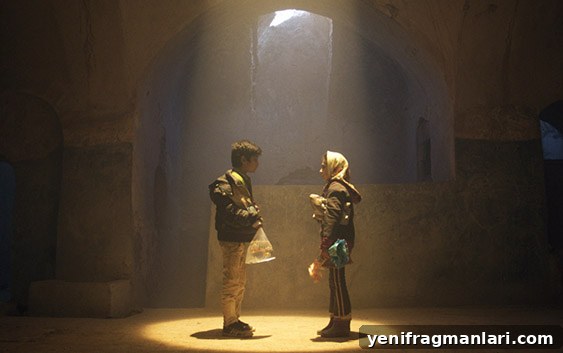

Winners (2022)
Director: Hassan Nazer
Screenwriters: Hassan Nazer, Hamed Emami
Starring: Parsa Maghami, Reza Naji, Hossein Abedini
Imagine finding an Oscar statuette on the street. Do you keep it, hand it in, or try to track down its rightful owner? That moral knot forms the central premise of Winners, a 2022 drama directed by Hassan Nazer. The film follows Yahya (Parsa Maghami), a young waste picker, who enlists the help of Naser (Reza Naji), a cinephile who works for him, to return the mysterious trophy. The setup suggests a tender homage to cinema’s power to transform lives, but the finished film struggles to live up to comparisons to titles like Slumdog Millionaire or Cinema Paradiso.
Yahya is presented as a keen movie lover—he stays up late watching films despite his mother’s protests because he must rise early to earn money for the family. This trait is introduced repeatedly, yet the film rarely explores it in depth. The result is a protagonist who likes films in name more than in lived detail, and a narrative that often tells us emotion rather than showing it.
Hassan Nazer’s own biography informs part of the film’s backstory. Born in Iran, Nazer left at eighteen when a university production he staged—with a cast of ten women—was boycotted by university officials. He has lived and worked in Scotland for decades, and Winners is his first feature wholly financed there. The director’s devotion to cinema is evident in his dedication to the project and in his decision to foreground the topic, yet the film’s engagement with cinema history and culture is disappointingly tenuous.
Winners markets itself as a loving ode to Iranian cinema, but references to film history are limited and often surface-level. A few posters and some direct nods—to Cinema Paradiso and to The Song of Sparrows, the latter starring Reza Naji—appear in the background or are name-checked in conversation. Beyond these brief gestures, however, the movie offers scant commentary on film as an art form or on the cultural role of cinema in Iran. For an audience seeking an in-depth exploration of cinematic heritage, that absence feels like a missed opportunity.
The screenplay compounds these problems through repetitive exposition and thinly drawn characters. Many scenes rely on characters stating facts rather than revealing them through action or nuance. Yahya remains largely defined by his love of movies; Leyla exists primarily as his friend; his mother is, too often, merely the nag who scolds him for late nights. These simplified roles prevent the ensemble from achieving the depth that would make their choices and conflicts compelling.

The plot mechanics also feel unnecessarily convoluted. The discovery of the Oscar—central to the narrative—arrives through a sequence of overly complicated events: a woman leaves the statuette in a taxi while briefly rushing away, the police instruct the cab to move, the driver loses the owner, and the object eventually ends up on the roadside where Yahya finds it. This chain of events renders Yahya’s occupation as a waste picker oddly peripheral, diluting the social context that could have grounded the story and deepened its stakes. Instead, the film often lingers on small, incidental details that do little to strengthen the core premise.
Directorial choices further influence the film’s emotional tone. Nazer favors a restrained, almost classical approach to editing and staging—shots are unobtrusive, cuts are straightforward, and the mise-en-scène rarely veers into experimental territory. While this understated style can suit intimate dramas, here it accentuates the script’s flatness. Without more distinctive visual or rhythmic flourishes, scenes that might have resonated remain muted.
Still, Winners has visual merits. Cinematographers Arash Seifi and Arash Seyfijamadi capture striking images of Iran’s urban landscape, producing moments of genuine beauty that hint at the film’s unrealized potential. These instances of strong composition and natural light provide the movie’s most tangible pleasures and remind viewers that the film’s shortcomings do not stem from a lack of technical skill.
Ultimately, Winners is a film with an admirable intention but uneven execution. It aspires to celebrate cinema and to tell a humane story about choice, ownership, and integrity, yet its treatment of those themes feels cursory. Characters remain underdeveloped, the screenplay relies on expository shorthand, and the plot’s structural decisions weaken the film’s emotional payoff. Viewers drawn to meditations on film history or to richly textured character studies may find the film wanting, while those content with a modest, visually pleasant fable might appreciate its gentler moments.
Score: 6/24