
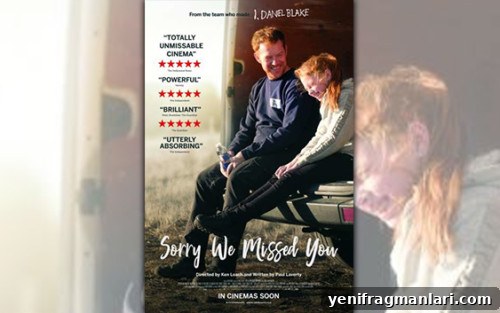

Sorry We Missed You (2019)
Director: Ken Loach
Screenwriter: Paul Laverty
Starring: Kris Hitchen, Debbie Honeywood, Katie Proctor, Rhys Stone
Ken Loach returns with a deeply felt, unflinching drama that examines the human cost of the modern gig economy. The director, known for landmark films such as Kes (1969) and I, Daniel Blake (2016), once again focuses his lens on ordinary people struggling against systemic forces beyond their control. In collaboration with longtime writer Paul Laverty, Loach crafts a film that is both intimate and broadly resonant: a portrait of a family pushed to the limits by insecure work, crushing schedules, and corporate practices that prioritize profit over people.
The story centers on Ricky (Kris Hitchen), a delivery driver who is persuaded to become nominally self-employed by a parcel company promising independence and better earnings. The reality is brutal: long shifts, fines for missed or late deliveries, and the constant pressure of algorithms and monitoring devices. Ricky’s wife, Abby (Debbie Honeywood), works as a care worker, and together they try to hold a family of four together while facing mounting financial strain. The film follows their daily routines and the small, telling humiliations that accumulate into crisis, portraying the effects of precarious labor on dignity, relationships, and mental health.
Loach and Laverty set this story in a community that feels specific yet emblematic, echoing the regional realism of their earlier work while addressing a global issue. The film’s Newcastle-adjacent setting serves as a stand-in for towns across the UK and beyond where full-time employment no longer guarantees security. In that sense, Sorry We Missed You is not only a local drama but also an international indictment of an economic model that shifts risk from corporations onto workers and families.
One of the film’s strengths is how it foregrounds a younger working protagonist and explores the pressures on a household where both parents are employed but still vulnerable. That contrast gives the film a particular urgency: this is not the story of the unemployed or the destitute alone, but of the employed who are impoverished by the terms of their work. Loach’s camera lingers on ordinary tasks and domestic moments, giving space for empathy to develop naturally. Small gestures and quiet scenes—family meals, arguments over bills, tired faces after long days—accumulate into an affecting portrait of strain and resilience.
The performances are understated and authentic. Kris Hitchen’s portrayal of Ricky is quietly powerful; he conveys pride, desperation, and a stubborn determination to provide for his family. Debbie Honeywood’s Abby is pragmatic and exhausted, the emotional backbone of the household who must juggle paid work and care responsibilities. The child actors contribute believable reactions that heighten the film’s emotional stakes, grounding social critique in a tangible family dynamic rather than abstract polemic.
Visually, Loach favors a restrained approach that reinforces the film’s realism. Composition and small visual metaphors are used sparingly but effectively—moments such as a father laboring up a street with a delivery bike, framed against industrial bins and bland urban infrastructure, underscore the film’s themes without resorting to melodrama. The result is a film that feels lived-in and immediate, a drama that earns its emotional power through observation and human detail.
Compared to I, Daniel Blake, which concentrated on the failures of government welfare systems, Sorry We Missed You widens the focus to include corporate practices and the broader mechanics of contemporary labor. It asks urgent questions about fairness, responsibility, and the social contract in an era where work can be designed to extract maximum effort for minimal security. Loach’s film is less about offering solutions than about making visible the costs borne by ordinary people—and about reminding viewers that these costs are the product of deliberate choices in policy and business.
Ultimately, Sorry We Missed You is a compassionate, enraging, and necessary film. It speaks for those whose voices are often ignored and does so with both moral clarity and cinematic restraint. The film is a reminder of why socially conscious filmmaking remains vital: it can translate systemic problems into human terms and prompt viewers to consider how economic structures shape daily life.
23/24