
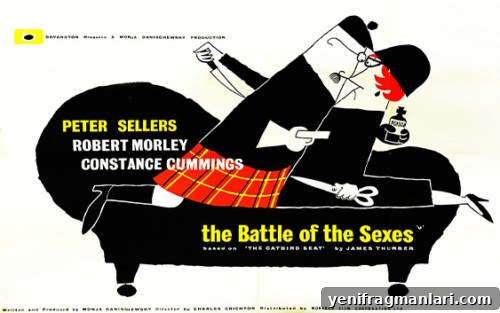
This article was written exclusively for The Film Magazine by Mark Carnochan.
The Battle of the Sexes (1960)
Director: Charles Crichton
Screenwriter: Monja Danischewsky (based on a short story by James Thurber)
Starring: Peter Sellers, Constance Cummings, Robert Morley
Charles Crichton’s The Battle of the Sexes (1960) is notable not only for its sharp comedic timing but also for the way it uses Edinburgh as a character in its own right. Even today, films set in Scotland’s capital remain relatively uncommon; Crichton makes generous use of the city’s streets and architecture, placing a witty, character-driven comedy against a striking urban backdrop.
Peter Sellers heads the cast as Mr. Martin, a mild-mannered accountant working for a traditional tweed company. His predictable routine and quiet dignity are disrupted when Robert MacPherson (Robert Morley) arrives to run the family business, accompanied by Angela Barrows (Constance Cummings), an assertive American business analyst whose presence challenges the firm’s old-fashioned ways. The tension that follows is less a simplistic gender confrontation than a clash of values: the conservative, local mindset versus modern, pragmatic American approaches to business and life.
The film’s title can be misleading if you expect a conventional “men versus women” comedy. Instead, the narrative explores contrasting ideals. Mr. Martin stands for tradition and restraint, while Ms. Barrows embodies efficiency, independence, and change. Monja Danischewsky’s screenplay—adapted from a James Thurber short story—opts for clever dialogue and subtle psychological humor rather than crude stereotypes or one-note gags.
That choice allows the central characters to be fully developed. Their battles are intellectual and emotional: each tests the other’s limits and capacity for compromise. The script gives both figures moments of dignity, vulnerability, and wit, so their rivalry feels real and engaging. Rather than relying on cheap gender-based jokes, the film mines comedy from the friction between lifestyles and personalities.
Peter Sellers delivers one of his finer character turns, disappearing into Mr. Martin rather than showcasing a recognizable star persona. His small gestures, from posture to hesitant speech, are precisely calibrated to build a quietly complex man. Sellers demonstrates that he can convey depth and pathos beneath his comic instincts, making Mr. Martin sympathetic even when the character’s choices are peculiar.
Charles Crichton’s direction highlights his mastery of physical comedy. The film’s choreography—how actors move through rooms, negotiate doors and stairways, and collide with social expectations—creates many of its funniest moments. One sequence set in Ms. Barrows’ flat balances suspense and slapstick so expertly that it turns awkwardness into comedy gold, shifting rapidly from tense anticipation to uproarious release.
However, the film does falter near its conclusion. A development late in the story suggests a hopeful evolution for Mr. Martin, a chance at emotional growth that could have given the film a satisfying, humane resolution. Instead, the character’s arc retreats into a more ambiguous place, and the final payoff loses some of its emotional weight. The ending remains amusing and consistent with the film’s tone, but it undercuts the thematic momentum built earlier, leaving the audience with mixed feelings about the story’s ultimate meaning.
Despite that shortcoming, The Battle of the Sexes remains an important entry in British and Scottish cinema. Before its release, notable Scottish-themed successes included films like Whisky Galore! (1949) and occasional sequences in older works such as Hitchcock’s The 39 Steps. Crichton’s film is distinguished by its extensive use of Edinburgh locations and the strength of its lead performances, even if most of the creative team were not Scottish. The combination of Sellers’ star power, Crichton’s comic craftsmanship, and the evocative setting make the film a memorable example of early 1960s British comedy.
20/24
Written by Mark Carnochan
You can support Mark Carnochan in the following places:
Twitter – @MarkJurassic