
Horror is a divisive genre: some viewers relish the thrill and the adrenaline of a well-crafted scare, while others avoid it because of the anxiety it can provoke. Research suggests people watch horror for three main reasons—suspense and tension, social or cultural relevance, and the knowledge that what they see is fictional—whereas those who avoid the genre usually do so for more immediate emotional or physiological reasons.
Although early cinema didn’t set out to scare audiences, French filmmaker Georges Méliès produced the 1896 silent short Le Manoir du Diable, widely acknowledged as the first horror film. That early experiment introduced supernatural themes to the screen and established a long-standing cinematic interest in exploring fear, the uncanny, and the monstrous.
Horror has evolved enormously since the 19th century, and not every film in the genre will leave you too frightened to sleep. If you want to explore horror but prefer milder tension over relentless shocks, here are five films that balance suspense and atmosphere with a lighter approach to jump scares. These selections emphasise mood, character, and storytelling, making them welcoming entry points for newcomers.
Make sure to follow us on Twitter for updates on similar articles.
1. A Quiet Place (2018)
Directed by John Krasinski and starring Emily Blunt and Krasinski as a married couple, A Quiet Place takes place in a post-apocalyptic world where blind creatures hunt by sound. The film builds tension through silence: dialogue is minimal—only around 90 lines appear across its runtime—and much of the storytelling relies on visual detail and performance. Evelyn (Blunt), heavily pregnant, faces mounting danger as she nears her due date, and the family’s survival depends on careful quiet.
The film was widely praised for its sensitive depiction of deafness and for including American Sign Language in key scenes. Several sequences are presented largely without sound to reflect the perspective of the family’s deaf daughter, which reinforces atmosphere while reducing conventional jump-scare techniques.
Because A Quiet Place emphasizes sustained suspense and character-driven emotion over abrupt frights, the scares are more effective as a slow-burn experience than as startling shocks—an approach that makes it a strong choice for viewers who want tension without relentless terror.
2. IT Chapter Two (2019)
Set 27 years after the events of the first film, IT Chapter Two reunites the adult members of The Losers’ Club as they return to Derry, Maine to confront Pennywise once more. The ensemble cast includes Jessica Chastain, James McAvoy, Bill Hader, and others, each portraying adult versions of characters we first met as children.
Running close to three hours, IT Chapter Two blends horror with coming-of-age drama and darkly comic moments. While Pennywise’s presence produces unsettling imagery, the film balances gore and shocks with emotional depth and occasional levity—most memorably in scenes that became widely discussed for their surreal or comedic tone. For viewers who find clowns unnerving, this film may still be intense, but for most newcomers it offers a mix of thrills and heartfelt storytelling that eases the transition into mainstream horror.
Recommended for you: 10 Best Horror Movies of the 2010s
3. Cloverfield (2008)
Cloverfield is a found-footage monster thriller that follows a group of friends attempting to survive a catastrophic attack on New York City. Directed by Matt Reeves with a screenplay by Drew Goddard and produced by J.J. Abrams, the film created early buzz with a largely mysterious marketing campaign and a cast that was relatively unknown at the time.
Although it features a massive creature and chaotic destruction, Cloverfield operates more as a tense thriller than a straightforward horror film. The first-person camerawork and intimate focus on a small group of characters generate suspense and immediacy. Explicit gore is limited to a few pivotal moments—most notably a single shocking sequence—so the film’s power lies in anticipation and the frantic energy of its handheld perspective.
4. Zombieland (2009)
Zombieland blends horror and comedy, offering laugh-out-loud moments alongside zombie action. Starring Woody Harrelson, Jesse Eisenberg, Emma Stone, and Abigail Breslin, the film follows a ragtag group of survivors navigating a post-apocalyptic United States as they seek a safe haven. The chemistry among the cast, sharp one-liners, and irreverent tone make the movie entertaining rather than relentlessly frightening.
Zombieland’s success at the box office helped revive mainstream interest in comedic takes on zombie fiction, and its combination of humor and action keeps the mood light even during scenes that depict violence. For viewers who want horror with a wink, it’s an accessible and fun introduction to the subgenre.
Recommended for you: Top 10 Zombie Movies
5. Scream (1996)
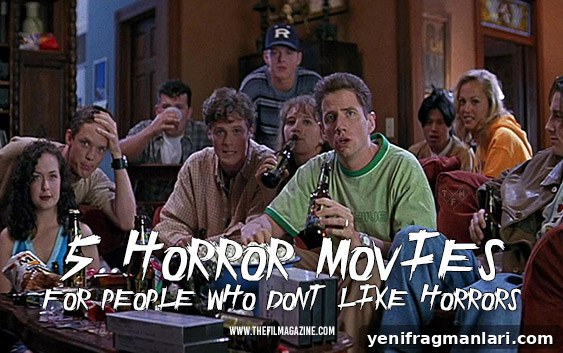
Wes Craven’s Scream revitalized the slasher genre in the 1990s with a self-aware blend of black comedy and murder mystery. The film follows high school student Sidney Prescott (Neve Campbell) as a masked killer known as Ghostface terrorizes her town. Written by Kevin Williamson, Scream plays with—and often satirises—the conventions of horror cinema while delivering effective thrills.
Part of Scream’s appeal is its meta-commentary: from the now-iconic opening sequence to its recurring references to horror film rules, the movie both honours and critiques genre tropes. It’s more playful than purely terrifying, and while it includes violent set pieces and a notable amount of fake blood, the tonal balance of humor and suspense keeps it approachable for viewers who are curious about classic horror without wanting nonstop dread.
Recommended for you: Scream Movies Ranked
If you’re stepping into horror for the first time, these five films offer a variety of tones—from tense, quiet dread to dark comedy—so you can discover which kind of fright works for you. Share your own beginner-friendly horror recommendations in the comments, and keep up with our coverage on social channels: follow us on Facebook and Twitter.
Written by Emma Kershaw
You can support Emma Kershaw in the following places:
Twitter – @emmagkershaw