
Someone once said that love is the only force in the universe stronger than time. On film, time travel doesn’t always require elaborate machinery—a DeLorean, a glowing machine, or an ornate contraption—to explore the relationship between love and the passage of time. Filmmakers often use time-bending devices as a way to heighten emotional stakes, allowing characters either to reclaim what they’ve lost or to learn how to let go. When matched with the right performances and visuals, the theme of love transcending time becomes both resonant and memorable.
An imaginative storyteller recognizes that the intersection of love and time can take many shapes: an endless loop used to become a better person, a literal reversal of the clock to save a life, or repeated attempts to change a tragic outcome. Films such as Groundhog Day, Superman’s famous turn of the Earth, and modern takes on grief and causality all demonstrate how time travel on screen can serve as an emotional engine rather than just a plot trick. This piece focuses on three distinct cinematic approaches to love and time from the perspectives of three very different filmmakers: Powell and Pressburger, David Lowery, and Christopher Nolan.
A Matter of Life and Death centers on Peter (David Niven), a World War II pilot who should have died when his plane went down over the English Channel. Due to an administrative error, he lingers between life and death, effectively suspended outside the normal flow of time. During this anomalous interval he falls in love with June (Kim Hunter), and that love becomes crucial evidence in a celestial trial over whether he belongs on Earth or in the afterlife.
Because Peter exists in a liminal state, he is not bound by the usual earthly progression of days. Powell and Pressburger use this condition to stage a poetic debate about human feeling versus bureaucratic order. The film’s climax positions love as incontrovertible proof of a life well lived: when a single tear from June is preserved on a rose petal, her willingness to sacrifice everything for love persuades the celestial court. In Powell and Pressburger’s vision, love can bend the rules of existence—time, space, and even death itself yield to the force of genuine connection.
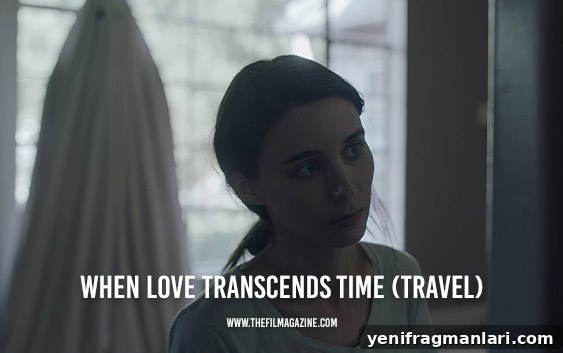
A Ghost Story takes a quieter, more meditative approach. After an unnamed man (Casey Affleck) dies in a car accident, he returns as a sheet-clad ghost. Unable to interact meaningfully with the world, he remains tethered to his former home by his love for his wife (Rooney Mara). As she moves through grief and eventually rebuilds her life, the ghost is forced to watch, trapped in a single location where years compress and blur.
Lowery’s film presents time in a fragmented, nonlinear way: the ghost experiences memories, regrets, and echoes of his relationship out of sequence. He witnesses successive occupants of the house and the slow erasure of the life he once shared, while occasional supernatural moments hint at the possibility of influence—objects move, lights flicker, messages are attempted across temporal boundaries. Ultimately, when the ghost finds and reads a note his wife tucked into a crack in the wall, he is able to let go. Lowery treats love as an enduring force that can persist beyond death and transform the way time is felt—shifting it from a forward march to a layered, emotional landscape.
Interstellar adopts a different stance, rooted in hard science fiction. The story follows Cooper (Matthew McConaughey), an astronaut who travels through a wormhole seeking a habitable world for humanity. The film foregrounds the scientific implications of gravity and time dilation: hours spent near a massive planet translate into years for loved ones left behind. In the film’s later acts, the manipulation of gravity and time becomes the vehicle through which Cooper attempts to communicate with his daughter Murph across decades and light-years.
Where Powell and Pressburger and David Lowery allow poetic flexibility in how love interacts with time, Interstellar foregrounds rigorous scientific rules, informed by consultations with physicist Kip Thorne. That dedication to scientific plausibility complicates the film’s emotional resolution: the idea that love itself can bridge dimensions feels both profound and contested. Nolan’s work can be deliberately ambiguous about whether love functions as a metaphysical force or whether it simply motivates human action within a deterministic universe. The result is a powerful but unresolved meditation on how affection and duty operate amid cosmic scales.
Recommended for you: 5 Movies About Time Travel for People Who Don’t Like Sci-Fi
Time travel in cinema doesn’t always mean elaborate machines or journeys to distant eras. By pairing the human experience of falling in love with modest speculative leaps—an administrative error in the afterlife, a ghost trapped by grief, or time-bending physics at the edge of a black hole—filmmakers probe how love changes our perception of time. Who hasn’t felt a moment stretch into eternity, watched someone slip away too soon, or wished desperately to reach back and say the thing that might have altered everything? These three films—each stylistically distinct—use time as a mirror to examine the depth and persistence of human attachment.
“Nothing is stronger than the law in the universe, but on Earth, nothing is stronger than love.” – Dr Frank Reeves, A Matter of Life and Death